Australia-EU FTA: Dairy Industry Issues Urgent Warning Over A$830m Trade Deficit
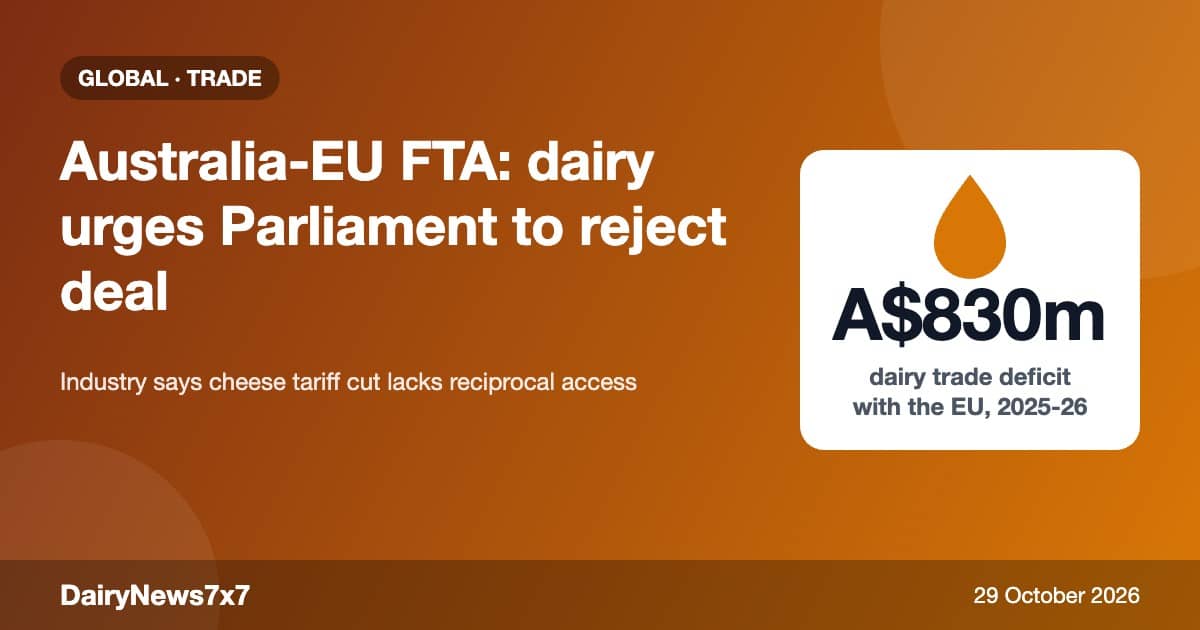
Australia's dairy industry has asked Parliament to reject the proposed Australia-EU FTA in its current form. The Australian Dairy Industry Council (ADIC) says the free trade agreement ignores the interests of dairy farmers and processors and would widen an already large trade imbalance with Europe.
The Australia-EU FTA and the Dairy Trade Gap
ADIC's central argument against the Australia-EU FTA is the scale of the imbalance. In 2025-26, Australia imported 71,912 tonnes of European dairy products worth A$858 million, while exporting only 349 tonnes worth A$28 million to the EU. That leaves Australia with a dairy trade deficit of about A$830 million with Europe.
ADIC chair Ben Bennett said the debate on the Australia-EU FTA had focused on agriculture in general, while the specific impact on sectors such as dairy needed much closer scrutiny. He said Parliament's test should be whether the agreement gives Australian dairy fair and reciprocal outcomes.
Australia-EU FTA Cheese Tariff at the Centre of the Dispute
Under the proposed Australia-EU FTA, Australia would phase out its out-of-quota tariff on EU cheese, currently A$1.22 per kilogram, over three years. This is Australia's most significant remaining dairy tariff.
At the same time, some Australian dairy exports to Europe would still face quotas and above-quota tariffs. ADIC says this one-sided arrangement fails to give Australian producers meaningful access to the European market in return.
Impact Beyond Specialty Cheese
ADIC deputy chair John Williams warned that the effects would reach far beyond specialty cheese counters. About 40% of Australia's milk is used to make cheese, so more competition in cheese affects the entire milk supply chain.
Williams pointed to high-volume markets such as pizza and sandwich cheese, UHT milk, dairy ingredients and nutritional products, where buying decisions are often driven by price. He said Australian farmers and manufacturers already carry some of the highest energy, labour, transport and regulatory costs, while European milk production and exports are growing and supported by subsidies.
One in four dairy products consumed in Australia is already imported, and 26 Australian dairy factories have announced closures over the past four years. Williams cautioned that processing capacity is very hard to rebuild once it is lost.
A Sector Under Pressure
The Australia-EU FTA objections come at a difficult time for Australian dairy. Milk production has been under pressure from high input costs, weather volatility and competition for land, and consolidation has accelerated as multinationals reshape the processing sector. Lactalis's purchase of Fonterra's Mainland business, which includes major Australian brands, is one example of how ownership of the industry is changing.
Bennett said dairy cannot be an afterthought in an agreement that will shape Australia's relationship with Europe for decades.
What Happens Next for the Australia-EU FTA
The Australia-EU FTA still needs parliamentary scrutiny before it can take effect. Dairy groups are lobbying for changes to the cheese tariff schedule, stronger safeguards against import surges, or improved access for Australian exports to Europe. Other agricultural sectors, such as beef and sugar, have pressed for better quota terms during the long-running negotiations.
Lessons for India's Dairy Trade Policy
The Australia-EU FTA dispute echoes India's long-standing stance on dairy in trade deals. New Delhi has consistently kept dairy outside tariff concessions to protect millions of small farmers, a position it maintained in its agreements with partners such as New Zealand. The Australian experience, where a large import deficit has developed alongside factory closures, is likely to strengthen India's resolve to keep dairy off the negotiating table. Our coverage of the US-India trade talks on dairy looks at the same pressures.
The key takeaway: Australian dairy wants the Australia-EU FTA reworked, arguing that removing cheese tariffs without reciprocal access would deepen an A$830 million trade deficit and threaten more factory closures.
Read the original report on The DairyNews and DairyReporter.
Source: DairyReporter, The DairyNews | DairyNews7x7
Never miss an important dairy update
Follow DairyNews7x7 on Google to get live milk prices, policy alerts, and daily headlines directly in your feed.