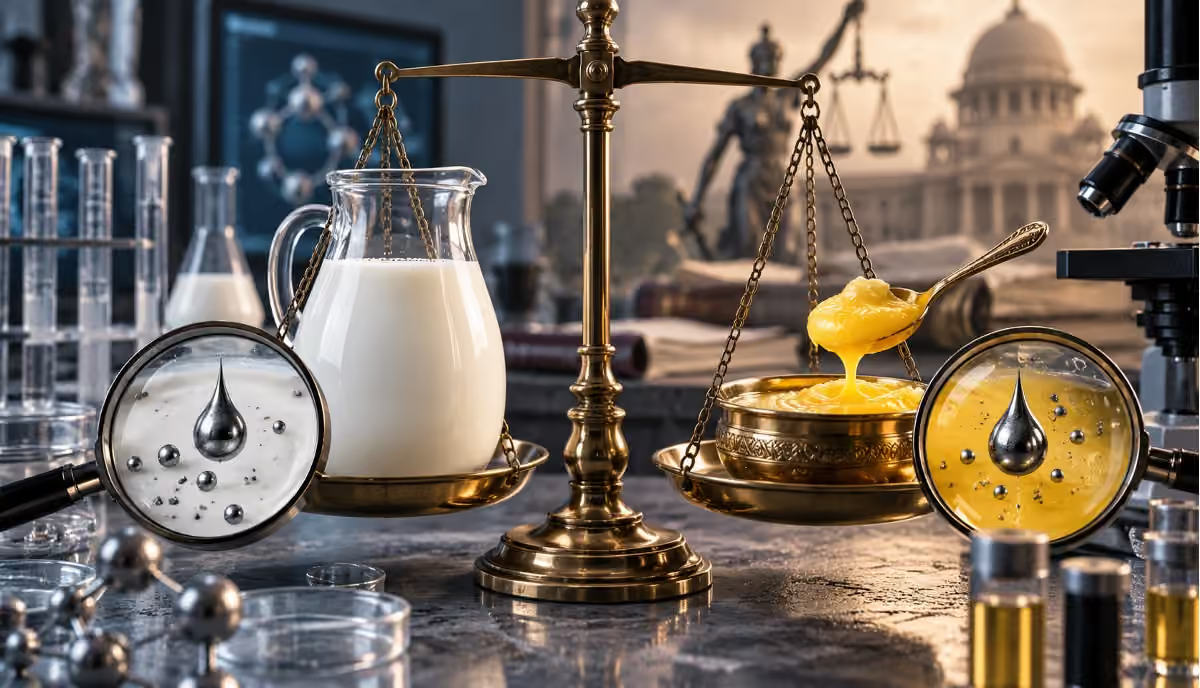
India recognises ghee as a distinct milk-fat product. Yet ambiguity over permissible lead levels raises a fundamental question: are we enforcing food safety standards according to science and product identity, or merely according to the source from which a food originates?
By Kuldeep Sharma
India's food safety framework faces an interesting regulatory contradiction. Milk, a product containing nearly 87% water and only about 3–7% fat, has a prescribed lead limit of 0.02 parts per million (ppm). Ghee, containing at least 99.5% milk fat, is a fundamentally different product. Yet an important question remains: should the same 0.02 ppm limit be applied to ghee simply because it originates from milk?
The Food Safety and Standards Authority of India (FSSAI) prescribes a separate lead limit of 0.5 ppm for edible oils and fats. This is 25 times the permissible limit for milk. It requires around 25 lit of cow milk to make 1 Kg of ghee.
Which standard should apply to ghee?
This is not merely a laboratory question. It has implications for dairy processors, regulators, testing laboratories and millions of consumers who consider ghee an essential part of their daily diet.
More importantly, it highlights a larger issue concerning the interpretation of food safety standards in India.
When milk becomes ghee, its chemistry changes
Milk and ghee may share a common origin, but their physical and chemical characteristics are vastly different.
Milk is a complex emulsion containing water, lactose, proteins, minerals and fat. Ghee is produced by separating milk fat and removing practically all the moisture and non-fat milk solids.
FSSAI itself recognises this distinction.
Under Regulation 2.1.8 of the Food Safety and Standards (Food Products Standards and Food Additives) Regulations, ghee, butter oil and anhydrous milk fat are separately standardised as milk fat products.
Ghee must contain a minimum of 99.5% milk fat, while anhydrous milk fat must contain at least 99.8%.
Therefore, ghee is not simply concentrated milk. It is a substantially different food matrix resulting from separation and clarification processes.
Why, then, should its contaminant classification be determined solely by the identity of its raw material?
Where does lead actually go during ghee manufacture?
The scientific behaviour of lead during dairy processing makes this question even more relevant.
Lead is not predominantly a fat-soluble contaminant. Research has demonstrated that it can associate strongly with milk proteins, particularly casein, and distribute between different milk fractions.
When cream is separated from milk, and subsequently converted into butter and ghee, lead does not necessarily follow the milk fat in the same proportion.
An experimental study examining the fate of lead, cadmium and aluminium during traditional dairy processing reported that lead concentrations decreased from approximately 0.431 ppm in the starting milk to 0.212 ppm in butter and 0.116 ppm in the resulting ghee.
These are observations from a specific experimental process, not universally applicable reduction factors. Nevertheless, they establish that processing can significantly change the distribution and concentration of heavy metals.
This has two important implications.
First, the lead concentration in ghee cannot simply be assumed to be the same as that in the milk from which it was manufactured.
Second, the relationship between the two must be established through analytical evidence rather than presumptions.
Ghee manufacture does not guarantee the removal of lead. Contamination from processing equipment, raw materials, the environment or packaging can still influence the finished product.
However, the underlying science clearly supports treating ghee as a separate food matrix when establishing and interpreting contaminant standards.
What do FSSAI regulations actually say?
The Food Safety and Standards (Contaminants, Toxins and Residues) Regulations prescribe different maximum levels of lead for different food categories.
The relevant entries include:
| Food category | Lead limit |
|---|---|
| Milk | 0.02 ppm |
| Secondary milk products, as consumed | 0.02 ppm |
| Edible oils and fats | 0.50 ppm |
The difficulty is that ghee is not expressly identified in these entries.
Since FSSAI separately recognises ghee and anhydrous milk fat as milk fat products, a strong regulatory argument exists for applying the edible oils and fats category.
However, another entry referring to secondary milk products creates scope for a different interpretation.
If all products manufactured from milk were intended to fall under the 0.02 ppm provision, the separate compositional and technological identity of milk fat products would lose much of its regulatory significance.
Conversely, if edible fats and oils are intended to include milk fat, ghee should not be excluded merely because it is derived from milk rather than from oilseeds.
The 0.5 ppm limit is therefore a legitimate basis for regulatory interpretation, although its applicability to ghee needs explicit confirmation from FSSAI.
What should not happen is for individual laboratories or enforcement authorities to settle this ambiguity through inconsistent interpretations.
A food business operator must know the applicable standard before a product is tested, not discover it only after a laboratory reports a non-compliance.
What does the rest of the world do?
International regulatory practices provide interesting insights.
The European Union, under Regulation (EU) 2023/915, prescribes a lead limit of 0.02 ppm for milk but separately specifies 0.10 ppm for fats and oils, including milk fat.
This is an important recognition that milk fat and liquid milk need not have identical contaminant standards.
The United States follows a different regulatory approach. The US FDA has not established a general numerical lead limit specifically for ordinary ghee or anhydrous milk fat. Instead, it uses food-specific action levels and risk-based regulatory measures.
Australia and New Zealand, operating under a common Food Standards Code, similarly do not list a distinct numerical lead limit specifically for ghee in their contaminant schedule. Their broader contaminant provisions and rules applicable to processed or concentrated foods remain relevant.
Closer to India, the Gulf regulatory framework also distinguishes milk from edible fats and oils. Published GCC contaminant standards have specified separate lead values for these categories, while newer draft provisions explicitly refer to milk fat.
The lesson from these examples is not that every country permits 0.5 ppm lead in ghee.
In fact, the European limit for milk fat is considerably lower than India's general edible-fats provision.
The important lesson is that international regulators recognise the need for product-specific classification and, where appropriate, different contaminant limits for different food matrices.
India should be no exception.
Food safety cannot become a contest between two interpretations
Lead is toxic, and its presence in food must be minimised. No amount of regulatory ambiguity changes this fundamental principle.
The argument for applying the appropriate edible-fat standard to ghee should never become an argument for accepting avoidable heavy-metal contamination.
However, food safety enforcement must also be scientifically sound, legally unambiguous and consistent.
A product that complies with one plausible interpretation of a notified standard but fails another should not be subjected to arbitrary enforcement without establishing which provision legally governs it.
The distinction matters because a regulatory maximum is not the same as a desirable contamination level.
Even if FSSAI confirms that 0.5 ppm applies to ghee, manufacturers should continue striving for lead concentrations substantially below the maximum permissible limit.
Equally, if FSSAI concludes that a lower, product-specific limit is scientifically necessary, it should notify that limit transparently after considering toxicological evidence, dietary exposure and available manufacturing data.
Food safety standards should protect consumers without creating uncertainty for responsible manufacturers.
Is it time for FSSAI to revisit its classification?
India is among the world's largest producers and consumers of ghee. Yet we have limited publicly accessible, nationally representative data on heavy metals in commercially manufactured and traditionally produced desi ghee.
There is a strong case for FSSAI to commission a comprehensive study covering lead contamination in milk, cream, butter, ghee and anhydrous milk fat.
Such research should evaluate different manufacturing processes, the partitioning of heavy metals, potential contamination from equipment and packaging, and actual dietary exposure associated with ghee consumption.
The resulting evidence should guide the development of an explicitly notified maximum permissible limit for milk fat products.
Meanwhile, an immediate regulatory clarification is necessary.
FSSAI should categorically state whether ghee, butter oil, anhydrous milk fat and anhydrous butter oil fall under the edible oils and fats category for the purpose of lead limits, or whether another provision is intended to govern these products.
If the latter interpretation is adopted, the scientific and legal rationale must be made equally clear.
The regulatory framework should not leave this decision to individual laboratories, inspectors or manufacturers.
The larger question
India's food safety system is evolving rapidly. Laboratories are becoming more sophisticated, testing capabilities are improving and regulatory surveillance is expanding.
But better testing alone does not guarantee better food safety.
The correct interpretation of standards is just as important as the accuracy of analytical results.
Ghee should be evaluated as ghee, not merely as milk from which the water and non-fat solids have been removed.
Our position must remain clear: consumer protection is non-negotiable, but so are scientific consistency, legal certainty and fair enforcement.
The issue is not whether India should permit more lead in ghee. The issue is whether India has clearly defined the standard against which ghee should be judged.
Until FSSAI answers that question, the debate over 0.02 ppm versus 0.5 ppm will remain unresolved.
And in food safety, ambiguity should never become a substitute for regulation.
Siource : Editorial by Kuldeep Sharma Chief Editor Dairynews7x7
References :
- FSSAI – Contaminants, Toxins and Residues Regulations, 2011. Regulation 2.1.1, metal contaminants, lead entries. Regulatory text.
- FSSAI – Food Products Standards and Food Additives Regulations. Regulation 2.1.8, standards for milk fat products. FSSAI standards compendium.
- European Commission – Regulation (EU) 2023/915. Maximum levels for contaminants in food, including lead in milk and milk fat. European regulation.
- Scientific research – Lead, cadmium, and aluminum in raw bovine milk: Residue level, estimated intake, and fate during artisanal dairy manufacture (2021). Full research paper.
- US FDA – Lead in Food and Foodwares. FDA guidance.
- Food Standards Australia New Zealand – Schedule 19. Version effective 1 September 2026. Australian/New Zealand regulation.
Never miss an important dairy update
Follow DairyNews7x7 on Google to get live milk prices, policy alerts, and daily headlines directly in your feed.