By Kuldeep Sharma, Chief Editor, DairyNews7x7
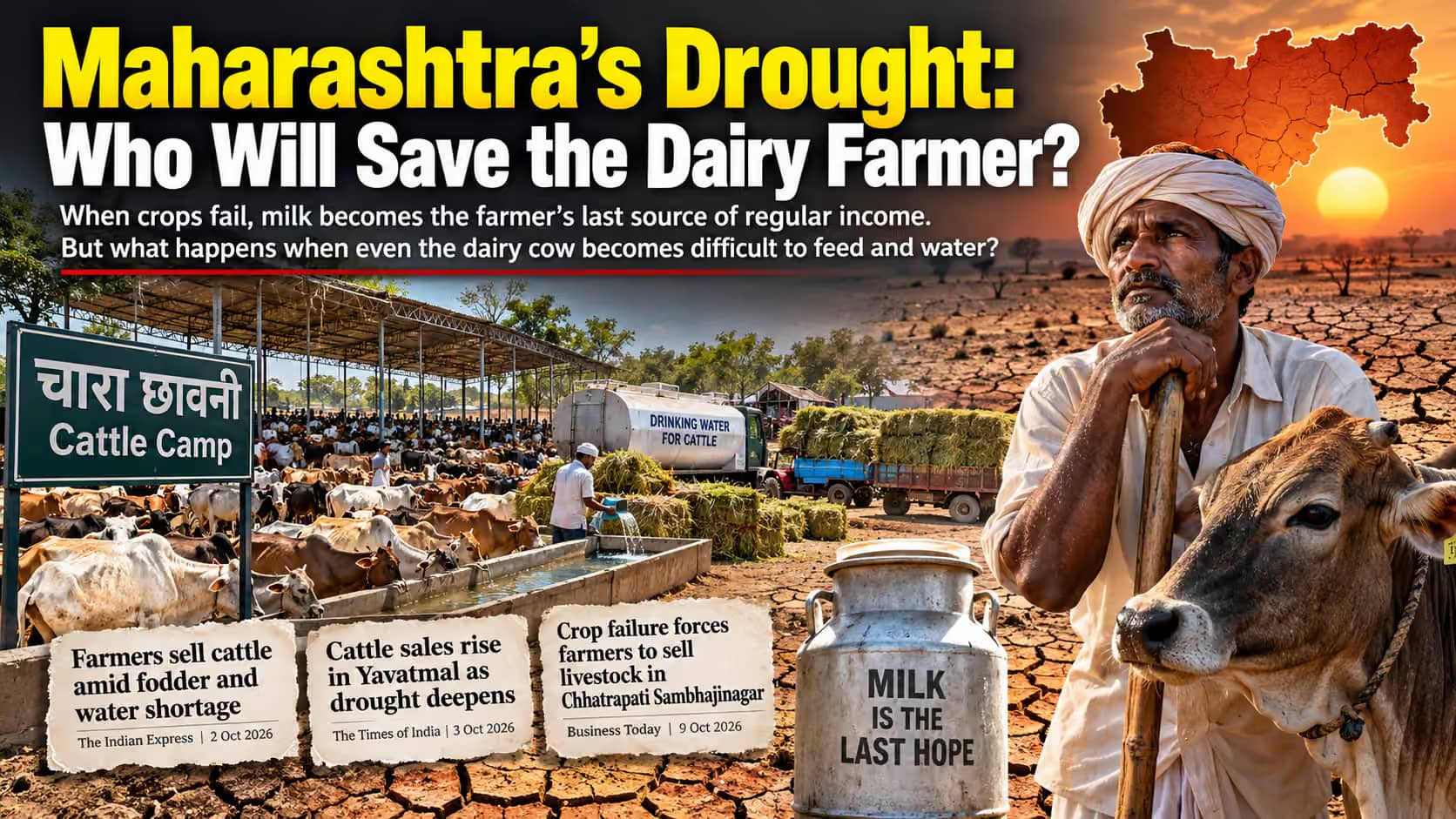
Milk prices are strong, yet a good cow sells for a fraction of its worth. The Maharashtra drought has quietly become a dairy crisis, and the relief package has not yet noticed.
Note: Most of the information in this article is based on multiple farmer-level interviews I conducted in Pune, Ahilyanagar and Nashik districts. All insights come directly from dairy farmers and milk collectors.
A cow giving 10 -12 litres of milk a day should fetch Rs 1.0 to 1.3 lakh in Maharashtra this year depending upon breed , number of lactation, Body score, etc. In the villages I have been travelling through during this Maharashtra drought, it is selling for well under a lakh. And this is happening in FY27, a year of some of the most consistently good milk prices the state has seen.
That one number tells you what no drought notification has captured yet. The farmer is not doubting the milk market. He is doubting whether he can keep a cow alive until the next monsoon.
When the asset that pays his household every ten days loses a quarter of its value in a strong market, the Maharashtra drought has stopped being only a crop story. It has become a dairy crisis.
The view from Ahilyanagar, Maharashtra's key milkshed
Ahilyanagar, the old Ahmednagar, is one of the most important milksheds in the state, at roughly 27 to 28 lakh litres a day. In my conversations with farmers and procurement operators this month, three things stood out.
First, the milk pool has plateaued. More operators are chasing the same litres, so each operator's volume has shrunk, while the farmer has gained no real bargaining power.
Second, nobody is buying good animals, despite good milk rates. The reason is simple: who will guarantee the fodder and water to keep that animal producing through April and May?
Third, every farmer is now cutting, drying and stacking whatever fodder he can find. They all say the same thing: in about a month there will be neither green fodder nor water in the fields until the next monsoon.
There is one more paradox policymakers should understand. Milk collection may actually rise in the coming weeks. When the soybean has failed and wage work is thin, the cow is the only asset still earning, so every family pushes it harder. That is not prosperity. It is a household liquidating its last reserve.
Maharashtra drought 2026: no rain, less water, fodder under lock
- Rain: the southwest monsoon withdrew from all of Maharashtra on 8 October and from the entire country on 15 October, according to the India Meteorological Department. IMD sees only light, scattered showers around 19 to 21 October. Skymet expects a break in rain activity in the last week of October, and the northeast monsoon now beginning waters the south, not the Deccan. Whatever fodder and water exists today is all there will be until June 2027.
- Reservoirs: statewide storage stood at about 75 per cent in early October, against 89 per cent a year ago. Marathwada had about 45 per cent against 83 per cent. Most telling are the minor projects in the Chhatrapati Sambhajinagar region, which actually water villages and cattle: 15.42 per cent on 13 October, against 66.70 per cent last year (Down To Earth).
- Water quotas: a minimum 10 per cent cut in supply now applies in every municipal corporation, municipality and gram panchayat. Each dam must keep an additional 10 per cent emergency buffer. Irrigation releases come only after drinking water, livestock and fodder needs, and in Marathwada they are restricted except where unavoidable. Water is reserved for drinking until August 2027.
- Fodder: collectors in Pune, Nashik, Solapur, Chandrapur and other districts have banned fodder from leaving their district. Traders in Marathwada now pay Rs 4,000 for 100 bundles of jowar kadba, against Rs 2,500 last year. Distress sales have begun at cattle markets such as Vadod.
Drought relief built for the crop, not the cow
The government has moved faster than in past droughts, and it deserves credit for that. On 14 October it declared drought in 305 of 358 talukas, announced Rs 5,000 per farmer before Diwali, extended twelve standard concessions and promised to buy fodder at MSP.
But look at what this architecture compensates: the failed crop. The dairy farmer's loss, the rising cost of keeping a productive animal fed, watered and milking, sits outside it.
Worse, the central disaster norm for cattle camps today is Rs 80 per large animal and Rs 45 per small animal per day. That is lower than what Maharashtra itself paid in 2019, seven years and several rounds of feed and fodder inflation ago.
Chara chhavni: we have done this before
The Maharashtra drought is a recurring guest: the state has faced drought every two or three years over the past fifteen, in 2012, 2015, 2017, 2019, 2023 and now 2026. In 2019, the chara chhavni carried the dairy economy through. More than 1,500 cattle camps sheltered over ten lakh animals at the peak. The daily grant began at Rs 90 per adult animal and Rs 45 per calf, and was raised to Rs 100 and Rs 50 in May 2019.
It was not flawless. Camps opened late, small ruminants were left out until the crisis peaked, and some Solapur operators from 2019–20 were still chasing their dues in 2025. In 2023 the state skipped camps altogether, distributed fodder grass instead, and later paid a Rs 5 per litre milk subsidy for two months.
The best of 2019 came from the village. Prithviraj Athare, sarpanch of Kaudgaon in Pathardi tehsil of Ahilyanagar, ran a chhavni on a six-acre shelter that held an estimated 2,000 cattle, cows along with calves and heifers. By his account, it needed around 50,000 litres of water and 40 tonnes of fodder every single day.
That is a logistics operation on the scale of a small dairy plant, run by a gram panchayat. No individual farmer can match that in a drought. Only a collective arrangement, backed by the state, can.
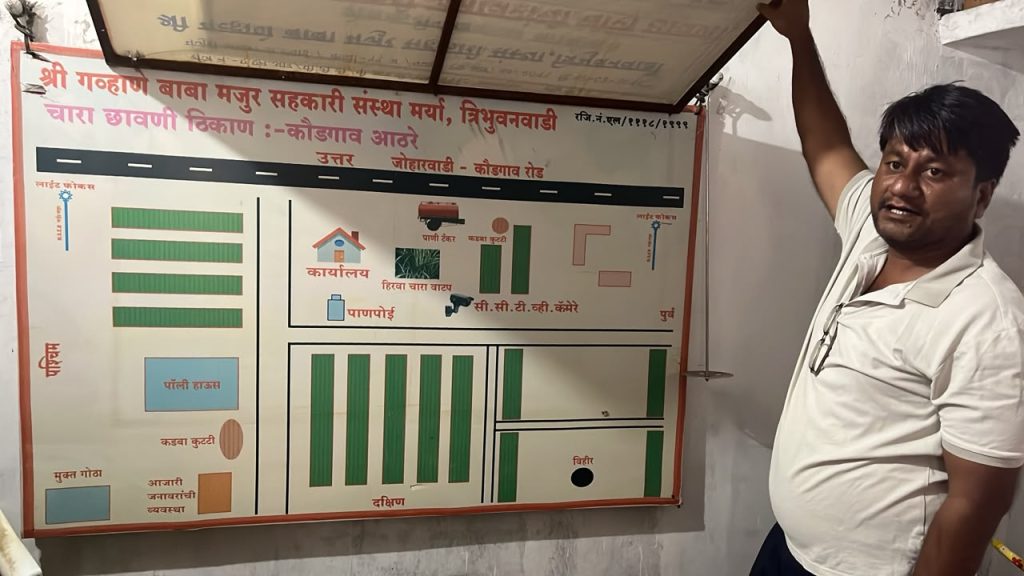
His camp layout, still displayed at the village, shows how it was done: separate sheds, a tanker point, centralised kadba-kutti and green fodder distribution, a well, CCTV cameras and an isolation area for sick animals. That is the kind of planning, and accountability, a 2026 chhavni should be funded to replicate.
The objection, and my answer
I can hear the objection from Mantralaya. State finances are stretched. Milk is a market activity and should carry its own risk. And the 2019 camps saw inflated animal counts and leakages.
All three points are fair.
But consider the alternative. A crop lost in one season is replanted the next. A milch animal sold in distress takes three to four years and a fresh loan to replace, if the family ever replaces it. The cheapest drought relief a government can buy is the relief that keeps the herd intact.
And leakage is an argument for better verification, not for doing nothing. With ear-tagged animals and digital milk-collection records, today's state can target relief far more precisely than it could in 2019.
Maharashtra drought: 6 things the government must do now
1. Give dairy agriculture status. I have argued this in several earlier blogs, and this drought makes the case unanswerable. When a crop fails, the farmer has relief norms, insurance and loan restructuring. When his dairy income collapses, he has nothing. Agriculture status would bring dairy losses under the same disaster, credit and insurance architecture that protects the crop.
2. Pay Rs 15,000 per milch animal as a drought survival grant. This one-time transfer would cover the extra fodder, feed and water a productive animal needs until the rains.
It should go by direct benefit transfer, verified against animal ear tags, veterinary records and milk-collection data, with a route for farmers who sell milk informally. Every ten lakh animals covered would cost Rs 1,500 crore, about five per cent of the Rs 31,628 crore the state committed to flood-hit farmers in 2025.
This is also the guarantee the cattle market is waiting for. Once the farmer knows his animal will be fed, a 10-litre cow will again be priced above a lakh.
3. Open chara chhavnis now, at Rs 120 per adult animal and Rs 80 per calf per day. Do not wait for April and the first carcasses. Camps for common fodder and water should open in vulnerable dairy clusters as soon as village stocks thin out.
Pay operators within 30 days, verify headcounts by ear tag, put a veterinarian on every camp, and include goats and sheep from day one.
4. Replace fodder blockades with a fodder grid. District bans freeze fodder where it happens to be; they do not create one extra kilogram. The state should publish a district-wise fodder balance, procure surplus through cooperatives, and move it to deficit talukas.
Milk unions and private dairies already visit every village twice a day. Their collection routes are the ready-made distribution network for fodder.
Read: Why India’s Dairy Needs a National Fodder Grid ?
5. Fix the cost of credit, not the price of the cow. I do not support a capital subsidy on cow purchase; it distorts animal prices and invites misuse. The real barrier is interest. Cattle loans today cost around 13 per cent. Bring that to 6 per cent and dairy development will move at a far faster pace.
Extend the Kisan Credit Card to finance cow purchase at 4 to 6 per cent. Add a Rs 50,000 working-capital line for dairy farmers at zero interest, rising to 12 per cent only on default.
The old fear of default has weakened: farmers now guard their CIBIL score because a default shuts them out of future credit. In the worst-hit talukas, protect the existing herd first and fund herd expansion once the rains return.
6. Ring-fence livestock water. The state has rightly reserved water for people and livestock until August 2027. Make the livestock share explicit, with a per-animal allocation, priority tanker supply for chhavnis, and protection for cattle troughs within every scarcity order.
The herd is not yet lost
The soybean is gone; no package will bring this season's crop back. The herd is still standing. Whether Maharashtra's dairy base survives this drought intact, or is sold off cow by cow at village markets, will be decided in the next four to six weeks, before the last green fodder disappears.
Milk carried rural Maharashtra through 2019. It can carry the state through the 2026 Maharashtra drought too. But only if the government stops treating the cow as a footnote to the crop.
Kuldeep Sharma is Chief Editor of DairyNews7x7 and founder of Suruchi Consultants, with nearly four decades in the Indian dairy industry. Views are personal.
Source: DairyNews7x7 16 Oct, 2026
#MaharashtraDrought #DairyFarmers #CharaChhavni #FodderCrisis #Ahilyanagar #DairyPolicy #DairyNews7x7
Never miss an important dairy update
Follow DairyNews7x7 on Google to get live milk prices, policy alerts, and daily headlines directly in your feed.