By Kuldeep Sharma, Chief Editor, DairyNews7x7
Milk cannot be safer than the feed that makes it. I have repeated that line for almost a decade. On 12 October 2026, the Government of India finally put a part of it into law. The Animal Feed Quality Control Order, formally the Animal Feeds and Feed Ingredients (Quality Control) Order, 2026, makes the BIS Standard Mark compulsory for three feed inputs that every Indian dairy animal eats.
It is a big win. It is also an incomplete one. This blog brings together everything I have written on feed regulation in India since 2018, congratulates those who made this Order happen, and names seven gaps that still leave our milk exposed.
Animal Feed Quality Control Order 2026: What the Gazette Says
The Department of Animal Husbandry and Dairying (DAHD) issued the Order as S.O. 5576(E), dated 7 October 2026. It was published in the Gazette of India Extraordinary on 12 October 2026 and came into force on that date. The legal basis is Section 16 of the Bureau of Indian Standards Act, 2016, used after consulting BIS.
Three products must now conform to their Indian Standard and carry the ISI mark under a BIS licence (Scheme-I of Schedule-II of the BIS Conformity Assessment Regulations, 2018):
| Product | Indian Standard | Large and medium units | Small enterprises | Micro enterprises |
|---|---|---|---|---|
| Mineral mixtures for supplementing cattle feeds | IS 1664 | 1 April 2027 | 1 July 2027 | 1 October 2027 |
| Dicalcium phosphate, animal feed grade | IS 5470 | 1 April 2027 | 1 July 2027 | 1 October 2027 |
| Common salt and cattle licks for animal consumption | IS 920 | 1 April 2027 | 1 July 2027 | 1 October 2027 |
BIS is both the certifying and the enforcing authority. Violations are punishable under the BIS Act, 2016. Goods meant for export are exempt. The latest version of each standard, with amendments, will apply.
One drafting point needs attention. The gazette table prints the implementation dates only against the first entry. The trade will reasonably read them as covering all three products, but a one-line clarification from DAHD or BIS would remove any doubt before April 2027.
The Order also travelled a long road. A draft Animal Feeds and Feed Ingredients (Quality Control) Order was circulated on 18 December 2024. It took 22 months to become law.
Congratulations to the Government and Every Stakeholder
Credit first, because it is earned. My congratulations to the Ministry of Fisheries, Animal Husbandry and Dairying and to DAHD, and to Joint Secretary Dr Muthukumarasamy B, who signed the Order. Equal credit goes to the Bureau of Indian Standards, whose technical committees kept these standards current through several revisions.
I also salute the stakeholders who carried this subject when it was unfashionable:
- The Indian Dairy Association (IDA), which kept milk safety and its feed roots on the industry's agenda, including through its December 2023 seminar on safer dairy products, where the feed-to-milk link was debated openly.
- NDDB, for years of work on aflatoxin management, area-specific mineral mixtures and ration balancing.
- Cooperative cattle feed plants, many of which took the ISI mark voluntarily long before any law asked them to.
- Private feed manufacturers and their association, CLFMA, who invested in quality while competing with unbranded products.
- Scientists at ICAR-NDRI and veterinary universities, whose data kept the feed-to-milk link in front of policymakers.
Why start with mineral mixtures? Because that is where cheating is easiest and hardest to detect at the farm gate. A bag of mineral mixture can be bulked with limestone powder or sand, or short-changed on copper, zinc and phosphorus, and the farmer sees nothing until fertility falls. Feed-grade dicalcium phosphate made from poorly processed rock phosphate can carry fluorine, and the IS 5470 specification exists to keep such material out of the feed chain.
The legal route also matters. The government chose a Quality Control Order under the BIS Act, notified by the Central Government itself. That is precisely the route the Delhi High Court said was missing when it struck down FSSAI's earlier attempt, which I discuss below. This Animal Feed Quality Control Order is the first central feed mandate that rests on firm legal ground.
Why Feed Regulation in India Could Not Wait: Eight Years of Warnings
The case for feed regulation in India was built in public, one dataset at a time. Here is the trail.
2018: the survey that changed the conversation. I was involved from 2016 in designing the framework for FSSAI's National Milk Safety and Quality Survey. It tested 6,432 samples from 1,103 towns. About 7 percent of milk was unsafe: 5.7 percent carried aflatoxin M1 above the limit and 1.2 percent carried antibiotic residues. Tamil Nadu alone had 88 non-compliant samples out of 551. Adulteration made the headlines, but contamination was the bigger story.
Aflatoxin M1 is not added to milk by anyone. It is the metabolite of aflatoxin B1 in mouldy feed. NDDB notes that roughly 0.3 to 6.2 percent of the B1 a cow eats is excreted as M1 in her milk. India allows 20 µg/kg of B1 in feed and 0.5 µg/kg of M1 in milk. The European Union allows only 5 µg/kg of B1 in dairy compound feed and 0.05 µg/kg of M1 in milk, a tenth of our limit.
The circle of control. In my December 2023 blog, Fingerprinting: Tracking Chemicals and Cos Behind Unsafe Milk, I showed that our regulatory oversight runs only from the milk collection centre to the dairy's cold store. The major contaminants, aflatoxin and antibiotics, originate outside that circle, at the farm and in the feed bag. With about 7 percent of roughly 600 million litres a day unsafe, I estimated that some 42 million litres of unsafe milk could be reaching households daily. In the same blog I proposed M-HIVE (Milk Hazard Inventory for Vigilant Evaluation), a national fingerprint database of contaminants and repeat offenders, and argued that a central food and feed regulator was inevitable.
2020: the first attempt, and global pushback. After the survey, FSSAI directed on 27 January 2020 that commercial feed for milk-producing animals follow BIS standards and that such animals not be fed meat or bone meal. As we reported in US Express Concern over Mandatory BIS Feed Regulation in India, the United States raised the matter at the WTO, seeking more consultation and a later start date. Timelines were extended repeatedly through 2021.
2026: residues push the issue to the feed bag. In May this year I reviewed FSSAI's draft amendment to the Contaminants, Toxins and Residues Regulations in Without Feed Regulation, How Will Dairy Manage Residue Compliance?. It proposes a default limit of 0.01 mg/kg for any pesticide not registered under the Insecticides Act, 1968, and revises limits for molecules such as chlorpyrifos, fipronil and cypermethrin in milk. These residues reach milk through cottonseed cake, maize, soybean meal, paddy straw and green fodder. Because many are fat-soluble, ghee, butter and milk powders concentrate them. My conclusion then holds now: residue compliance without feed regulation is compliance on paper.
When the Delhi High Court Disconnected FSSAI from Feed
On 7 April 2026, a Division Bench of Chief Justice Devendra Kumar Upadhyaya and Justice Tejas Karia decided Godrej Agrovet Ltd v. FSSAI (2026:DHC:2861-DB). The Court quashed Note (c) to Regulation 2.5.2 of the Food Products Standards and Food Additives Regulations, 2011, as amended in 2021. That note carried both the meat and bone meal ban and the BIS compliance requirement for commercial feed.
The reasoning was simple and, on the law, hard to fault:
- The Food Safety and Standards Act, 2006 regulates food for human consumption. Its definition of food expressly excludes animal feed.
- Terms such as "food safety", "primary food" and "unsafe food" cannot be stretched to cover cattle feed.
- FSSAI's 2019, 2020 and 2021 directions mandating BIS certification for feed were therefore beyond its powers.
- BIS standards are voluntary unless the Central Government itself makes them compulsory under the BIS Act.
I do not quarrel with the judgment. The Court read the statute as Parliament wrote it. The fault lay in a 2006 law that drew a hard line between the cow's feed and the cow's milk, a line that science does not recognise.
The consequence was a vacuum. From April to October 2026, India had no central legal mandate on cattle feed quality and no central ban on feeding meat and bone meal to dairy animals. The new Animal Feed Quality Control Order fills part of that vacuum, six months later and through the door the Court pointed to. But it fills only part of it, and that is where my concerns begin.
Cattle Feed, Calf Feed, Milk Replacer, Silage and Hay: Where Do They Stand?
The short answer: none of the products an organised dairy farm actually buys in bulk is covered by the new Order. Compounded cattle feed, calf starter, calf grower, calf milk replacer, silage and hay all sit outside it. FSSAI cannot touch them after the Delhi High Court ruling. What remains is a patchwork of voluntary BIS standards and a handful of state laws.
| Product | Indian Standard | Mandatory under the 2026 Order? | State feed law coverage |
|---|---|---|---|
| Mineral mixture, feed-grade DCP, salt and cattle licks | IS 1664, IS 5470, IS 920 | Yes, from April to October 2027 | Covered in Kerala, Karnataka, Punjab and Gujarat |
| Compounded cattle feed | IS 2052:2023 | No, voluntary since April 2026 | Covered as compound feed in Kerala, Karnataka, Punjab and Gujarat |
| Compounded feed for buffalo | IS 18792:2024 (new) | No, voluntary | As above |
| Bypass protein feed | BIS standard exists | No, voluntary | As compound feed, where defined |
| Calf starter and calf grower | IS 5560:2024 | No, voluntary | Kerala and Karnataka ban urea in young-stock feed |
| Calf milk replacer | No Indian Standard found | No | Unclear; depends on each state's definition |
| Silage | Draft IS on maize silage (2025), not yet confirmed as final | No | Kerala treats it as a roughage ingredient |
| Hay and dry fodder | No Indian Standard found | No | Kerala exempts green and dry fodder from packing and labelling |
| Total mixed ration | None | No | Defined only in Kerala's Act |
A few findings deserve emphasis.
Compounded cattle feed is back to voluntary. BIS has an up-to-date standard, revised in 2023, with an aflatoxin B1 cap. Since the Delhi High Court struck down FSSAI's 2020 direction, nothing at the central level makes it compulsory. BIS has also published a separate buffalo feed standard, IS 18792:2024, which deserves attention in a country where buffaloes give a large share of our milk.
Calf starter and calf grower have a fresh standard but no mandate. BIS revised IS 5560, the standard for compounded feeds for young stock, in 2024. It covers calf starter meal and calf growth meal and bars animal-origin ingredients other than milk and milk products. It remains voluntary.
Calf milk replacer is the most exposed product. I could find no Indian Standard for it. The original 1970 version of IS 5560 expressly left out feeds for calves from birth to about eight weeks, which is exactly the milk replacer window. Cooperatives now sell whey-based and milk-based replacers widely, yet the product has no national specification, is outside FSSAI because it is feed, and is outside the new Order. If a replacer is made from imported whey or milk powder, those ingredients may need DAHD's sanitary import permit, but the finished replacer itself has no quality standard to meet.
Silage and hay are a grey zone. A draft standard for maize silage as livestock fodder was circulated by BIS in August 2025; I have not been able to confirm that it has been finalised. I found no Indian Standard for hay. Yet baled silage is now a traded commodity across states, and badly made silage is a classic source of mycotoxins.
The old central safety net was removed in 2006. The Essential Commodities Act once listed "cattle fodder, including oilcakes and other concentrates" as an essential commodity, and states used it to issue feed control orders. The Essential Commodities (Amendment) Act, 2006 dropped it from the list and kept only seeds of cattle fodder. That is why states such as Karnataka have since replaced their old orders with full Acts.
The constitutional door, however, is still open. Entry 33 of the Concurrent List continues to cover trade, commerce, supply and distribution of cattle fodder, including oilcakes and other concentrates. Parliament therefore has the power to enact a central feed law whenever it chooses.
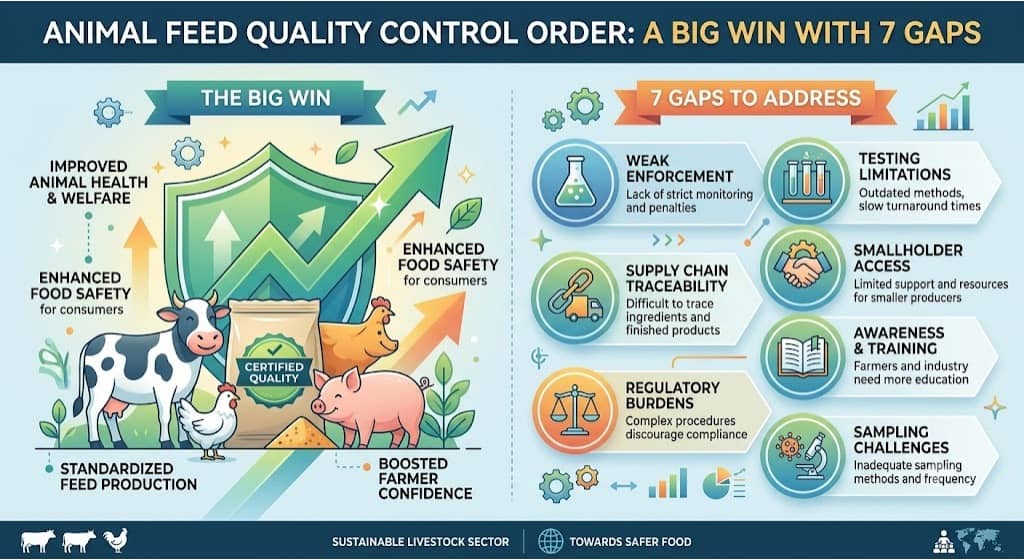
Seven Gaps in the Animal Feed Quality Control Order
The Order is a strong first step. Read against the Delhi High Court judgment and the 2018 survey, seven gaps stand out.
1. Compounded cattle feed and calf feeds are left out. IS 2052:2023, the standard for compounded cattle feed, is not in the schedule. This is the very product whose mandate the Court struck down. It is also the main carrier of aflatoxin B1 into the dairy animal, and the standard caps B1 at 20 µg/kg and cadmium at 0.5 mg/kg. Calf starter and grower (IS 5560:2024) and buffalo feed (IS 18792:2024) are out too, and calf milk replacer has no standard at all. Regulating the mineral supplement while leaving the main ration voluntary is like locking the window and leaving the door open.
2. "Feed Ingredients" covers only two ingredients. Despite its title, the Order covers dicalcium phosphate and salt. BIS already has standards for cottonseed, groundnut, mustard, coconut and other oilcakes, solvent-extracted meals, maize gluten and rice bran. These are the high-risk inputs for aflatoxin and pesticide residues, and none of them is mandatory.
3. The meat and bone meal ban has no legal home. With Note (c) quashed, no central instrument that I am aware of now prohibits feeding ruminant-derived protein to dairy animals. IS 2052 limits animal-origin ingredients to milk and milk products, but only for licensed product, and compounded feed is outside this Order. The ban matters for BSE precaution and for consumer trust, and it needs a proper statutory basis.
4. Quality is not the same as safety. A BIS mark certifies conformity to a product specification. It is not a risk-based feed safety system. The Order has no feed residue limits linked to FSSAI's milk limits, no control of antibiotics or growth promoters in feed, no rules for premixes, feed additives or medicated feed, no feed mill hygiene code and no recall mechanism.
5. No registration, no traceability. There is still no central register of feed mills and dealers, and no way to trace a contaminated lot of milk back to a batch of feed. Home-mixed and loose feed, which most smallholder animals eat, stays entirely outside the net.
6. MSME and laboratory capacity. Many mineral mixture makers are micro units. The staggered dates help, but BIS licensing, in-house testing and surveillance sampling all need accredited feed laboratories, which are few and unevenly spread. Without support, the risk is shortage, higher prices or a drift to unbranded supply. Imports also come under the Order, so foreign suppliers will need BIS licences; after the 2020 WTO episode, early engagement with trading partners would be wise.
7. No bridge between the feed regulator and the food regulator. FSSAI sets the limit for aflatoxin M1 in milk. BIS sets the limit for aflatoxin B1 in feed. DAHD owns animal husbandry policy, and the states own most enforcement. Nobody is charged with making these numbers add up across the chain. That brings me to the deeper structural problem.
The Hidden Cost of Keeping Food and Feed Regulation Decentralised
India regulates food and feed under different laws, different ministries and, often, different levels of government. Food adulteration sits in the Concurrent List (Entry 18, List III), and Parliament occupied that field with a single central law, the FSS Act. Animal husbandry and veterinary matters sit in the State List (Entry 15, List II). So feed has historically been left to state control orders under the Essential Commodities Act, 1955, or to state feed Acts.
Punjab shows how slowly this patchwork moves. It ran a cattle feed control order from 1988. Its Assembly passed a cattle feed regulation Bill in 2018, but the Bill received Presidential assent only in 2025, seven years later. Until then, about 2,000 feed manufacturers serving 65 lakh cattle and buffaloes in one of India's most intensive dairy states had no binding rules.
Other states are now moving, each in its own way. Kerala enacted its Livestock Feed, Poultry Feed and Mineral Mixture Act in 2023, with licensing, feed safety officers and a ban on animal protein in ruminant feed. Karnataka passed its Animal Feed (Regulation of Manufacture and Quality Control) Act in April 2025 and published draft rules in December 2025; it ties manufacturers to BIS or ICAR standards. Gujarat's Assembly passed its own livestock feed Bill on 10 September 2026. Their definitions differ: Karnataka covers only compounded feed, while Kerala also names silage, hay, straw and total mixed ration. A bag of feed or a bale of silage can therefore be regulated in one state and not in the next.
Let me concede the case for decentralisation. Feed resources are local. Mineral deficiencies differ by soil and district, which is why NDDB promotes area-specific mineral mixtures. States know their dealers and their villages, and the feed industry fairly fears layers of inspectors adding cost without adding safety.
But decentralised feed regulation creates problems that no single state can solve:
- Feed crosses borders; regulation does not. Cottonseed cake from Gujarat feeds cows in Punjab whose milk becomes ghee sold in Delhi or exported from Maharashtra. A contaminant can enter in one state and surface in another, with no common rulebook.
- Uneven standards and enforcement. A few states have feed laws; most rely on old control orders or nothing. Manufacturers face different rules for the same bag.
- Split accountability for one hazard. Aflatoxin in milk is FSSAI's problem, aflatoxin in feed is BIS's, and the farmer's storage shed is the state's. When milk fails a test, everyone can point elsewhere.
- No shared data. Feed test results, milk surveillance and residue findings sit in separate silos, so nobody can map hotspots or trace contamination to its source.
- Trade credibility. Importing countries expect a single competent authority that can certify the whole chain. A patchwork weakens India's case in premium dairy markets.
The world's leading dairy economies solved this long ago. In the United States, the Federal Food, Drug, and Cosmetic Act defines food to include food for animals, and the FDA regulates both. The European Union's General Food Law, Regulation (EC) No 178/2002, covers food and feed under one framework with a feed hygiene regulation beside it. Codex has a Code of Practice on Good Animal Feeding. India needs the same principle: set standards centrally, enforce locally, and treat feed and food as one chain.
What Comes After the Animal Feed Quality Control Order: A Seven-Point Roadmap
The Order should be read as Phase 1. Here is what Phase 2 should contain:
- Bring compounded cattle feed and key ingredients under a second QCO within 12 months. IS 2052 cattle feed, IS 18792 buffalo feed, IS 5560 calf starter and grower, bypass protein feed and the major oilcakes and meals should follow, with the same staggered MSME dates. BIS should also finalise standards for calf milk replacer, silage and hay.
- Give feed a statutory home. Either amend the FSS Act to cover feed for food-producing animals, or enact a central Livestock Feed Safety Act with a single authority. Restore the meat and bone meal ban by statute, not by footnote.
- Link feed limits to milk limits. Set aflatoxin B1 and pesticide limits in feed so that compliant feed reliably yields compliant milk, aligned with FSSAI's new residue regulations.
- Create a national feed register with traceability. Register every feed mill and dealer, put a QR code on every bag, and link it to NDDB's animal identification systems so a failed milk test can be traced to a feed batch.
- Build laboratory and MSME capacity. Fund accredited feed labs in every major milk shed, subsidise testing for micro units, and allow cluster-level certification.
- Launch M-HIVE. A national hazard inventory for milk and feed, holding contaminant fingerprints, surveillance data and repeat offenders, shared between FSSAI, BIS, DAHD and the states.
- Train the farmer. Most aflatoxin begins in a damp storage corner. Simple guidance on drying, storage and binders, delivered through dairy cooperatives, will do more than any inspector.
Conclusion: A Big Win, Now Finish the Job
The Animal Feed Quality Control Order deserves a warm welcome. After a survey in 2018, a WTO objection in 2020, extensions through 2021 and a court defeat in April 2026, the Central Government has finally placed a piece of feed regulation on solid legal ground. I congratulate DAHD, BIS and every stakeholder who stayed the course.
But mineral mixture, dicalcium phosphate and cattle licks are the garnish, not the meal. Until compounded feed and oilcakes are covered, until feed and food sit under one coherent law, and until a contaminated glass of milk can be traced back to its feed bag, the job is half done. Milk cannot be safer than the feed that makes it. Let Phase 2 begin now.
I invite comments from industry, regulators and farmer organisations at dairynews7x7@gmail.com.
Related reading on DairyNews7x7:
- Without Feed Regulation, How Will Dairy Manage Residue Compliance?
- Fingerprinting: Tracking Chemicals and Cos Behind Unsafe Milk
- US Express Concern over Mandatory BIS Feed Regulation in India
Source: The Gazette of India, S.O. 5576(E) | DairyNews7x7. Blog by Kuldeep Sharma, Chief Editor, DairyNews7x7.
Never miss an important dairy update
Follow DairyNews7x7 on Google to get live milk prices, policy alerts, and daily headlines directly in your feed.