Indian Dairy Association organized a Seminar on “Safer Dairy Products – Challenges for Industry and Administrators” in Delhi. The seminar featured two Panel discussions, the first focusing on nutrition and the other on the safety of milk. I am grateful to the Indian Dairy Association for providing me the opportunity to moderate the session on Safe Milk.
The panel on Safe Milk comprised Dr. Rajan Sharma (Jt Dir NDRI Karnal) and Dr. K.D. Aparnathi (Ex-SMC College) from academia . Mr Vijay Sardana (Renowned Food Expert) and Ms. Rajeshwari Sinha (CSE) represented practicing professionals.
Nurturing Milk Safety: A Personal Commitment
In 2016, I got involved in designing the framework for the National-Milk-Adulteration-survey, which expanded on a larger scale in 2018. The survey covered various chemicals and contaminants, including pesticidal residues. The results revealed around 7% of the milk as unsafe (1.2% with Antibiotic residue and 5.7% Aflatoxin M1). This transformative journey included crafting Schedule IV (GMP) and curriculum for the Dairy-Food-Safety-Supervisor program, uncovering my life’s true purpose and shedding light on factors contributing to unsafe milk.
Safeguarding Our Fundamental Right to Safe Food
Highlighting the constitutional perspective on the right to safe food, this section emphasizes that while food is essential for survival, unsafe-food-is-akin-to-a-slow poison. Safe food is not a luxury but a fundamental requirement, integral to the human right to access food. The World Health Organization’s definition of food safety is explored, noting its absence in the Constitution of India. Despite this, Entry 18 in List III empowers legislatures to enact laws on food adulteration.
Every citizen’s fundamental right to safe food is guaranteed by Article 2. With Article 47 imposing a duty on the State to enhance nutrition and public health. Post-Maneka Gandhi, the right to life has expanded to include living with human dignity. Ignoring unsafe practices in agriculture and animal husbandry jeopardizes food safety.
Ensuring Safe Milk Delivery at Every Tier
Dairy is a a three-tier activity involving production, collection and processing, and distribution and sales. It requires control at all levels to ensure safe milk delivery. Regulatory interventions, including capacity building, handholding, surveillance, and enforcement, are crucial at every stage.
The accompanying illustration identifies all areas of contamination in the primary and processing stages of a dairy value chain.
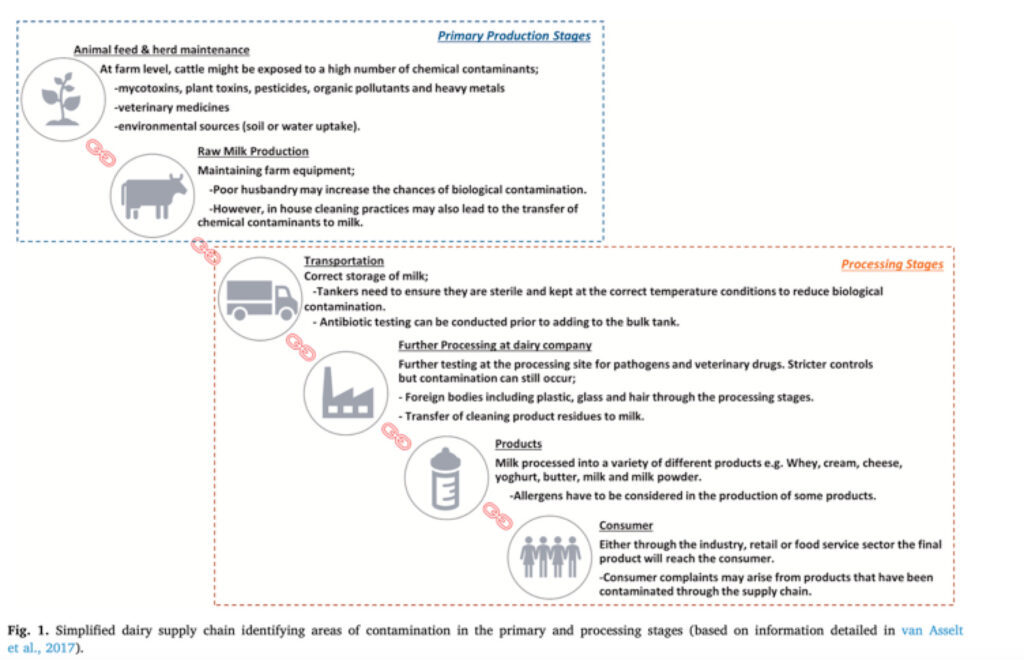
In the Indian context, our regulatory oversight is limited. It stretches from milk collection centers to the cold store of processing plants. All food safety measures operate within this framework. The 2018 Milk Adulteration survey revealed that major contaminants, such as antibiotics and aflatoxin, originated from outside the “Circle of Control” of Quality Assurance in milk processing companies.
India produces nearly 600 million liters of milk daily. With 7% of this milk found to be contaminated, approximately 42 million liters per day are unsafe for consumption. Considering an average household milk consumption of around 1 liter. This unsafe milk reaches approximately 42 million households, nearly one-sixth of India’s 300 million households.
Inclusion of Farmers for Ensuring Safe Milk Production
The latest report on Antimicrobial Resistance (AMR) by CSE and WHO recommends timely vaccination for all livestock, emphasizing a preventive approach. Integrating the One Health Program in the fight against AMR is a key objective.
Farmers often face challenges, including antibiotic misuse by unqualified individuals and issues like mastitis leading to drug residues in milk. Clean Milk Production (CMP) is essential to control microbial contamination, necessitating regular training for farmers with a simplified Standard Operating Procedure (SOP) during milking.
Training should extend to making and storing quality compound feed, considering that Aflatoxin M1 often results from fungus growth in stored feed. Regular water testing and preventing the mixing of animal waste into drinking water are crucial areas covered in a standard CMP checklist.
Constitutional Provisions for Agricultural Upgradation
Article 48 of the constitution emphasizes organizing agriculture and animal husbandry on modern and scientific lines, while Article 48A focuses on environmental protection. Scientific methods can control livestock emissions and water pollution, ensuring responsible agricultural practices.
With the development of a national food regulation, the creation of a central food and feed regulatory body is anticipated. This evolution necessitates the inclusion of farmers, cattle feed manufacturers, and other stakeholders. Farmer inclusion is vital for extending the role of FSSAI in primary production.
To avoid political considerations, the inclusion of farmers in the regulatory framework can begin through cattle registration with the farmer’s name in a society. The existing Information Network for Animal Productivity & Health (INAPH) program, managed by NDDB, already provides unique identities for millions of cattle, facilitating vaccination and reducing the need for drugs.
This identity can be used to ensure that milk from animals under antibiotic treatment is not mixed at the society level. Proper farmer training with a clear SOP, checklist-based Clean Milk Production, and Ethno-veterinary treatment are essential components. Implementing a ration balancing program under the same initiative can contribute to achieving the One Health dream by controlling drug use in livestock.
Addressing Endocrine-Disrupting Chemicals in Milk and Milk Products
Source : Environmental Pollution 288 (2021) 117750 https://doi.org/10.1016/j.envpol.2021.117750
One of the research in Delhi and NCR region found the following findings
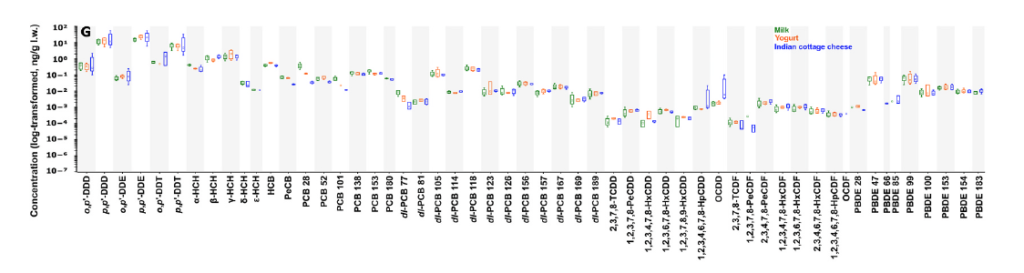
“Products of animal origin were higher than plant-based food items. In total, up to 55 compounds were detected in milk, yogurt, and Indian cottage cheese (Fig. 1G, Table S15) with similar levels and profiles among these products. DDT congeners had the highest levels with a prevalence of p, p’-DDE (up to 54.8 ng/g l.w. in cottage cheese). All isomers of HCH were detected in at least one type of dairy product. The highest concentration was observed for γ-HCH (3.6 ng/g l.w.) in yogurt. Among PCBs, the highest concentration was detected for PCB 28 in milk (0.6 ng/g l.w.).
Among PBDEs, PBDE 99 was detected with the highest concentration of 0.2 ng/g l.w. in yogurt. PBDE 209 (typically the most abundant among PBDEs in other food items) could not be detected in any of the dairy products owing to the high detection limits achieved (i.e. 101–1830 pg/ g l.w.). In addition to the detection limits, lower presence of PBDE 209 in dairy products can be due to its high molecular mass leading to its lower bioaccumulation compared to other PBDE congeners with lower molecular mass, moreover, PBDE 209 has the capacity to breakdown in more toxic and easily absorbed congeners such as those existing in penta- and octa-BDEs (McDonald, 2002; O’Driscoll et al., 2016). “
Presence of Heavy metals in milk and milk products ( Source :
Source : Archives of Environmental Contamination and Toxicology- https://doi.org/10.1007/s00244-023-01017-x
Subsequent research revealed the following results.
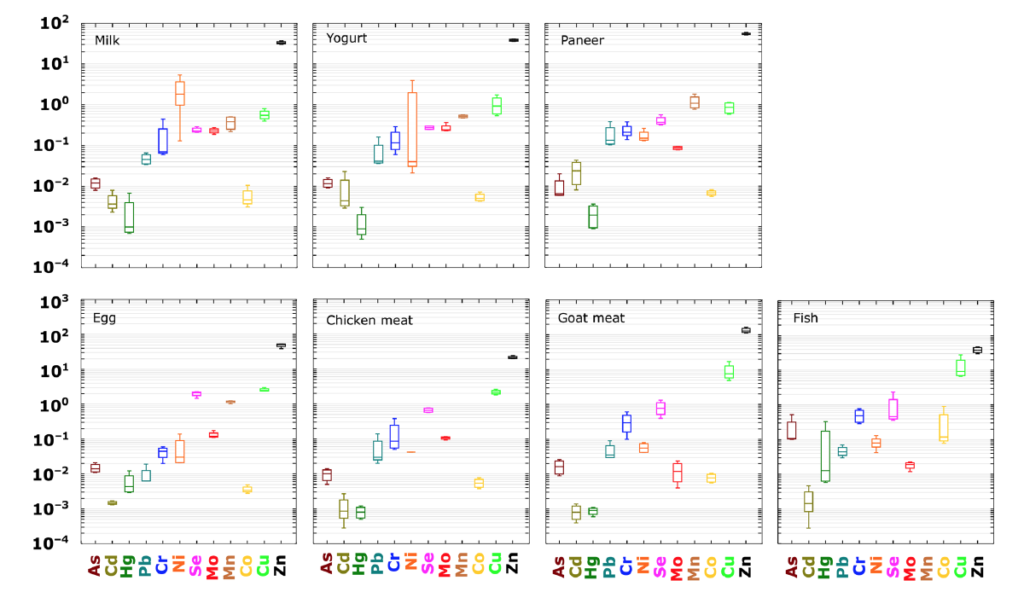
ΣtHM was the highest in milk (1.95 mg/kg) followed by cottage cheese (0.52 mg/kg) and yogurt (0.21 mg/kg), however in case of essential elements, the highest sum was observed in cottage cheese (56.41 mg/kg) followed by yogurt (40.46 mg/kg) and the least in milk (34.39 mg/kg).
The median concentrations of individual metals in milk ranged from 0.001 (Hg) to 33 (Zn) mg/kg, in yogurt from 0.001 to 38.5 mg/kg and in cottage cheese from 0.002 to 54.0 mg/kg. Usually, cottage cheese contained higher residues of the essential elements as compared to milk, which can be due to the selective binding of metals to proteins, which this product is enriched of (Witkowska et al., 2021).
Concentrations of Cr and Pb varied noticeably among different zones of Delhi, for example, Cr in milk from South zone (0.44 mg/kg) was 7 times higher than in the East zone (0.07 mg/kg); similar variations were observed for Cr in cottage cheese and yogurt. Pb in cottage cheese from the West zone (0.38 mg/kg) were 4 times higher than in samples from the East zone (0.1 mg/kg). Several distinct milk farms feed a few milk processing and distribution plants in Delhi.
An unending list of culprits
While reviewing an analytical test report from a reputable milk supplier, I was astonished to discover a milk analysis report encompassing over 200 tests, including 13 for chemicals, 1 for mycotoxins, 4 for microbiological factors, 5 for heavy metals, 32 for drug residues, and an extensive range of 62-159 tests for pesticidal residues.
Are we genuinely discussing milk here? State-of-the-art FTIR machines now offer up to 30-35 tests for chemical adulterants, capable of identifying even unknown chemicals not typically found in milk. These machines, deployed in large dairies nationwide, play a pivotal role in enhancing testing capabilities. For instance, in drug residues, the number has been reduced from 92 to under 30, and the milk adulteration survey found minimal samples with pesticidal residue under 18 different categories.
Considering the presence of endocrine-disrupting chemicals and harmful heavy metals in common dairy products like Paneer and yogurt, isn’t it time for a nationwide initiative against this menace? Shouldn’t we label these toxic chemicals and contaminants as criminals and create a national database using cutting-edge testing and sensing technologies?
M-HIVE: Milk Hazard Inventory for Vigilant Evaluation
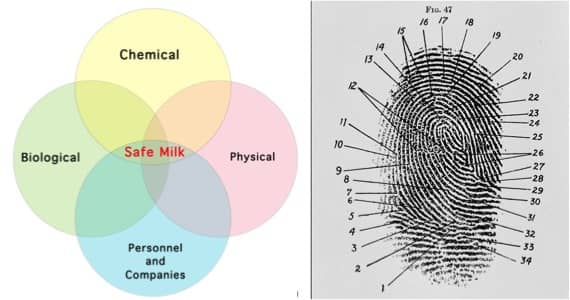
To address these concerns, I propose establishing a dedicated desk at the Ministry of Dairying or FSSAI to implement M-HIVE (Milk Hazard Inventory for Vigilant Evaluation). This dairy-specific inventory should include fingerprints of all possible known and unknown chemicals, microbes, and contaminants across various categories. Additionally, it should encompass all individuals and companies involved in food adulteration cases, those failed at international destinations, and laboratories with compromised results after exports.
Let’s not become complacent about milk safety. “Just because something isn’t happening for you right now doesn’t mean that it will never happen.”
With 140 crores of people in India consuming 60 crores liters of milk daily, ensuring the safety of this essential commodity becomes a collective responsibility. I invite your comments and suggestions on how to achieve this goal at dairynews7x7@gmail.com, a direct channel to connect with me.
Source : Blog by Kuldeep Sharma Chief Editor Dairynews7x7
Never miss an important dairy update
Follow DairyNews7x7 on Google to get live milk prices, policy alerts, and daily headlines directly in your feed.