What August's FAO numbers — and back-to-back GDT auctions — tell us about a market still searching for a floor
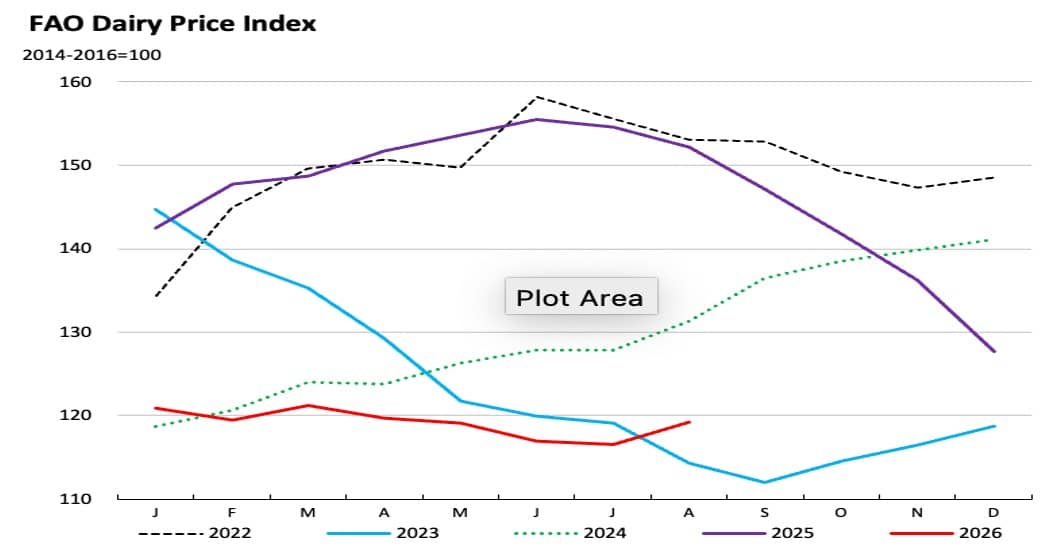
For three straight months, anyone tracking global dairy prices had grown used to reading bad news. So when the Food and Agriculture Organization's Dairy Price Index (FDPI) came in at 119.2 points for August — up 2.7 points, or 2.3 percent, from July — it was tempting to call it a turning point. It is more accurate to call it a pause. The index remains 21.7 percent below where it stood a year ago, and one month of gains, however welcome, does not undo the deepest slide the sector has seen in years.
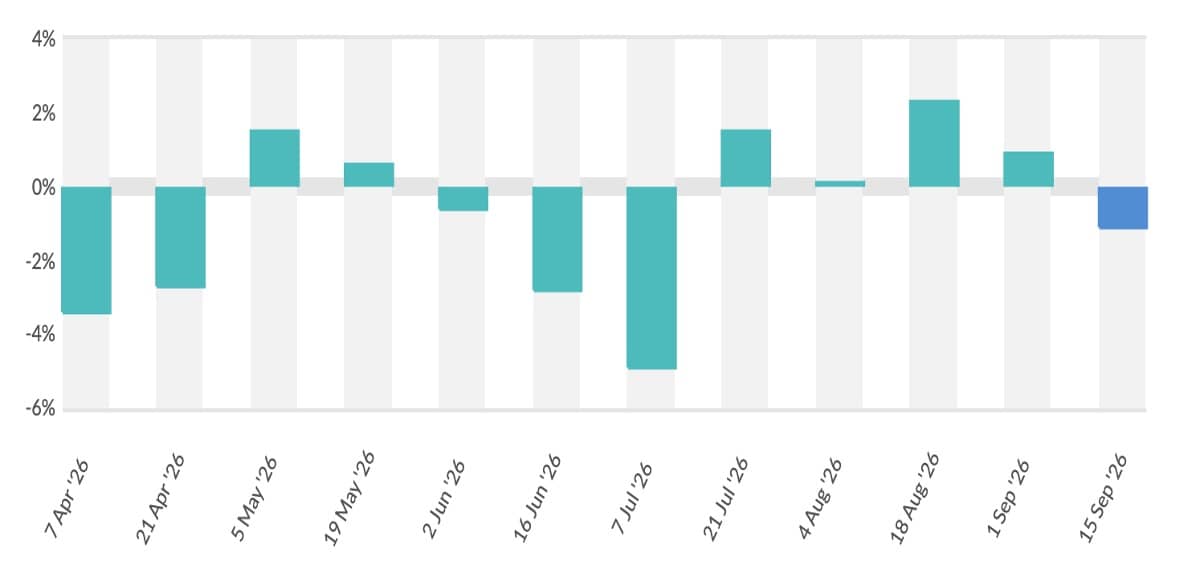
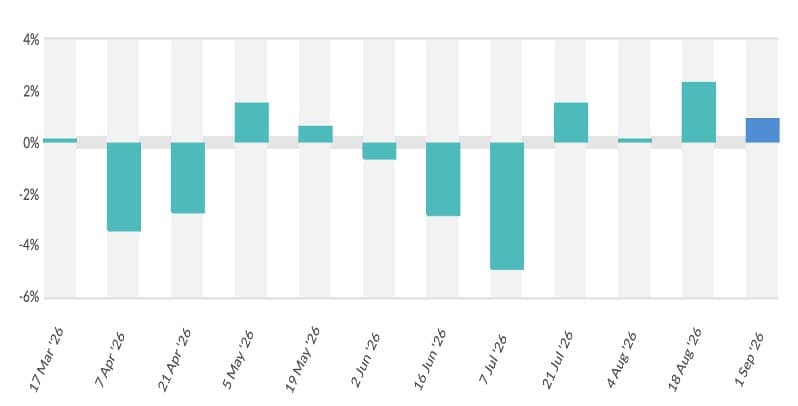
Still, the composition of the rebound is instructive, and it lines up almost neatly with what happened in two consecutive Global Dairy Trade (GDT) auctions that bracketed the month — Event 410 on August 18 and Event 411 on September 1. Together, the FAO index and the GDT results tell a coherent story about where the pressure in dairy markets is building, and where it is easing.
Powder led the way — and the auction floor agrees
The FAO data show skim milk powder (SMP) and whole milk powder (WMP) prices rising 3.0 percent and 2.4 percent respectively in August, with firmer European Union quotations outweighing the seasonal softening typical of Oceania at this time of year. That is almost a mirror image of what GDT Event 410 delivered a fortnight before month's end: SMP was the standout performer of the auction, jumping 7.6 percent to roughly €2,700 (about $3,021) a tonne, while WMP rose a more modest 3 percent. The GDT index itself climbed 2.3 percent to 1,166, its third consecutive rise, on turnover of just over 41,000 tonnes.
The read-through is straightforward: milk supplies are tightening in the Northern Hemisphere just as buyers keep showing up. The FAO report points to hot, dry weather compounding an already-thin milk pool across several major EU producing regions — a supply-side story, not a demand shock — while GDT's bidder data (176 participants, 130 successful, an unusually deep field) suggests import appetite has not gone anywhere. When a shrinking pool of milk meets a steady queue of buyers, powder prices are the first place it shows up, and August delivered that lesson twice — once in the monthly FAO average, once in the fortnightly auction print.
Cheese's slow climb, butter's split personality
Cheese extended its recovery for a second month, up 2.7 percent on the FAO index as tight EU milk availability outweighed a softer Oceania market, where U.S. competition for export share is keeping a lid on prices. GDT's own cheese-adjacent categories backed this up: mozzarella surged 6.1 percent at Event 410, even as cheddar barely moved, up just 0.6 percent — a reminder that "cheese" is not one market but several, each responding to its own regional supply lines.
Butter is where the two datasets diverge most sharply in texture, if not in direction. FAO describes butter as "broadly unchanged" in August, with firmer European quotations offset by rising Oceania supply. GDT's auction snapshot was blunter: butter fell 2.0 percent at Event 410, and anhydrous milk fat dropped a steep 6.0 percent, alongside a 3.5 percent decline in buttermilk powder. The monthly average smooths over what the fortnightly auction shows in sharper relief — that milkfat products, unlike powders, are still finding fresh supply from Southern Hemisphere producers moving into their spring flush, and that is capping any European-driven strength before it can show up in a broader index.
Does the momentum hold?
The most useful confirmation came just after August closed. GDT Event 411, held September 1, posted a fourth consecutive increase — a smaller 0.9 percent gain to an index reading of 1,177 — even as cheddar reversed hard, down 6.6 percent. That deceleration matters. It suggests the powder-driven rally that lifted both the FAO index and the GDT benchmark through August was real, but is already losing some of its force as Oceania's spring milk flow starts to weigh more heavily on the market — precisely the dynamic FAO flagged as a drag on Oceania powder prices even while August's headline number rose.
The bigger picture
None of this changes the fundamental story of 2026: a market that spent much of the year correcting from elevated 2024–25 levels, with the FAO index still sitting more than a fifth below year-ago levels. What August — and the GDT auctions that bookended it — add is texture. The recovery, such as it is, is being driven narrowly by milk powders responding to a genuine EU supply squeeze, not by a broad-based rebound in demand. Butter and cheese are moving on separate, more regionally fragmented logic, and the deceleration already visible in Event 411 suggests dairy exporters and buyers alike should treat August's gain as a stabilization, not a rally to bank on.
For policymakers and processors alike, the lesson is a familiar one dressed in new numbers: weather in a handful of EU milksheds can move a global index, but it cannot yet overcome the countervailing pull of an Oceania season that is only getting started.
Source: FAO Dairy Price Index (August 2026); Global Dairy Trade Events 410 (August 18, 2026) and 411 (September 1, 2026)... Sep 04,2026 editorial by Kuldeep Sharma Chief editorial Dairynews7x7