GDT 412: Fats fall as Cheddar rebounds sharply
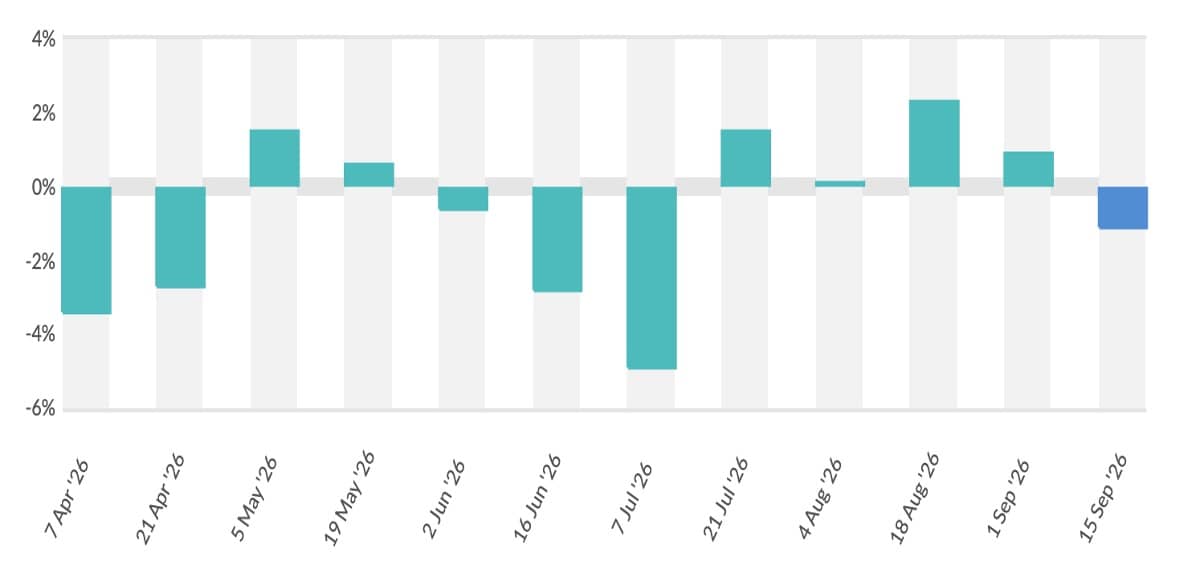
The Global Dairy Trade Event 412 held on 15 September 2026 has interrupted the four-auction recovery seen since July, with the GDT Price Index declining 1.1%. The fall, however, should not be read as a uniform weakening of the global dairy market. Once again, individual commodities moved in sharply different directions—milk powders remained relatively resilient, milk fats weakened further, while Cheddar staged an unusually strong rebound. GDT confirms that its index measures the weighted change in product prices rather than a simple change in the overall average selling price, making this divergence particularly important. (Global Dairy Trade)
Event 412 saw 42,444 MT of dairy products sold, against an offered supply range of 38,570–45,568 MT. A total of 155 bidders participated, of whom 126 emerged as winning bidders, after 18 bidding rounds lasting 2 hours and 56 minutes. The quantity sold was about 3.5% lower than the 43,976 MT traded in Event 411, but remained substantial. The weighted average winning price across products was USD 3,868/MT, compared with USD 3,910/MT in the previous event.
The commodity numbers tell the real story. Whole Milk Powder (WMP) declined 0.8% to USD 3,565/MT, while Skim Milk Powder (SMP) remained almost unchanged, rising marginally by 0.1% to USD 3,689/MT. SMP therefore continues to trade above WMP—by USD 124/MT—even after its extraordinary 5.3% rise in Event 411. Butter fell sharply by 5.7% to USD 4,760/MT and Anhydrous Milk Fat (AMF) declined 3.0% to USD 5,739/MT. Butter Milk Powder (BMP) eased 0.5% to USD 4,549/MT, while Lactose fell 4.3% to USD 1,794/MT. (MilkPoint)
Cheese produced the most dramatic movement. Cheddar jumped 16.5% to USD 4,075/MT, reversing the 6.6% decline recorded in Event 411, while Mozzarella moved in exactly the opposite direction, falling 6.0% to USD 3,992/MT. The contrast is striking because only two weeks earlier Cheddar had fallen to USD 3,503/MT. Such sharp two-way movement suggests that cheese prices are presently being influenced by product-specific availability and short-term purchasing requirements rather than by a uniform strengthening of global cheese demand. (IndexBox)
The 1.1% decline in the overall GDT index is therefore primarily a milk-fat story rather than a collapse in powder demand. WMP, which represents the largest share of GDT volumes, lost only 0.8%, while SMP was virtually unchanged. Butter and AMF, however, continued their correction. Butter has now fallen from USD 5,090/MT at Event 410 to USD 5,028 at Event 411 and USD 4,760 in Event 412. AMF has similarly moved from USD 5,993 to USD 5,917 and now USD 5,739/MT. Improving milk availability in major exporting regions, comfortable cream availability and buyers' reluctance to rebuild fat inventories aggressively appear to be keeping pressure on the fat complex. The high traded volume also indicates that international buyers do not currently feel compelled to chase supplies at progressively higher prices. (MilkPoint)
The behaviour of SMP deserves even greater attention. In Event 410 SMP rose 7.6%, followed by another 5.3% increase in Event 411, and has now held those gains with a further 0.1% increase to USD 3,689/MT. WMP, meanwhile, remains around USD 3,565/MT. The unusual SMP-over-WMP inversion that emerged in Event 411 has therefore not disappeared—it has actually widened slightly. This suggests that demand for skim solids and dairy protein remains stronger relative to available supply than demand for the complete milk-solids package represented by WMP. (DairyNews7x7)
On the demand side, I would still describe the global market as selective rather than weak. Event 412 sold more than 42,000 MT and produced 126 winning bidders, which hardly suggests an absence of buyers. What appears to be changing is their behaviour. Buyers are willing to replenish powders but are reluctant to chase milk fats, while cheese purchasing can change sharply from one auction to another. China and North Asia remain central to GDT, but the broader demand base from Southeast Asia, the Middle East and Africa is becoming increasingly relevant for milk powders used in recombination, consumer dairy products and food processing. Detailed regional purchases for an individual event are part of GDT's paid Insight data, so it would be premature to assign the Event 412 movement to any particular new country without that dataset. (Global Dairy Trade)
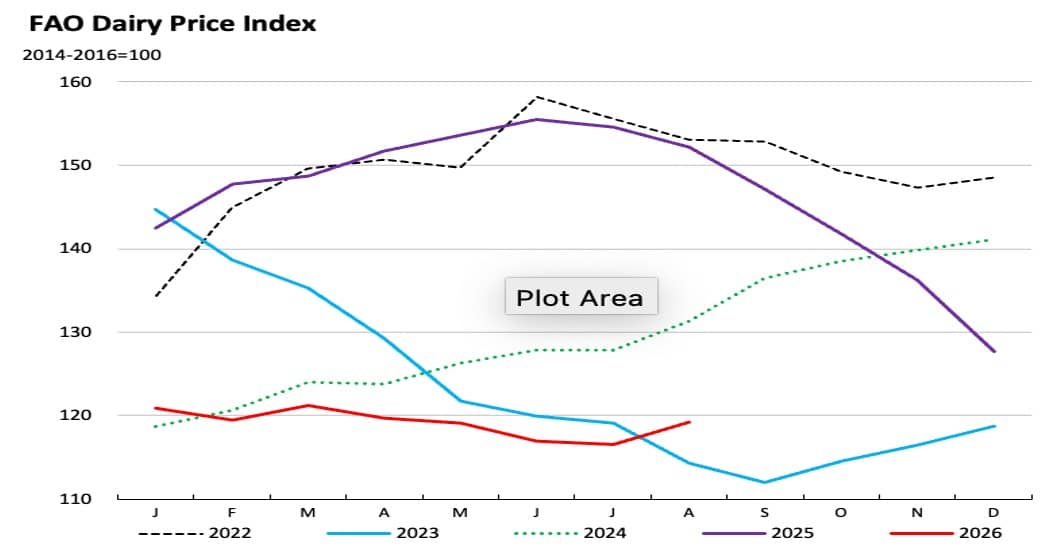
The longer 2026 journey of the GDT index puts this auction into better perspective. The year began extraordinarily strongly with increases of 6.3% on 6 January, 1.5% on 20 January, 6.7% on 3 February, 3.6% on 17 February and 5.7% on 3 March. That rally subsequently lost momentum: the index fell 3.4% on 7 April and 2.7% on 21 April, recovered modestly in May, and then weakened again through June and early July, culminating in the 4.9% decline on 7 July. Four consecutive positive auctions followed—+1.5%, +0.1%, +2.3% and +0.9%—before the latest 1.1% correction. In other words, 2026 has moved from an early-year rally to correction and now into what increasingly looks like a period of consolidation. (FX Blue)
My assessment for the next two to three months remains moderately positive for milk powders but cautious for fats. SMP holding near USD 3,700 after two strong auctions is encouraging and I would expect it broadly to remain in the USD 3,550–3,850/MT range, unless global milk production expands more rapidly than expected. WMP could remain around USD 3,450–3,750/MT, with a meaningful breakout requiring stronger Chinese or broader Asian buying. Butter and AMF may remain under pressure until the market absorbs the increased availability of milk fat; Butter could test the USD 4,600–5,000 range while AMF may broadly remain around USD 5,500–5,900. These are analytical ranges rather than formal price forecasts, and stronger Asian purchasing or unexpected production disruptions could quickly change them.
For India, the most relevant signal is again SMP rather than the headline GDT index. Global SMP at USD 3,689/MT provides a much healthier international benchmark for Indian powder manufacturers than existed earlier in the year. It keeps alive the possibility of export enquiries if Indian SMP can be produced competitively after accounting for freight, exchange rate and quality specifications. More importantly, a firm international SMP benchmark can provide some support to domestic powder values as Indian milk availability moves through its own seasonal cycle.
The fat signal for India is quite different. Butter at USD 4,760/MT and AMF at USD 5,739/MT are clearly weakening internationally, but this should not automatically be interpreted as bearish for Indian butter and ghee. India's fat economics are driven predominantly by domestic milk procurement, buffalo milk availability, seasonal production and festival demand. Global fat weakness may therefore put a ceiling on international replacement values without necessarily producing an equivalent fall in domestic fat prices.
Event 412 finally reinforces something that has become increasingly visible during 2026: there is no longer one global dairy commodity market moving in one direction. SMP at USD 3,689, WMP at USD 3,565, Butter at USD 4,760, AMF at USD 5,739, Cheddar at USD 4,075 and Mozzarella at USD 3,992 are sending very different signals. Protein and skim solids remain relatively well supported; milk fats are still searching for a floor; and cheese has become highly product-specific.
The next two or three auctions will therefore be important. If SMP continues around USD 3,600–3,700 and WMP holds above USD 3,500 while Butter and AMF stabilise, the 1.1% decline in Event 412 could simply represent a pause in the recovery. But if WMP begins slipping below USD 3,500 and fats continue their decline, the market may be signalling that improving milk supply in the major exporting regions is beginning to outrun demand. For Indian dairies, perhaps the most important message is not whether the GDT index is up or down—it is to increasingly watch each component of milk separately, because the global market is currently placing very different values on protein, skim solids and milk fat.
Source: Global Dairy Trade – Product Results; GDT Event 412, 15 September 2026. GDT confirms that prices are normally reported in USD/MT and that percentage movements refer to the GDT product price indices, which can differ from a simple comparison of weighted average prices. (Global Dairy Trade)
Dairynews7x7 Sep 16th 2026
Never miss an important dairy update
Follow DairyNews7x7 on Google to get live milk prices, policy alerts, and daily headlines directly in your feed.