India's dairy decade is already written. Only policy can change the ending.
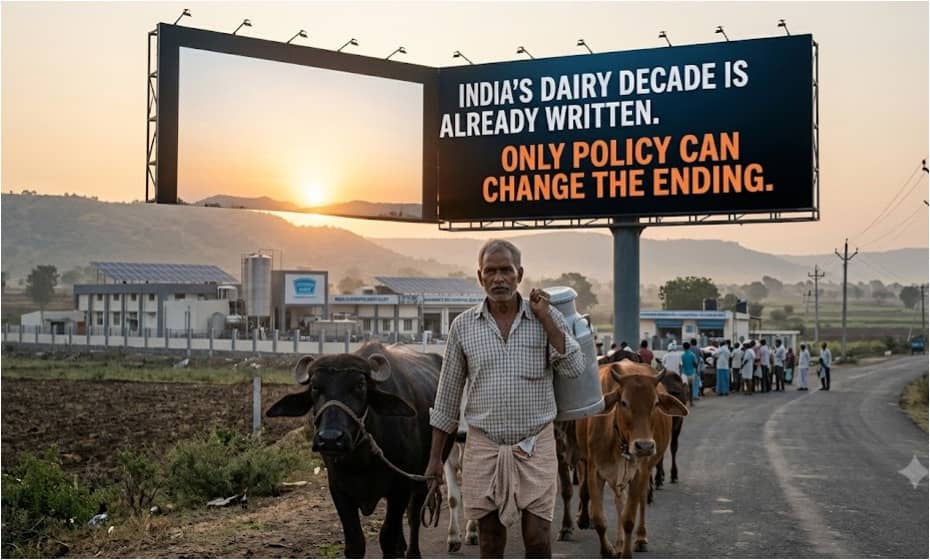
The milk is ours. The margin isn't. By 2035 nearly one litre in every three drawn anywhere on earth will be drawn in India, and the OECD-FAO Agricultural Outlook shows us capturing almost none of its value. The window to change that is this decade.
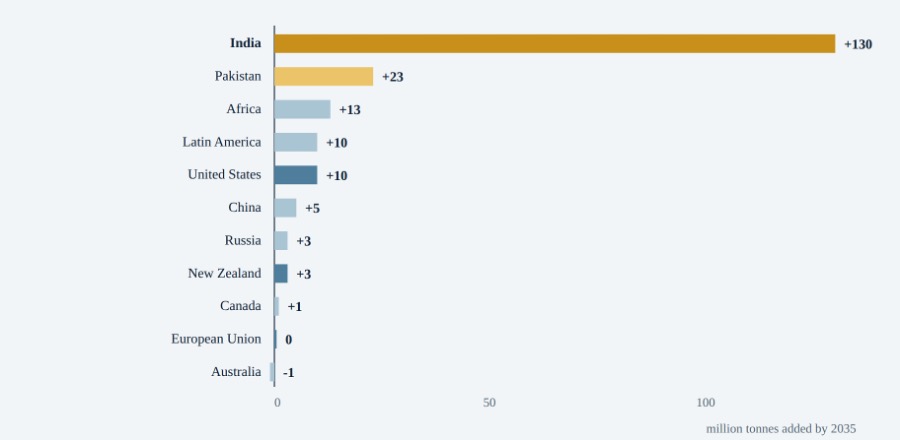 Change in milk production, 2023-25 base period to 2035, million tonnes
Source: OECD-FAO Agricultural Outlook 2026-2035, Figure 6.3. World milk production rises from 1,005 Mt in 2025 to a projected 1,223 Mt in 2035. Regional changes are derived from values read off the published chart and are approximate; the chapter text states that more than half of global growth comes from India.
Change in milk production, 2023-25 base period to 2035, million tonnes
Source: OECD-FAO Agricultural Outlook 2026-2035, Figure 6.3. World milk production rises from 1,005 Mt in 2025 to a projected 1,223 Mt in 2035. Regional changes are derived from values read off the published chart and are approximate; the chapter text states that more than half of global growth comes from India.
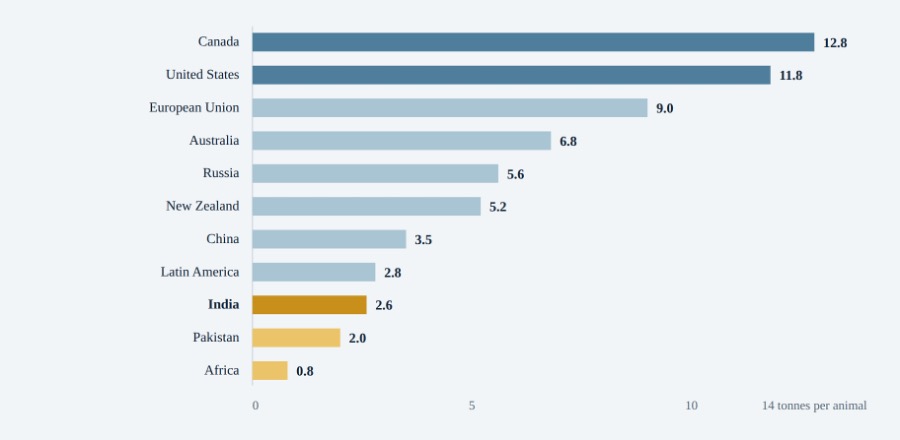 Milk yield per cow or buffalo, tonnes per animal, projected for 2035
Source: OECD-FAO Agricultural Outlook 2026-2035, Figure 6.3. Yield is calculated per cow or buffalo. Values are read from the published chart and are approximate.
Milk yield per cow or buffalo, tonnes per animal, projected for 2035
Source: OECD-FAO Agricultural Outlook 2026-2035, Figure 6.3. Yield is calculated per cow or buffalo. Values are read from the published chart and are approximate.
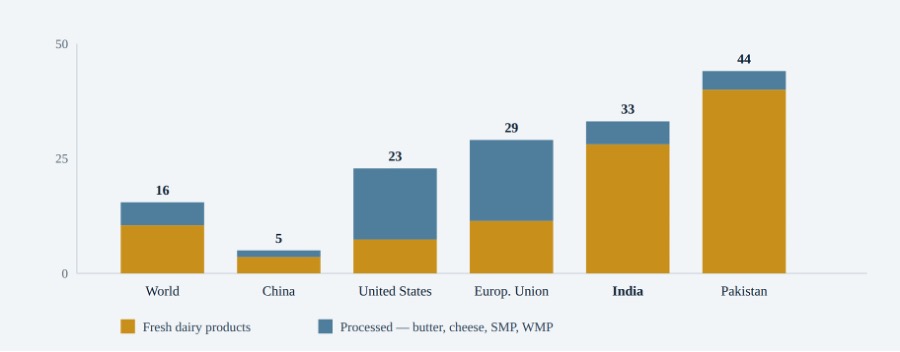 Per capita consumption of milk solids, kg per person, projected 2035
Source: OECD-FAO Agricultural Outlook 2026-2035, Figure 6.1. Milk solids are fat plus non-fat solids. India's 33 kg and Pakistan's 44 kg are stated in the chapter text; the fresh and processed split and other totals are read from the published chart and are approximate.
Per capita consumption of milk solids, kg per person, projected 2035
Source: OECD-FAO Agricultural Outlook 2026-2035, Figure 6.1. Milk solids are fat plus non-fat solids. India's 33 kg and Pakistan's 44 kg are stated in the chapter text; the fresh and processed split and other totals are read from the published chart and are approximate.
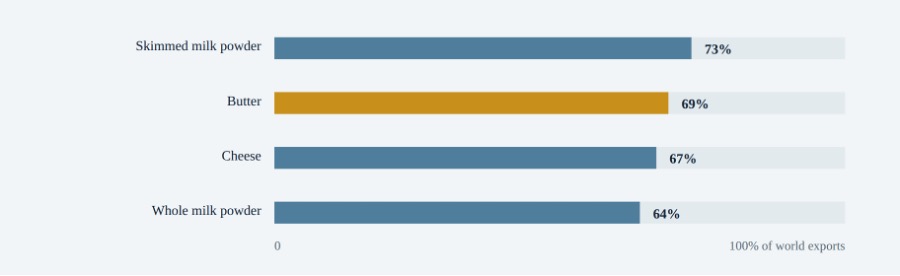 Projected share of world exports held jointly by the European Union, New Zealand and the United States
Source: OECD-FAO Agricultural Outlook 2026-2035, Chapter 6, projected 2035 export shares for the European Union, New Zealand and the United States combined.
We are entitled to read that exclusion two ways. The defensive reading is that we kept dairy out of both agreements and protected 80 million milk-producing households from powder dumped at world prices. That reading is legitimate and I have argued it myself. The other reading is that a sector confident of its cost structure does not need to be kept out of trade agreements. Protection buys time. The question the Outlook implicitly asks is what we are buying it for.
Projected share of world exports held jointly by the European Union, New Zealand and the United States
Source: OECD-FAO Agricultural Outlook 2026-2035, Chapter 6, projected 2035 export shares for the European Union, New Zealand and the United States combined.
We are entitled to read that exclusion two ways. The defensive reading is that we kept dairy out of both agreements and protected 80 million milk-producing households from powder dumped at world prices. That reading is legitimate and I have argued it myself. The other reading is that a sector confident of its cost structure does not need to be kept out of trade agreements. Protection buys time. The question the Outlook implicitly asks is what we are buying it for.
Kuldeep Sharma, Chief Editor, DairyNews7x7
Every year the OECD and FAO publish their ten-year Agricultural Outlook, and every year the Indian dairy trade press lifts one sentence out of the dairy chapter and runs with it. This year that sentence is a good one: more than half of the growth in world milk production over the coming decade is expected to come from India. It is worth being pleased about. It is also worth reading the other ten pages in the report and this article. Because when you sit with the whole chapter, a different argument emerges. India is projected to supply the world's additional milk while remaining almost entirely absent from the world's dairy trade. We will pour the volume. Someone else will book the margin. That is not a prediction the authors make explicitly — it is simply what their own numbers say when you put them side by side.The global frame first
World milk production reached 1,005 million tonnes in 2025, having grown 2.1% that year. The Outlook projects it to reach 1,223 million tonnes by 2035, growing at 2.0% a year — faster than most other major agricultural commodities. Of that total, 81% is cow milk, 16% buffalo milk, and 3% comes from goats, sheep and camels combined. Growth over the decade is expected to come principally from higher yields per animal rather than from bigger herds. Two structural facts govern everything else in the chapter. First, less than 7% of world milk production is traded internationally, because milk is perishable and more than 85% water. Second, only about a quarter of milk globally gets processed into butter, cheese, powders or whey — the rest is consumed fresh. Dairy is, and will remain, an overwhelmingly domestic business with a small, concentrated and volatile international layer sitting on top of it. One country accounts for most of the world's additional milk
Change in milk production, 2023-25 base period to 2035, million tonnes
Source: OECD-FAO Agricultural Outlook 2026-2035, Figure 6.3. World milk production rises from 1,005 Mt in 2025 to a projected 1,223 Mt in 2035. Regional changes are derived from values read off the published chart and are approximate; the chapter text states that more than half of global growth comes from India.
India carries the decade
India is already the world's largest milk producer, at 255 million tonnes in 2025, up 3% on the year. The chapter's own production chart puts India on a path from roughly 240 million tonnes in the 2023-25 base period to about 370 million tonnes by 2035. Pakistan, the other engine, moves from around 64 to 87 million tonnes. The European Union, the second-largest producer, flatlines at about 154 million tonnes with a shrinking herd. Australia declines. Set those two numbers against the world total and you get the figure that should be on the desk of every policymaker who touches this sector. India produced roughly 24% of the world's milk in the 2023-25 base period. By 2035 we are projected to produce close to 30% of it. Within a decade, very nearly one litre in every three drawn anywhere on earth will be drawn in India. No country has ever held that share of a global food commodity while remaining a negligible participant in its trade. That is the anomaly this chapter documents, and it is a policy anomaly before it is a commercial one. Also Read : White revolution 2.0- Expanding without diluting local institutions What is striking about India in the herd-and-yield scatter is that we are the only large producer expanding on both axes at once — roughly 2% a year more animals and roughly 2% a year more milk per animal. Everyone else is trading one against the other. The European Union is shedding cows to gain yield. The United States is holding its herd flat and growing entirely through productivity. Africa is adding animals with barely any yield gain. India alone is doing both, and the Outlook expects it to keep doing both for a decade. What the Outlook says about India, in its own numbers| Milk production, 2025 | 255 Mt (+3% y-o-y) |
| Projected production by 2035 | ~370 Mt |
| Share of world milk production growth to 2035 | more than half |
| Yield per cow or buffalo, 2023-25 to 2035 | ~2.1 to ~2.6 t |
| Per capita milk solids consumption by 2035 | 33 kg |
| Annual herd growth / yield growth, 2026-35 | ~2% / ~2% |
| Position in world dairy trade | self-sufficient, not integrated |
| Dairy in the NZ-India and EU-India FTAs | largely and wholly excluded |
The number that does not make the press release
Now the uncomfortable part. The same chart that shows India's magnificent production bar also plots yield per milking animal, and there India sits at roughly 2.1 tonnes today, rising to about 2.6 tonnes by 2035. Canada is at around 12 tonnes today. The United States is at about 11. The European Union is near 8. After a decade of the strongest yield growth of any major producer, India will still be delivering roughly a fifth of what a North American cow delivers. I have written for years that our productivity conversation is distorted by aggregate pride. Both things are true at once: India is the largest producer in the world, and India has among the lowest yields per animal in the world. The first is a function of an extraordinary number of animals in an extraordinary number of small holdings. The second is what determines cost per litre, feed conversion, emissions intensity, and ultimately whether Indian milk solids can ever compete on a landed-cost basis anywhere outside India. After a decade of the fastest yield growth among major producers, India still ends up near the bottom
Milk yield per cow or buffalo, tonnes per animal, projected for 2035
Source: OECD-FAO Agricultural Outlook 2026-2035, Figure 6.3. Yield is calculated per cow or buffalo. Values are read from the published chart and are approximate.
Where the value actually goes
This is the part of the chapter I would put in front of every dairy board in the country. The Outlook projects Indian per capita consumption of milk solids to reach 33 kg by 2035. That is higher than the European Union. It is substantially higher than the United States. By 2035 the average Indian will consume more dairy solids than the average European. And yet the composition chart shows almost all of it arriving as fresh dairy — liquid milk, dahi, lassi, paneer, chhena. The processed share, the butter and cheese and powders, stays a thin band at the top of our bar. In the European Union the proportions are close to inverted: a smaller total, but the majority of it processed. The Outlook says plainly that in low- and lower-middle-income countries most milk is consumed fresh and expects that preference to persist. We are on course to out-consume Europe in milk solids per head while capturing a fraction of the value per kilogram of those solids. Volume is not the problem. Form is. Fresh dairy is a low-margin, high-turnover, logistics-bound business. Processed dairy is where the branded margin, the shelf life, the export optionality and the industrial by-product value live. Every additional kilogram of milk solids we consume as loose milk rather than as cheese, whey protein or a functional ingredient is a kilogram on which the Indian dairy chain earns a distribution margin instead of a manufacturing one. Thirty-three kilograms per head is a magnificent nutrition achievement. It is a mediocre industrial one. India will consume more milk solids per head than the EU — and process far less of it
Per capita consumption of milk solids, kg per person, projected 2035
Source: OECD-FAO Agricultural Outlook 2026-2035, Figure 6.1. Milk solids are fat plus non-fat solids. India's 33 kg and Pakistan's 44 kg are stated in the chapter text; the fresh and processed split and other totals are read from the published chart and are approximate.
The seventy per cent club, and why we are not in it
World dairy trade is projected to reach 13.7 million tonnes by 2035, 11% above the base period. Three exporters — the European Union, New Zealand and the United States — are projected to take about 69% of butter, 73% of skimmed milk powder, 67% of cheese and 64% of whole milk powder. New Zealand alone is expected to hold roughly 41% of butter and 56% of whole milk powder exports. This is a concentrated oligopoly, and it is being reinforced, not eroded, over the decade. The Outlook is explicit about where India sits. India and Pakistan, it says, are not expected to integrate into the international dairy market, because domestic production will expand fast enough to meet domestic demand. It then notes two things that ought to sting: the New Zealand-India free trade agreement concluded in 2025 phases out tariffs on infant formula but largely excludes dairy, and the EU-India agreement concluded in 2026 excludes dairy altogether. Three exporters will still control most of the world's dairy trade in 2035
Projected share of world exports held jointly by the European Union, New Zealand and the United States
Source: OECD-FAO Agricultural Outlook 2026-2035, Chapter 6, projected 2035 export shares for the European Union, New Zealand and the United States combined.
We are entitled to read that exclusion two ways. The defensive reading is that we kept dairy out of both agreements and protected 80 million milk-producing households from powder dumped at world prices. That reading is legitimate and I have argued it myself. The other reading is that a sector confident of its cost structure does not need to be kept out of trade agreements. Protection buys time. The question the Outlook implicitly asks is what we are buying it for.