Milk Fat Shortage: The 4 Lakh Tonnes India Missed With Its Buffaloes
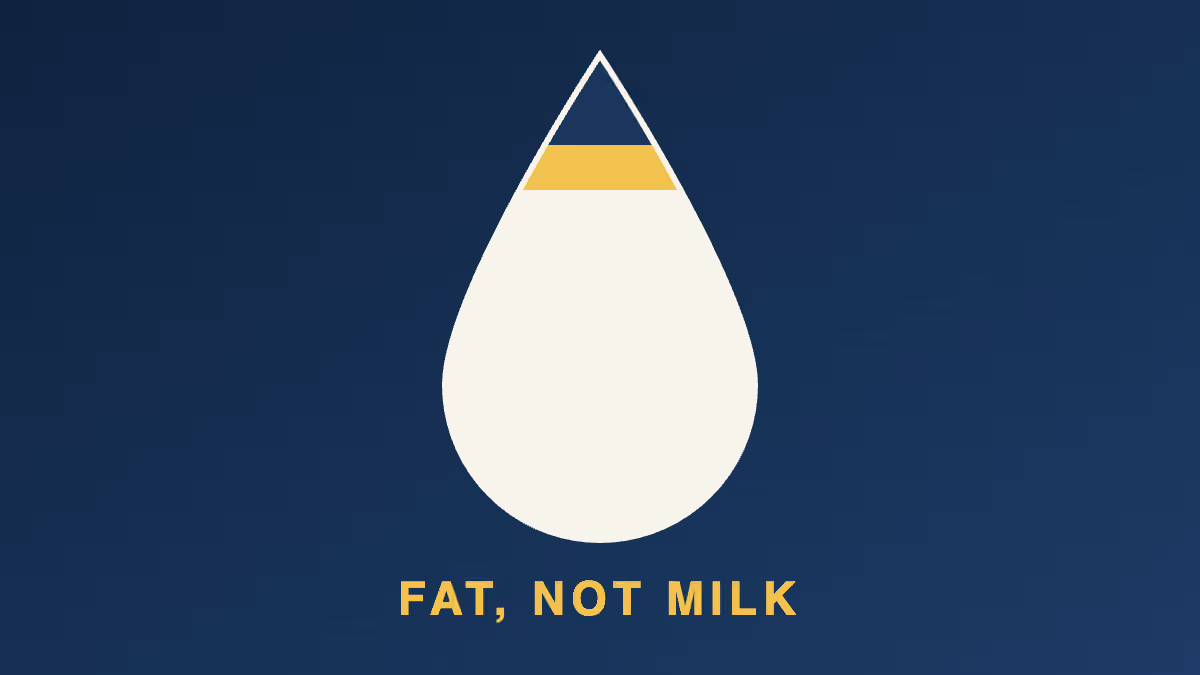
India is not short of milk. It is short of fat. Read USDA's latest India dairy report against BAHS 2025 and the 20th Livestock Census, and the numbers say the same thing.
By Kuldeep Sharma, Chief Editor, DairyNews7x7
Washington says India will produce 226.5 million tonnes of milk in 2027. New Delhi says India had already produced 247.87 million tonnes in 2024-25. Those two numbers will never shake hands.
Read USDA's Dairy and Products Annual (IN2026-0055, 28 October 2026) next to DAHD's Basic Animal Husbandry Statistics 2025 and the 20th Livestock Census, though, and both lead to a conclusion neither states. India's real crisis is a milk fat shortage, not a milk shortage.
Butter is at record prices, ghee is vanishing from shelves in Gujarat during the festive season, and SMP, the product that sank farmer prices two years ago, is only edging up. Three forces have met at once: a herd quietly shifting from buffalo to cow, an enforcement drive that has removed SMP-and-palm-oil imitations, and a drought year that leaves no slack.
Milk fat shortage: what the USDA report says
USDA expects El Niño to slow 2027 milk growth to 2%, taking output to 226.5 MMT, with butter (in effect the butter-ghee fat complex) at 7.6 MMT and SMP at 8.1 lakh tonnes. Between January and August 2026, average prices rose about 4% for milk, 8% for SMP (₹280/kg in August) and 10% for butter. Butter reached ₹515/kg in August, and USDA expects it to break the October 2025 record of ₹530/kg.
The trade chapter repeats Washington's familiar complaint about 30–60% duties, a restrictive veterinary certificate, and TRQs (10,000 t of powder, 15,000 t of butter and milk fat) that only NDDB, NCDF and NAFED can use. What is more useful is what USDA's balance sheets reveal about us.
Washington doubts our cow, not our buffalo
| Species | USDA CY2025 (MMT) | BAHS 2024-25 (MMT) | Gap |
|---|---|---|---|
| Cow milk | 103.2 | 132.7 (53.53%) | ~29.5 |
| Buffalo + goat | 113.3 | 115.2 (46.47%) | ~1.9 |
| Total | 216.5 | 247.87 | ~31.4 |
Calendar and fiscal years differ, so read this as a direction rather than a reconciliation. Still, USDA accepts our buffalo milk almost to the tonne and does not believe roughly 30 million tonnes of our cow milk.
The sharper line is USDA's own footnote: there are no reliable sources of government or published industry estimates on production of various processed dairy products. That indicts us, not USDA. We publish milk by species, state and breed to the decimal, but no national balance sheet for butter, ghee, SMP or paneer, and no fat-and-SNF account. When we do not write our own product balance sheet, Washington writes it for us.
Stocks: the data gap behind the milk fat shortage
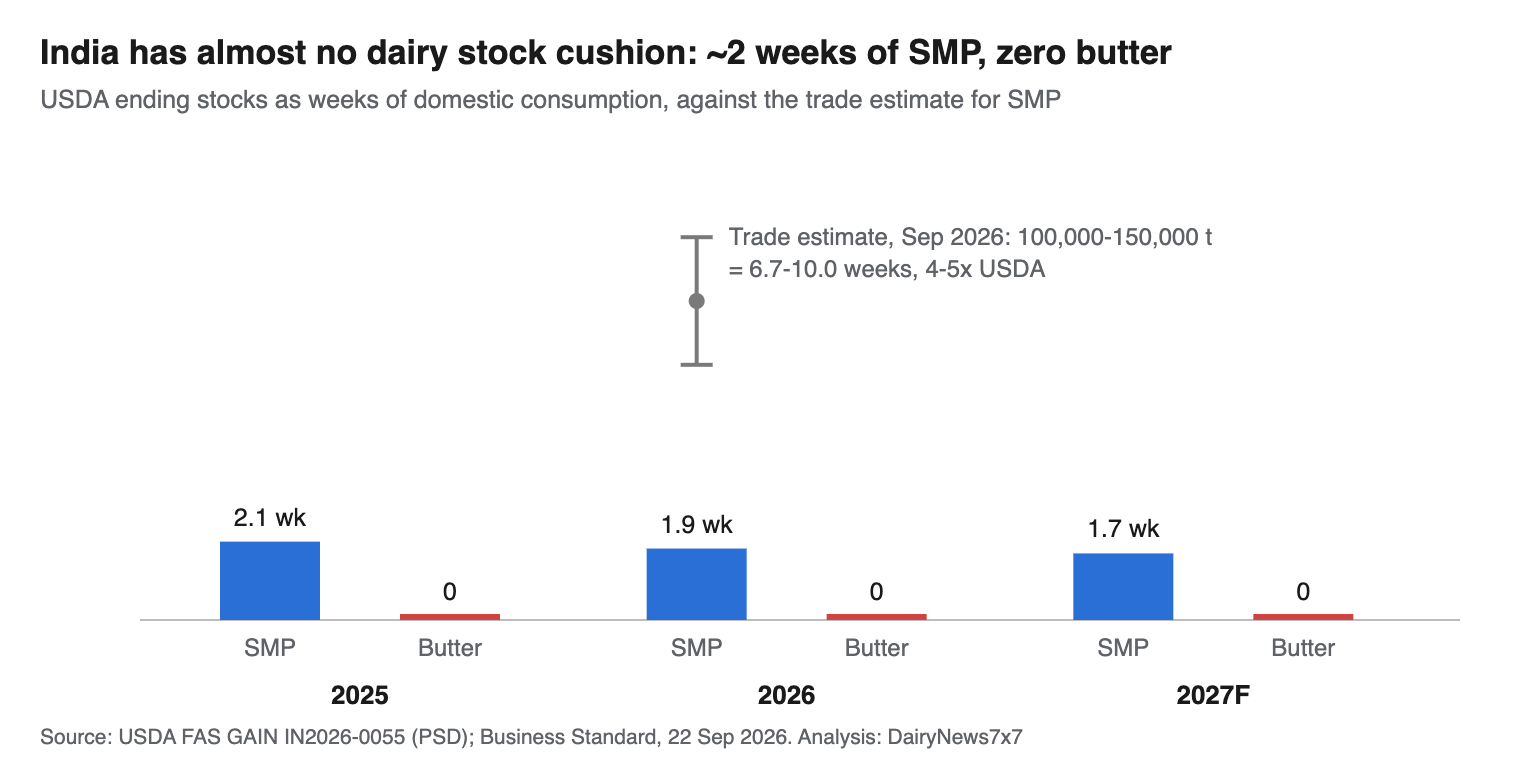
SMP. USDA puts ending stocks at 28,000 t for 2026 and 27,000 t for 2027, less than two weeks of consumption. The trade estimates 1–1.5 lakh tonnes. That is a four- to five-fold gap on the one number that decides whether we export, hold or import.
I have asked for this number for three years. In Diwali se Diwali tak (November 2023), the industry was sitting on an estimated 1.75–2 lakh tonnes of SMP and about 1 lakh tonnes of butterfat. At a minimum loss of ₹50 a kg on that stockholding, the damage came to about ₹1,400–1,500 crore: ₹875–1,000 crore on SMP and about ₹500 crore on butterfat. I called for a market-information platform for dairy. In March 2025 I proposed a National Dairy Data Centre, and last month in After the Lamps a monthly public stock register. In 2023 the blind spot cost us a glut. In 2026 it risks a shortage.
Butter. Last year's USDA annual (IN2025-0057) forecast 2026 butter ending stocks of 45,000 t. This year the line reads zero for 2026 and 2027. The market agrees:
- Domestic butter was about ₹540/kg in September, roughly 20% up on a year earlier.
- Amul raised MRPs from 2 October: 1 kg ghee from ₹630 to ₹680, 500 g butter from ₹310 to ₹325. Cow ghee ran short in Gujarat.
- KMF raised Nandini milk by ₹8/litre from 1 November, followed by ghee, butter and paneer. Aavin revised prices from 28 October.
- Cow milk procurement was about ₹42/litre in September, around 30% above last year, with buffalo milk up by a similar margin.
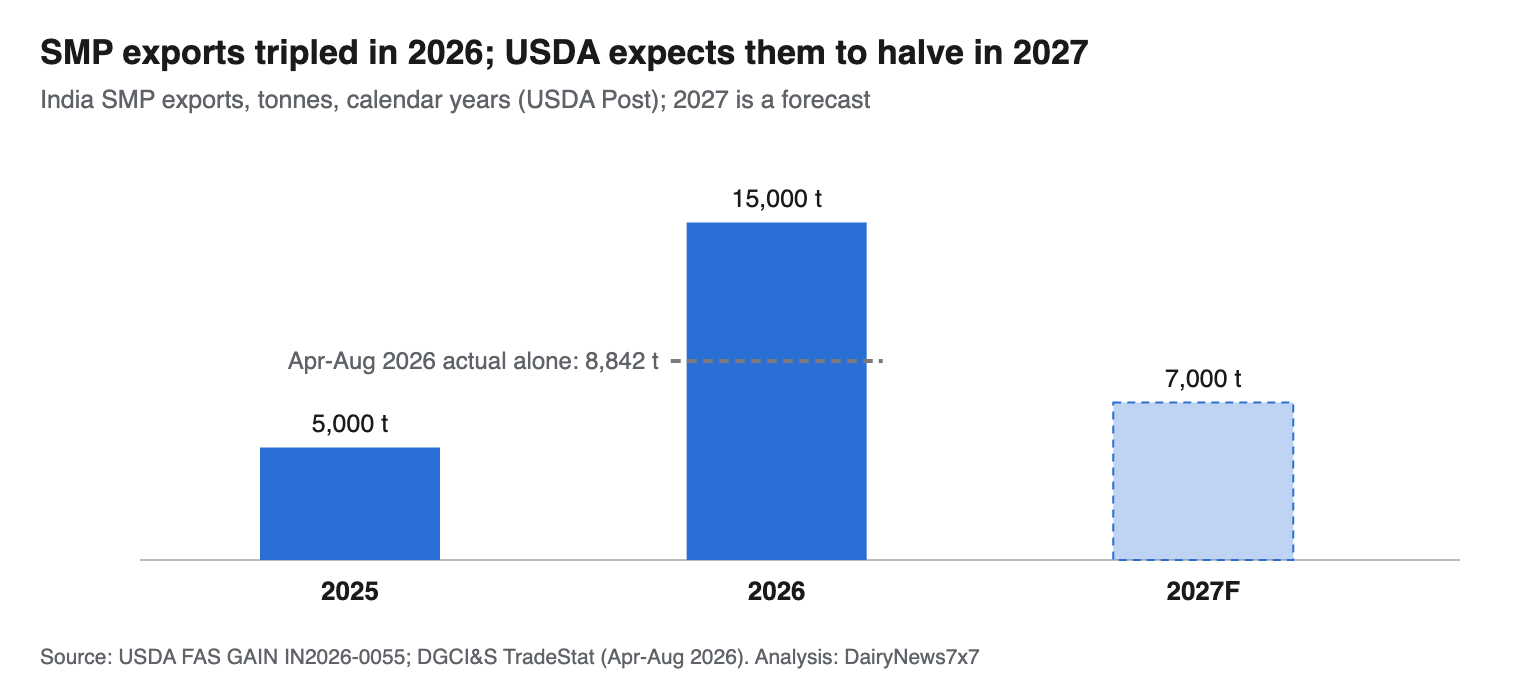
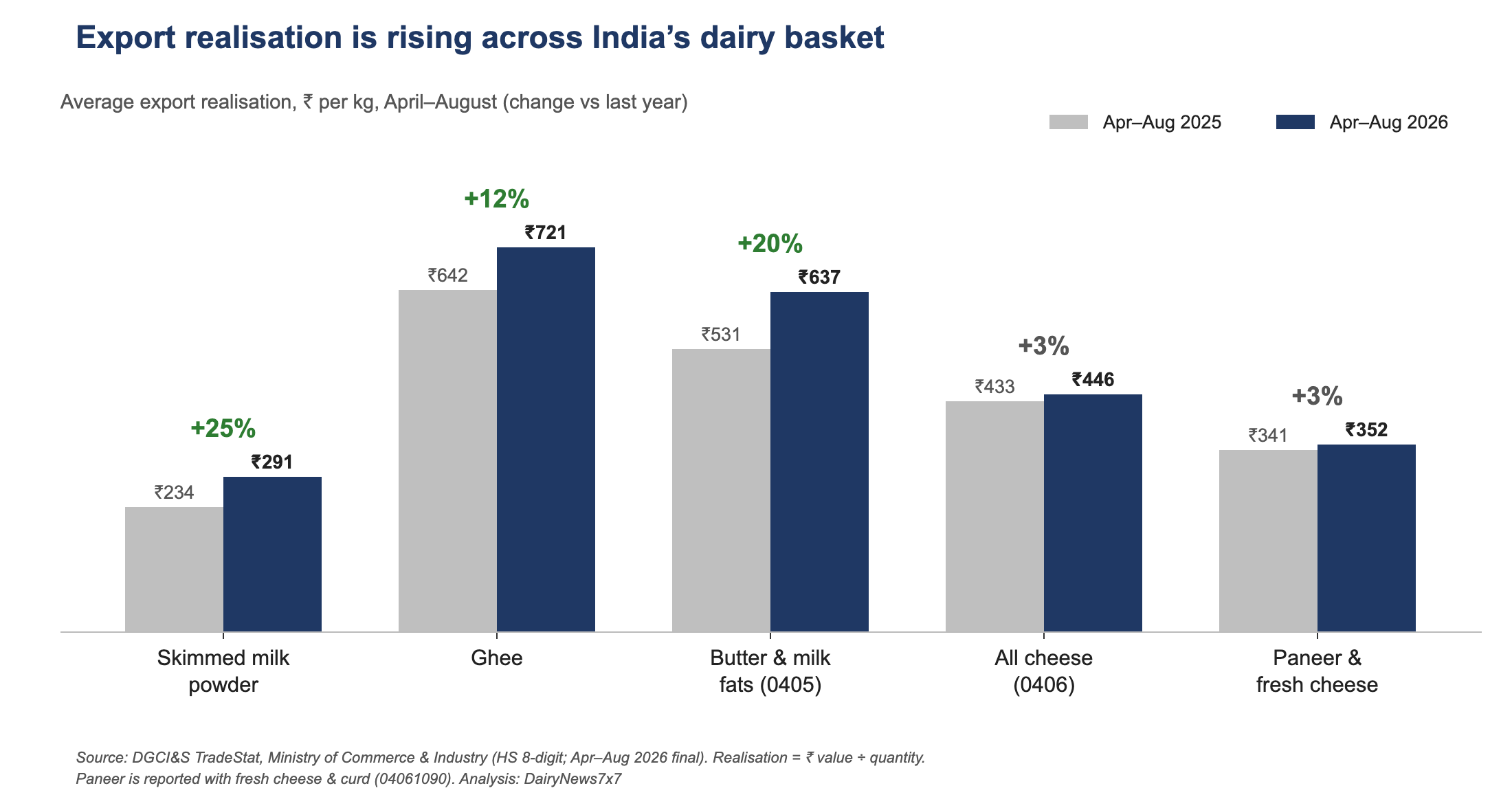
Exports. Globally it is skim that is scarce. GDT SMP reached $4,109/t on 3 November, the highest since June 2022, and EU SMP is up about 59% year-on-year. Indian exporters have responded: SMP exports nearly quadrupled to 8,842 t between April and August, earning more than all our cheese exports combined. USDA nonetheless expects exports to halve to 7,000 t in 2027 as the drought eats into lean-season powder. That caution is right. The export window should open against a national stock trigger, not blindly.
The buffalo arithmetic behind India's milk fat shortage
In 2018-19 buffaloes produced 91.8 MMT and cattle 89.8 MMT. By 2024-25, buffalo (indigenous 31.18% plus non-descript 11.97%) had fallen to 43.15%, about 107 MMT, while cattle had risen to 53.53%, about 132.7 MMT. Over six years buffalo milk grew 16% and cow milk 48%. The 20th Livestock Census foreshadowed this: buffaloes rose just 1.06% over 2012 to 109.85 million, while crossbred cattle rose about 29% to 51.4 million and indigenous cattle fell about 6%.
The trade in spent animals is speeding up the shift. As I wrote in October in Buffalo Meat Exports Are Now Pricing India's Milk, buffalo-meat exports earned $5.1 billion in FY2025-26, up 25.6%. A culled buffalo fetches about ₹50,000 against ₹1.5 lakh for a good replacement, and USDA sees slaughter rising from 41.6 to 44.2 million head by 2027. In December 2024 I warned that the 21st Census could show buffaloes below 100 million. We still do not know. Enumeration closed in early 2025, the results are held up by technical issues, and Punjab's preliminary count alone shows 5.22 lakh fewer buffaloes. We are debating a milk fat shortage without knowing how many buffaloes India has.
Why does this matter for ghee? Buffalo milk carries 7–8% fat, against roughly 4% for a crossbred cow.
- On the 2024-25 species mix, India's average milk fat works out to about 5.4%.
- On the 2018-19 mix, the same 247.87 MMT would carry about 5.6%.
- The difference is about 3–5 lakh tonnes of milk fat a year, with a central estimate of 4 lakh tonnes (close to 4 lakh tonnes of ghee equivalent), depending on the fat levels assumed.
Method: species shares from BAHS 2019 and 2025; central case assumes fat at 7.0% for buffalo, 4.2% for cattle and 4.5% for goat. With buffalo at 6.5–7.5% and cattle at 3.8–4.5%, the gap ranges from about 2.9 to 5.3 lakh tonnes. DAHD publishes no national fat average, so these are indicative assumptions; the point is the order of magnitude.
To be precise, India's total milk-fat pool still grew, from roughly 10.5 MMT in 2018-19 to about 13.4 MMT in 2024-25. The 4 lakh tonnes is a shortfall against the old herd mix: the fat India would have had this year if buffaloes still gave the same share of its milk. With demand for ghee, paneer and mawa rising faster than that, the shortfall is what we feel on the shelf.
Even the low end of that range is about 20 times the 15,000 t butter-and-fat TRQ that USDA wants opened, a quota worth about 0.2% of our butter output. Imports cannot fix this.
Cow milk also carries more SNF per kilo of fat. A herd tilting towards cows therefore produces a skim surplus and a fat deficit together. The 2023-24 SMP glut and the 2025-26 fat squeeze are not two crises. They are one herd composition seen from two sides.
The crossbred shift did lift productivity: 8.95 kg/day for crossbred cows against 6.92 kg/day for indigenous buffalo. I am not arguing for reversing it. But a country whose dairy culture runs on ghee, mawa and paneer cannot plan its herd in litres alone.
FSSAI's analogue crackdown deepens the milk fat shortage
- April: FSSAI's Western Region ruled that selling cheese analogue as paneer is a serious violation.
- August: Chhattisgarh (1 August), Maharashtra, Gujarat and Madhya Pradesh (13 August) banned analogue paneer. MP estimated its consumption at 9,000–12,000 quintals a month. Uttar Pradesh banned analogue paneer, ghee, khoya, cream and chhena outright.
- Festive season: FSSAI inspected 56,431 establishments, seized 3,279.57 t of non-compliant food worth ₹81.80 crore, suspended 1,133 licences and sealed 314 premises. Delhi seized more than 8,800 litres of adulterated ghee in a month, and Meerut destroyed about 2,500 kg of mawa.
The crackdown is right. FSSAI's credibility rests on enforcement, not circulars. But analogue paneer, synthetic mawa and spurious ghee ran on cheap SMP and cheap vegetable fat. Take them off the market and two things happen at once:
- SMP loses a quiet buyer. That is one reason domestic powder is barely moving while world skim prices sit at four-year highs.
- Fat demand jumps. Genuine paneer carries roughly 25% milk fat. Replacing MP's 900–1,200 t a month of analogue paneer alone needs 225–300 t of milk fat a month, or 2,700–3,600 t a year, in one state.
Parag Milk Foods' COO has warned of a milk demand-supply gap, and the company is investing about ₹100 crore in 60 t/day of new paneer capacity. Nobody has measured how much SMP the analogue trade absorbed. It is one more number we do not collect.
What should be done
- Release the 21st Livestock Census now, with species, sex and age structure. Policy for 2027 cannot run on a 2019 headcount.
- Build the national stock register. Publish SMP, butter and ghee stocks monthly, and add a fat-and-SNF balance sheet with product-wise estimates to BAHS.
- Give buffalo its own mission. Murrah, Mehsana, Jaffarabadi and Banni need Gokul-scale money for progeny testing, sexed semen and IVF, and productive young females should stay in the dairy herd.
- Export skim through a calibrated window tied to the stock trigger, alongside protein valorisation through MPCs, fortification and school milk.
- Pair enforcement with honest labelling. An analogue named as an analogue, under its own standard, moves the trade into the open. Blanket bans risk driving it underground.
- Stop treating imports as the fat solution. A 15,000 t quota cannot fill a milk fat shortage measured in lakhs of tonnes. Only the herd can.
Washington counts India's milk in litres, and too often so do we. The 2026 season is telling us the unit that matters now is the kilogram of fat. The sooner our statistics, breeding policy and food-safety enforcement count in that unit, the sooner the ghee shelf in Ahmedabad stops going empty in the week before Diwali.
Source: Editorial by Kuldeep Sharma, Chief Editor | DairyNews7x7
References
- USDA FAS GAIN: Dairy and Products Annual, India, IN2026-0055
- DAHD: Basic Animal Husbandry Statistics 2025
- PIB: 20th Livestock Census key results
- Business Standard: Milk prices may stay elevated during the flush season
- Business Today: Amul and Nandini raise ghee and butter prices
- UkrAgroConsult: Global SMP prices hit highest level since 2022
- NewsBytes: FSSAI festive enforcement drive
- Tribune: Punjab preliminary livestock census
Never miss an important dairy update
Follow DairyNews7x7 on Google to get live milk prices, policy alerts, and daily headlines directly in your feed.