Sandeep Aggarwal on Pure Ghee: The Inspiring Diwali the Honest Dairyman Waited 40 Years For
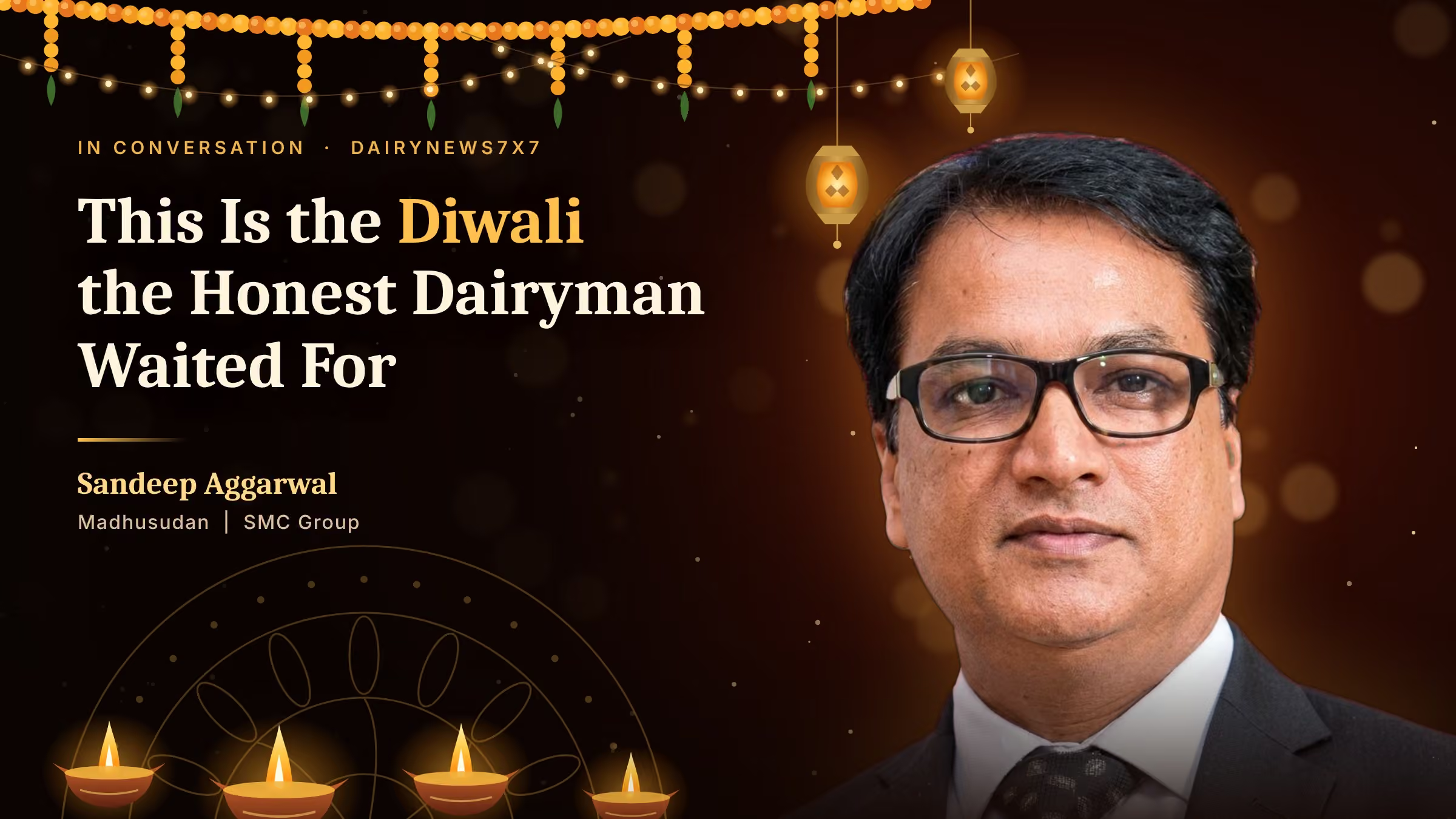
Sandeep Aggarwal of Madhusudan on purity, the regulator, the farmer with four buffaloes, and why he bought a GC machine before anyone asked him to
By Kuldeep Sharma, Chief Editor, DairyNews7x7
There is a peculiar silence in the Indian dairy trade this festive season.
Sampling vans are out in force. FSSAI and the State Food Safety Commissioners are drawing festive samples at a scale I have not seen in four decades. Several states have stopped the sale of dairy analogues until the season is over. Ask any dairy owner how business is, and you get a shrug and a change of subject.
I expected to hear the same in my conversation with Sandeep Aggarwal. Madhusudan, the flagship brand of the Saharanpur-based SMC Group, has been selling milk and ghee for over three decades. It handles about 45 lakh litres of milk a day from more than three lakh farmers. If this crackdown hurts dairy, it should hurt Madhusudan.
Instead, within ten minutes, he had turned my question upside down.
I spoke with Sandeep Aggarwal ji a few days before Diwali. What began as a festive greeting turned into a serious conversation on the changing face of Indian dairying.
"The industry has read this moment backwards"
Kuldeep: Sandeep ji, the trade is nervous. Sampling vans everywhere, analogues banned in several states, and Diwali just a few days away. Most of your peers call it a crisis. Are they wrong?
Sandeep Aggarwal: They are not wrong to feel uneasy, Kuldeep ji. Nobody likes a sampling van at the gate in the busiest week of the year. But look carefully at what is being disrupted.
No one is stopping the supply of milk. No one is stopping ghee being made from cream. What is being stopped is the parallel market — material that reaches the mandi at a fraction of our cost and takes the sweet shop order and the hotel contract that should have gone to genuine dairy.
For as long as I have been in this business, the honest manufacturer has competed against a price he cannot legally reach. Every Diwali we lost volume, not to a better product, but to a cheaper lie. This year that lie is off the shelf, right when it does the most damage. How can I call that a crisis?
"Every Diwali we lost volume, not to a better product, but to a cheaper lie."
Kuldeep: Still, it is unusual to hear a dairy owner speak warmly of a regulator that is suspending dairy licences.
Sandeep Aggarwal: (smiles) I am not cheering anyone's licence being suspended. I am welcoming the fact that food safety in dairy is finally being enforced and not just written down.
Our industry has a short memory. For decades every honest dairyman said the same thing: we have the FSS Act, we have standards for every product, and still synthetic milk is sold from a tanker in a district town and nothing happens. We wrote letters. We sat on committees.
Now something is happening. That is not a crisis for dairy. That is dairy getting what it asked for. I would say to FSSAI and the state commissioners: thank you. Keep it firm, keep it fair, and keep it predictable. An honest manufacturer has nothing to fear from that, and Madhusudan's plants and laboratories are open to them any day.
I pushed him on one point. Enforcement at this pace, I said, sometimes catches honest operators in its net. He was careful.
Sandeep Aggarwal: Every system improves as it is used. Where there is anxiety among food business operators, it is rarely about being sampled. It is about clarity — how long a report takes, what happens next. I am confident the authorities are already working on this. The more predictable the process, the stronger it becomes. That is in everybody's interest, the regulator's most of all.
Kuldeep: Let me take you to the village. What does the fake market cost the farmer with four buffaloes?
This is where his voice changed. He leaned in.
Sandeep Aggarwal: This is the part of the conversation our industry has least, and it is the part I care about most.
Fat is the farmer's price. His payment is written largely on fat, and the value of that fat is set by what the market pays for ghee, butter and cream. When a vegetable-fat product sits where milk fat should have been, it does not just steal one sale. It takes demand out of the fat pool, and a weak fat pool pays the farmer less.
One kilogram of ghee needs roughly 15–18 litres of buffalo milk, or about 25 litres of cow milk. One kilogram of paneer needs about 5-6 litres. Every kilogram of counterfeit that moves is milk that was never bought from a farmer. Multiply that across a festive season and across India, and a huge amount of milk demand simply disappears — exactly when the farmer should be earning his best price of the year.
So when someone tells me this drive is bad for dairy, I ask: bad for whom? It is very good for the man with four buffaloes. And he is the industry. Everything else we do comes after him.
"It is very good for the man with four buffaloes. And he is the industry."
"The analogue is not the crime. Passing it off is."
Kuldeep: Analogues are a legal category. FSSAI has standards for them. Is it fair to stop the sale of a lawful product?
Sandeep Aggarwal: This is the question our industry should debate openly. Instead, it whispers.
I have no quarrel with the analogue as a category. A vegetable-fat product, properly made, properly labelled and honestly priced, has its place — in certain price segments, in industrial use, in some export markets.
The problem starts four steps down the line. The analogue leaves the factory in a labelled bag, with an invoice. Somewhere between the distributor and the plate, the label is thrown away and it is sold as paneer. Not analogue paneer. Paneer.
Our labelling law protects a package. But most festive dairy in India is sold loose — at a sweet shop counter, on a caterer's tray. So I see these time-bound state orders as a sensible step for the season, while the trade builds better tools for that last mile: distinctive packing, bold declarations, counter and menu disclosure, and an invoice trail that survives till the plate. If the analogue makers do this, they protect themselves too.
Kuldeep: And your message to hotels, restaurants and caterers, who have been big buyers of this material?
Sandeep Aggarwal: Do the arithmetic honestly. On one plate of paneer, the saving from substitution is a few rupees. Against that, you are risking your licence and your name. That is not a margin strategy, Kuldeep ji. That is a gamble.
And there is an upside nobody talks about. At Diwali, people are buying food for their families, their guests and their gods. Purity is the whole point. A restaurant that writes "made with pure milk paneer" on the menu and can show the invoice is not adding cost. It is winning trust.
"On one plate of paneer, the saving is a few rupees. Against that, you are risking your licence and your name."
Kuldeep: Isn't it a hard ask, telling households to pay more when budgets are tight?
He laughed. "I knew you would ask me that."
Sandeep Aggarwal: I don't want to sound like a ghee seller telling people to buy expensive ghee. So I'll keep it simple. I am not asking anyone to change their budget. I am asking them to change one question.
Today the question at the counter is "what is the rate?" I am asking that it also become "what is it made of?" That question is free.
This is food for elderly parents, for children, for the temple. If there is one purchase in the Indian year where certainty is worth more than a discount, it is this one. And behind every litre of genuine milk is a family that milked twice a day, every day, including Diwali day. A fair price for genuine ghee is how that money reaches them.
"Not only 'what is the rate?' but 'what is it made of?' That question is free."
"We bought the GC machine before anyone asked us to"
Kuldeep: Every brand says its ghee is pure. Why should a consumer believe Madhusudan?
Sandeep Aggarwal: Because we can show it, not just say it.
Three to four years ago, when hardly anyone in the industry was talking about it, we brought in gas chromatography for our ghee. It was an apt decision taken up by my uncle Chandra Prakash Agarwal ji at a time when no one in private sector was thinking about it. People asked me why. It was not a requirement for us then, and it was a serious investment.
My answer was simple. A GC test reads the fatty-acid fingerprint of the ghee. It tells you whether anything other than milk fat has gone in — vegetable oil, animal body fat, anything. The usual tests on a certificate can be managed. The fingerprint cannot. If we were going to tell a mother that our ghee is pure, I wanted the science to back it up.
Today, when families across India ask for GC-tested ghee, and #GheeKaSach trends on social media, I feel we were right to go early. Not because we were clever, but because the consumer deserved it.
Alongside that, every batch goes through up to 36 checks at different stages before it leaves our plants. And our ghee comes from milk we collect ourselves, from farmers we know by name.
"The usual tests on a certificate can be managed. The fingerprint cannot."
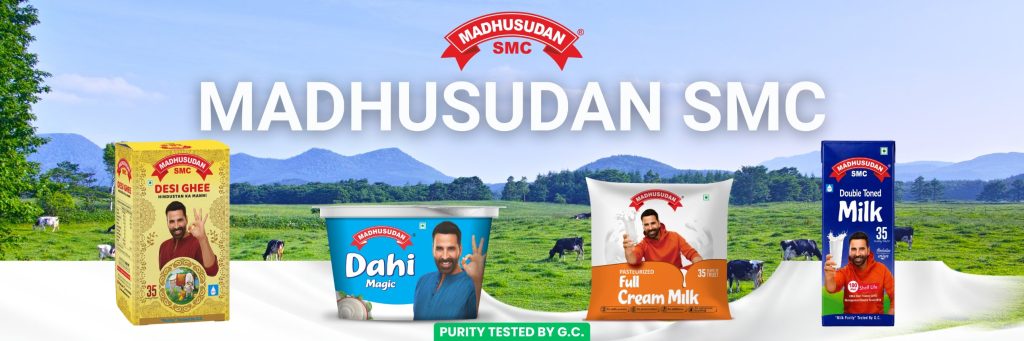
Sandeep Aggarwal on building Madhusudan, one village at a time
Kuldeep: Madhusudan began as a Saharanpur dairy. Today it is a name families recognise across India. How did that happen?
Sandeep Aggarwal: It started with our founder, the late Shri Sewa Ram Aggarwal ji. He taught us that in food you can lose money and recover it, but if you lose trust, you never get it back. Madhusudan began in 1992 with that one principle.
The rest was patience. Building the milk collection network village by village — today about 11,000 village societies and 70 chilling centres. Building plants at Nanauta and Khurja, and now Bareilly. Then taking the brand to 19 states and more than two lakh shops, one distributor at a time.
He spoke of the company, never of himself. So let me fill that gap from what I have seen.
Over the years I have watched Sandeep ji emerge as a market maven in the ghee trade. This is a market where traditional players have operated for more than half a century, and many of them now watch his moves closely and follow his strategies. In trade circles, his reading of market movements is spoken of with respect. So is his insistence on product quality, and his discipline on timely delivery and availability for his channel partners. Over time, Sandeep Aggarwal has become a name to reckon with in Indian ghee, and in many seasons the price leader the rest of the market looks to.
When I put this to him, he waved it away.
Sandeep Aggarwal: A household name is not built through advertising, Kuldeep ji. It is built when a mother buys the same ghee for twenty years and never once has to doubt it.
"We are standing on a level field, complaining about the weather"
Kuldeep: Last question. What would you say to the dairy fraternity this Diwali?
He paused for a long moment before answering.
Sandeep Aggarwal: For forty years we asked for a level field. It has arrived at an inconvenient time, and we are standing on it complaining about the weather.
The counterfeit is off the shelf. The consumer is asking the right question. The regulator is enforcing the law we all wanted enforced. Everything we said we needed is here at once.
So let us not use this moment to raise prices. Let us use it to earn a customer for life. Let us pass a fair share of this season's gain back to the farmer — Madhusudan will, and I hope every processor says so publicly. And let us test ourselves before anyone tests us.
To every farmer, every worker in our plants and on our milk routes, every distributor and shopkeeper, every officer who protects the consumer, and every family that trusts us with their festival — my heartfelt wishes for a happy, healthy and prosperous Diwali. May every diya burn with pure ghee.
Shubh Deepavali.
"For forty years we asked for a level field. It has arrived, and we are standing on it complaining about the weather."
I have heard many dairy owners speak about purity. Fewer have put money into proving it before the market demanded it. Whatever one's view of this season's enforcement drive, Sandeep Aggarwal's message is one the whole trade can sign: the honest story finally has clear air this Diwali. If we do not tell it now, we may not get a better chance.
Wishing all our readers a very Happy Diwali.
— Kuldeep Sharma, Chief Editor, DairyNews7x7
Kuldeep Sharma is Chief Editor of DairyNews7x7 and founder of Suruchi Consultants, with nearly four decades in the Indian dairy industry.
Source: DairyNews7x7 07 Nov, 2026
#SandeepAggarwal #Madhusudan #PureGhee #Diwali2026 #GheeKaSach #FoodSafety #IndianDairy #DairyNews7x7
Never miss an important dairy update
Follow DairyNews7x7 on Google to get live milk prices, policy alerts, and daily headlines directly in your feed.