Did People in Finland Put Live Frogs in Milk to Keep It Fresh? The Science Behind the Unusual Tradition
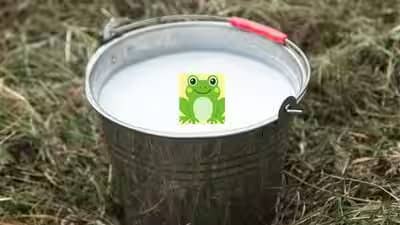
Imagine trying to preserve fresh milk by placing a live frog inside the container. It sounds unbelievable today, but historical accounts describe this unusual practice in rural parts of Finland and Russia, long before modern refrigeration became widely available.
The tradition has attracted renewed attention following a report by The Times of India exploring the possible scientific connection between frog-skin secretions and antimicrobial activity.
While the practice may sound like an example of unconventional food preservation, the science requires an important distinction: certain compounds produced by amphibian skin can inhibit microorganisms under laboratory conditions, but that does not establish that placing a frog in milk is safe or effective by modern food safety standards.
Why Did People Put Frogs in Milk?
Before refrigeration was widely accessible, keeping fresh milk from spoiling was a significant challenge for farming communities.
Milk is highly perishable, and microbial growth can accelerate when it is kept at unsuitable temperatures or handled under unhygienic conditions.
Historical accounts describe communities in parts of Finland and Russia placing live brown frogs in milk containers in the belief that this could delay souring.
A 2013 paper examining traditional Sami healing practices, documented by Johan Turi, also refers to reports of this custom.
Although the exact effectiveness of the historical practice remains uncertain, the tradition has prompted scientific interest in the natural defence mechanisms of amphibians.
The Science: Antimicrobial Compounds in Frog Skin
Frog skin does more than provide a protective outer covering. It can produce secretions containing biologically active compounds, including antimicrobial peptides.
Research on certain amphibian species has identified peptides with activity against particular bacteria and fungi in laboratory experiments.
Studies involving the Russian brown frog have also investigated skin-derived peptides and their potential antibacterial properties.
These findings offer a scientific explanation for why researchers have explored a possible connection between the historical tradition and natural antimicrobial substances.
However, three points are essential:
- Laboratory activity is not the same as proven food preservation. A compound that inhibits bacteria under controlled conditions may behave differently in milk.
- Results vary by species and compound. Not all frogs produce the same secretions or have the same antimicrobial effects.
- A live frog is not a validated food-preservation method. Introducing an animal into milk can create contamination risks, and the historical practice should not be replicated.
The research is scientifically interesting, but it does not establish that the traditional method reliably made milk safe to consume.
Why This Matters for the Dairy Industry
The story illustrates how observations from traditional practices can inspire scientific questions. It also demonstrates why food preservation must be evaluated through controlled research rather than folklore alone.
For today's dairy industry, safe milk handling depends on established and validated procedures, including:
1. Hygienic milk collection
Clean equipment, sanitary milking practices and contamination control help reduce the introduction of unwanted microorganisms.
2. Appropriate heat treatment
Pasteurisation and other validated heat-treatment processes are designed to control relevant pathogens when properly applied.
3. Temperature management
Rapid cooling and maintenance of the required cold chain help slow microbial growth and preserve milk quality.
4. Microbiological testing
Appropriate testing and quality-control systems help verify compliance with applicable food safety requirements.
5. Scientific validation
Any proposed preservation technology must be assessed for safety, effectiveness, regulatory acceptability and suitability for commercial dairy operations.
From Traditional Knowledge to Modern Food Science
The frog-in-milk story is a reminder that unusual historical practices can lead to legitimate scientific questions. Natural antimicrobial compounds are of interest to researchers investigating potential applications in medicine, biotechnology and food science.
Nevertheless, discovering an antimicrobial compound is only the beginning. Researchers must determine its effectiveness, safety, stability and practical application before it can be considered for use in food preservation.
For dairy processors, the opportunity lies in evidence-based innovation—not in reproducing historical practices without validation.
Source: Dairynews7x7 19 Oct, 2026 Read full story here
Never miss an important dairy update
Follow DairyNews7x7 on Google to get live milk prices, policy alerts, and daily headlines directly in your feed.