This article forced me to think
Some articles you read and nod. Some you read and forward. And once in a while, one comes along that keeps you awake. Moneycontrol Research's piece asking whether a higher VAP mix justifies premium valuations for listed dairy players was that one for me.
The piece lays out the case neatly. Milky Mist is a pure VAP player; Dodla and Heritage mix liquid milk with VAP. Milky Mist's 14.9% EBITDA margin is well ahead of peers. It trades at 133x trailing earnings and about 78x FY28 estimates, against roughly 20x for peers. And capital efficiency, it argues, may increasingly decide that premium. The question is fair, and the market has already answered it in its own way: more VAP, higher multiple. But after four decades of walking through chilling centres, cheese vats and distributor godowns, I found myself asking a more basic question. What exactly are we calling "value added"? And if most of that value is collected by the channel that sells it, whose value is it?
I also carry a nagging memory from every milk cycle I have lived through. There are seasons when milk from the farmer is so cheap that plain pouch milk quietly becomes the most profitable product in the plant. Nobody calls it VAP then. So let me try to think this through, with numbers, and with a little honesty about what our industry likes to tell investors.
What the market is paying for
The market is paying four to five times more per rupee of profit for a VAP story than for a milk story. As of end-August, Milky Mist traded at about 133x trailing earnings and Hatsun at about 71x, while Dodla, Heritage and Parag sat at 23-31x (PrimeInvestor, 31 Aug 2026). Milky Mist has the smallest revenue and profit of the five, yet its market cap is second only to Hatsun's. Even on FY28 estimates, Moneycontrol puts Milky Mist at about 78x against roughly 20x for peers (Moneycontrol).
Look closer at those FY28 estimates and the premium becomes stark. On similar revenue, Rs 5,021 crore for Milky Mist and Rs 5,266 crore for Dodla, the two are expected to earn almost the same profit: Rs 315 crore and Rs 310 crore. The market pays 77.7x for one and 19.7x for the other. That is four times the price for the same rupee of FY28 profit, a bet that a 15.3% EBITDA margin compounds and an 8.4% one does not.
Every listed private dairy now has a VAP target on its investor deck:
- Heritage: VAP revenue up 40% to a record 44% of Q1 FY27 revenue, from 36% a year ago, with Vision FY30 aiming for 50% (Arihant, Q1 FY27).
- Dodla: VAP at Rs 414.7 crore, 34.6% of Q1 FY27 sales, up 17.6% year on year by the company's own call (GuruFocus). Moneycontrol's 41% is the underlying figure once bulk SMP and butter are stripped out. That gap, 17.6% versus 41%, is my whole argument in miniature: commodity powder and butter sit inside the VAP label and drag it down (Equitybulls).
- Parag: value-added products are more than 90% of turnover (JM Financial).
- Milky Mist: 100% VAP, no liquid milk at all.
- Hatsun: does not disclose its mix, but ice cream, curd and dairy products carry a big share.
And the two biggest names in Indian dairy, neither of them listed, are still milk-led. Fresh products were about half of GCMMF's turnover in FY23 (Indian Cooperative), and Mother Dairy's value-added dairy was just over 23% of its Rs 20,300 crore FY26 turnover (Dairy Business MEA). Amul crossed Rs 1 lakh crore of brand turnover in FY26 without anyone calling it a VAP story.
I do not quarrel with the direction. My quarrel is with the label. If Parag is 90% VAP and still earns roughly the same EBITDA margin as milk-heavy Heritage did in a good year, then "VAP" by itself is telling the investor very little.
Five quarters, five companies: what the numbers say
Over the last five quarters, raw milk ate a bigger share of every rupee at every company except Milky Mist, and EBITDA followed it down. The period runs from Q1 FY26 (Apr-Jun 2025) to Q1 FY27 (Apr-Jun 2026), the squeeze that came from a weak flush, costly fodder and erratic rain.
Raw material cost as % of revenue (100 minus reported gross margin; consolidated)
| Company | Q1 FY26 | Q2 FY26 | Q3 FY26 | Q4 FY26 | Q1 FY27 | Farm/procurement price |
| Heritage | 76.2% | 75.5% | 77.0% | 77.6% | 78.8% | Rs 46.61/L landed in Q1 FY27, +7% YoY |
| Dodla | 74.2% | 72.3% | 74.0% | 77.0% | not disclosed | Rs 41.3/L vs Rs 59.4/L realisation in Q1 FY27 |
| Parag | 72.6% | 74.2% | 74.1% | 72.0% | 72.7% | Rs 37/L to Rs 42/L, +13% YoY |
| Hatsun* | 60.6% | 69.8% | procurement and packaging both up | |||
| Milky Mist | 68.5% | 64.3% | 65.8% | buys at Tamil Nadu market price |
*Hatsun: cost of materials consumed only, before inventory change, so read it as direction, not level. Milky Mist did not publish Q2 and Q3 FY26 separately before listing.
Company results and broker result updates (sources below) · consolidated · Parag as company-reported
The milk-heavy players lost 2-3 points of EBITDA margin in a year; Hatsun gave back nearly 3; Parag barely moved.
The farm-to-pack spread per litre (selling or realisation price minus procurement price)
| Quarter | Dodla procurement (Rs/L) | Dodla realisation (Rs/L) | Dodla spread (Rs/L) | Heritage procurement, landed (Rs/L) | Heritage selling price (Rs/L) | Heritage spread (Rs/L) |
| Q1 FY27 | 41.3 | 59.4 | 18.1 | 46.6 | 58.7 | 12.1 |
| Q4 FY26 | 41.0 | 58.4 | 17.4 | 46.7 | 57.8 | 11.1 |
| Q3 FY26 | 38.7 | 57.8 | 19.1 | |||
| Q2 FY26 | 37.3 | 57.0 | 19.7 | |||
| Q1 FY26 | 37.4 | 57.2 | 19.8 | 43.3 | 56.4 | 13.1 |
Source: company data via Moneycontrol Research.
Dodla's spread shrank by Rs 1.7 a litre in a year, and procurement went from 65% of realisation to almost 70%. Heritage's landed-cost spread is thinner still, about Rs 12. Every rupee lost here, multiplied across lakhs of litres a day, is exactly the profit that VAP is now being asked to replace.
Three things jump out at me.
- The milk-heavy players could not pass it on. Dodla's procurement price rose 10.4% while realisation rose only 3.9%. Heritage's VAP margin fell from 9.7% to 8.06% and its liquid milk margin from 5.8% to 3.03%. VAP cushioned the fall; it did not stop it.
- Parag, 90% VAP, held its gross margin at 27.3% through calibrated price hikes and mix. That is real pricing power. But its EBITDA still sits at 7-8%, no better than a milk player in a normal year.
- Milky Mist is the only one whose margin went up while milk went up. Gross margin rose from 31.5% to 34.2%, EBITDA from 12.2% to 14.9%. That is the one data point the VAP bulls are entitled to wave.
Now hold that Milky Mist number for a moment. A 34% gross margin becoming a 15% EBITDA margin means 19 paise of every rupee goes between the factory gate and the consumer's fridge. At Heritage, the same gap is about 16.6 paise (21.2% gross, 4.6% EBITDA). The VAP player earns more at the gate, and then spends most of the extra getting it to market.
Sources: Heritage Q1 FY27, Q4 FY26, Q3 FY26, Q2 FY26, VAP vs milk margins; Dodla Q4 FY26, Q2 FY26, Q1 FY27; Parag Q1 FY27, Q4 FY26, Q3 FY26, Q1 FY26; Hatsun Q1 FY27; Milky Mist Q1 FY27, vs Q4 FY26.
What is value added, and what is merely value relabelled
A product is value added only if it earns more per litre of milk after paying everyone who stands between the plant and the consumer. Everything else is a different pack, not a different business.
Let me concede the bulls' point first. Converting milk into paneer, cheese, curd or ice cream does lift realisation per litre, and Heritage's own numbers show VAP margins at more than double liquid milk margins. I am not denying that. I am saying the term has become too elastic. In my book, products fall into three honest buckets.
- Genuine value addition: transformation that milk cannot do by itself.
- Ghee, SMP, butter, UHT milk: they turn a 48-hour product into a 6 to 12 month one. They let a dairy store the flush and sell in the lean. That is time value, and it travels in an ambient truck to any kirana.
- Cheese and whey proteins: they capture solids value that pouch milk throws away, and whey that was once an effluent becomes a protein business. Parag doubling cheese capacity and expanding whey is value addition in the truest sense.
- Products with real pricing power: Milky Mist sells paneer and curd at 10-30% above large brands (Aditya Birla Money) and held margins while milk rose. That is a brand premium the consumer pays, not one the platform pockets.
- Value relabelled: minimal transformation, premium price, premium channel cost.
- Curd in a cup, buttermilk, lassi and flavoured milk. Useful, popular, and better margin than pouch milk at the gate. But the process is short and the premium is largely consumed by cold chain and channel. Calling a 400 g curd cup "value added" in the same breath as a 12-month cheddar is stretching the word.
- "High protein" and "A2" variants that are reformulation and storytelling more than processing. Some will become real brands. Many are simply a higher MRP waiting for a channel to take its cut.
- Not value added at all, however it is classified.
- Bulk SMP, bulk butter and institutional sales. They are processed, yes, but they are priced as commodities. Parag carries roughly 30% B2B, much of it SMP, which is exactly why its margins wobble with the milk cycle despite a 90% VAP label (PrimeInvestor).
So when a deck says "VAP 44%", my first question is: which bucket is that 44% sitting in?
Where does the value go? Follow the channel
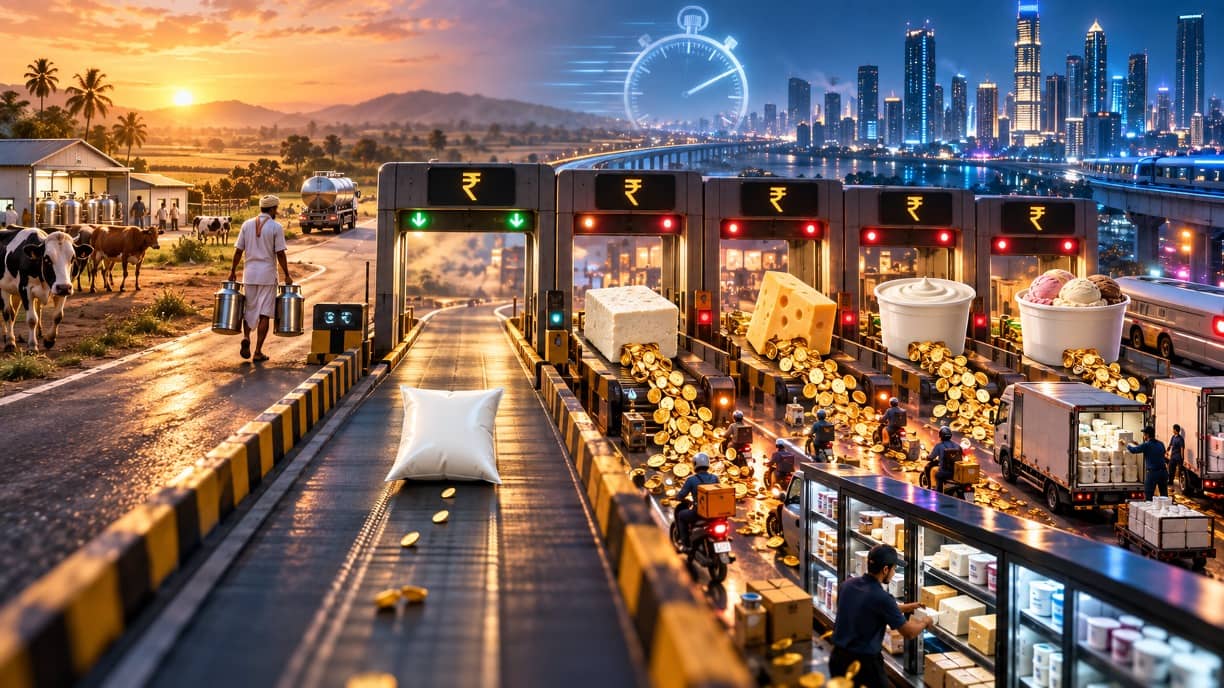
On quick commerce, the platform keeps 21-28 paise of every rupee of orders. But the toll is not spread evenly: milk pays almost nothing, while ice cream, chilled VAP and challenger brands pay the most. And, to my surprise, the platforms are not banking that money either.
What the platforms keep, and what they end up with (latest disclosures)
| Platform | Kept from each rupee of orders | What is left after delivery and dark stores |
| Blinkit, Q1 FY27 (owns inventory) | 27.5% gross margin on net order value, up from 23.6% a year ago | 5.3% contribution; adjusted EBITDA of Rs 102 crore on Rs 17,132 crore of orders, about 0.6% |
| Swiggy Instamart, Q1 FY27 (marketplace) | about 21%: Rs 108 revenue per order on a Rs 508 average order (my calculation; includes ads and customer fees) | contribution at -0.2% of GOV; adjusted EBITDA loss of Rs 778 crore |
| Zepto, FY26 (updated DRHP) | not disclosed; industry estimates put it at 15-20% | net loss of Rs 5,905 crore on revenue of Rs 22,624 crore |
Sources: Blinkit margins, Blinkit inventory losses, Instamart revenue per order, Instamart order value, Zepto estimate, Zepto DRHP figures. BigBasket's BB Now does not report quick commerce separately; with Dunzo and others it held about 3% of the market in FY25 (Indira Securities).
What the platform earns, category by category (JM Financial estimates, February 2024)
| Category | Platform product margin |
| Milk and core dairy (after wastage) | low single digit |
| Other dairy | high single digit |
| Ice cream | 15-20% |
| D2C and challenger brands | 15-25% |
| Fruits, meat, general merchandise | 20-25% |
On top of product margin, JM estimated Blinkit earned about 3.5% of order value from ads and 3% from customer fees (JM Financial). For a small brand, agency estimates put headline commissions at 15-25%, plus 18% GST on the commission (Confetti).
Now read this as a dairyman. The platform treats milk the way the kirana treats salt: a footfall item, sold at near-zero margin to bring you in. The toll is collected on exactly what our industry calls premium. Ice cream pays 15-20%. A new Greek yogurt or high-protein paneer brand pays 15-25%, then buys ads to stay on the first screen. The bigger and older the brand, an Amul or a Mother Dairy, the smaller the bite; the more "value added" and the younger the brand, the bigger the bite.
But here is what I did not expect. The platforms are not getting rich on it. Blinkit keeps 27.5 paise and ends with about half a paisa. Instamart is only just breaking even per order. Zepto lost about 26 paise for every rupee of revenue in FY26. Blinkit also wrote off 1.8% of its order value to expiry, damage and theft, and JM noted that fresh categories, dairy included, can lose up to 20% of inventory. The value our plants create is not banked in Gurugram or Bengaluru. It is burnt on riders, dark-store rent and curd that expired on the shelf, and the consumer collects it as ten-minute convenience.
General trade wants its share too. The distributors' federation, AICPDF, has demanded a minimum 20% margin for retailers, 10% for distributors and 5% for super stockists to compete with platforms (Business Standard). Every channel wants a slice of the VAP premium.
How much dairy actually moves this way? No platform discloses dairy as a share of its revenue. Bain estimates household essentials make up 85-90% of quick commerce GMV (Bain). From the dairy side, the picture is clearer:
- Mother Dairy: quick commerce was 5% of FY26 turnover of Rs 20,300 crore, roughly Rs 1,000 crore (Dairy Business MEA).
- Milky Mist: e-commerce platforms 13.7% and modern trade 23.1% of FY26 revenue, against 37.7% from general trade (JM Financial).
- Heritage: e-commerce and modern trade together about 11% of revenue as of Q3 FY24 (JM Financial).
- HUL ice cream: about 10% of sales through quick commerce and similar channels as early as FY23 (same JM report).
- Hatsun: a reported Rs 160 crore quick commerce run-rate, not independently verified (Sahi).
For a milk-led dairy, quick commerce is still a single-digit share of sales. For a VAP-led brand, modern and online channels are already a third of revenue, and the most expensive third.
So here is my point. The channel toll is not a tax on dairy; it is a tax on VAP. Pouch milk passes almost free. Every step up the value ladder pays a higher toll, and the platform does not even keep most of it. The value is created at the plant. A good part of it is spent, not banked, before it reaches the consumer's fridge.
The cold chain wall: why VAP cannot simply walk into a kirana
Most chilled VAP is pushed into modern channels not by choice but by refrigeration. India's 13 million kiranas still carry more than 90% of FMCG sales (Conclave TechMedia), but very few of them can hold paneer, yogurt or ice cream at the right temperature.
Think of what each product asks of the shop:
- Ambient (ghee, SMP, UHT milk, milk powder): any shelf in any village. General trade works beautifully.
- Chilled, 2-8°C (curd, paneer, cheese, yogurt, buttermilk): a working visi cooler, steady power, and a shopkeeper who rotates stock by date.
- Frozen, -18°C (ice cream, frozen snacks): a freezer, and a power supply that does not trip in May.
So who pays for the fridge? Either the dairy buys and places it, or the dairy rents the platform's dark store and pays the commission. Milky Mist now runs more than 41,000 visi coolers and freezers, over 375 vehicles and 3.94 lakh retail touch-points (Moneycontrol), and earmarked IPO money for still more coolers, ice cream freezers and chocolate coolers (Strategy Story, Just Food). Hatsun built more than 4,000 HAP Daily outlets of its own and plans over 5,000 (Angel One). That is cold chain capex wearing a retail badge.
There is a third road, and Country Delight took it: own the last mile yourself. It sells premium fresh milk on subscription, straight to the door; fresh milk was 67.8% of its FY22 revenue (Entrackr), and revenue reached a reported Rs 1,380 crore in FY24. It proves that even plain milk can carry a premium when the consumer trusts it. It also proves how costly that door is: in FY22 it spent Rs 1.35 to earn each rupee of revenue, and it lost a reported Rs 260 crore in FY23 (Entrackr). Whether you rent the fridge or drive it to the door, someone pays.
The working capital tells the same story. Milk-heavy Dodla has at times run negative working capital, because milk money comes in daily and often in advance. Parag carries the heaviest working capital in the group, because cheese ages 6-12 months, and Milky Mist sits in between (PrimeInvestor). Every step into VAP pulls more of the balance sheet into inventory, coolers and receivables. This is why I agree with Moneycontrol that capital efficiency may decide the premium from here. Milky Mist's FY26 return on equity was lifted by heavy pre-IPO debt, which IPO money is now repaying (PrimeInvestor). Moneycontrol's own numbers make the point. Milky Mist grew revenue at 31% a year over FY24-FY26, yet earned only a 12% ROCE in FY26. On FY28 estimates, about 59% of its Rs 769 crore EBITDA disappears into depreciation, interest and tax before becoming Rs 315 crore of profit; for Dodla the leak is about 30%. That leak is the cost of coolers, plants and trucks, and peers are now building theirs too: Dodla alone has outlined more than Rs 590 crore of capex. The real test is return on capital once all of it sits on the books, not margin alone.
It is not an accident that the VAP and quick commerce stories arrived together. The dark store solved the cold chain problem for dairies that could not afford to solve it themselves. It just sends a bill every month.
When milk is cheap, milk is the most value-added product
In a cheap-milk year, the humble pouch quietly out-earns most of the VAP shelf on return on capital. The data from the last cycle says so.
Remember FY25. Farm prices had softened after the FY23 spike, and Parag's average milk cost in Q1 FY25 was about Rs 31 a litre, down 16% year on year; its gross margin jumped 550 basis points (Indian Retailer). That same year, milk-heavy Heritage posted an 8.0% EBITDA margin and 26.2% ROCE. One year later, with milk costly again, Heritage was at 5.9% and 15.2% (Arihant). Dodla went from 10.2% to 7.5% (Arihant).
Why does this happen? Because consumer milk prices almost never come down. When the farmer's price falls, the pouch price stays where it was. The spread widens, and it widens on a product that:
- needs no aging, no visi cooler and no dark store;
- pays a retailer a couple of rupees, not a platform a quarter of its price;
- turns into cash in a day, often in advance.
Meanwhile, in a flush year the so-called value-added outlets for surplus milk, bulk SMP and butter, are exactly the ones whose prices sag. The "VAP" becomes the parking lot. The pouch becomes the profit centre.
The reverse is also true, and we saw it in Q1 FY27. When farm prices run up, pouch milk cannot be repriced fast because cooperatives hold the line, and margins collapse. That is when VAP looks like a saviour. So VAP is not a permanent truth about a product. It is a position in the milk price cycle. A board that understands this will flex its milk between pouch, curd, paneer and powder by season, rather than chase a fixed VAP percentage to please an analyst.
Amul shows the other end of this equation. It says 80-85 paise of every consumer rupee goes back to its 36 lakh farmers, a self-reported figure that has never been independently audited (YourStory). GCMMF kept just Rs 123 crore of profit on Rs 59,286 crore of revenue in FY24. Our listed players spend roughly 60-79% of revenue on all raw materials, milk, packaging and purchased goods together, so the farmer's own share there is lower still. When Amul raised milk prices by Rs 2 a litre in May 2026, it raised the farmer's price per kg of fat by 3.7% in the same breath (DairyNews.today). For the cooperative, the farmer's milk price is the value, and the ceiling every private dairy prices against.
This is what I meant in my earlier piece on the Q1 FY27 results, when I called the VAP pivot a warning signal as much as a strategy. A pivot made only because milk got expensive will be quietly reversed when milk gets cheap.
So what does "value added" really mean?
Here is the definition I would put on the table: a dairy product is value added only if, across a full milk cycle, it earns more net rupees per litre of milk equivalent than the same litre sold as pouch milk, after every channel, cold chain and promotion cost is paid.
By that test, some of today's VAP passes with flying colours. Cheese, whey protein, ghee and a genuinely premium brand that holds price when milk rises all pass. Some of it passes only in the lean season. And some of it, sold through a platform at a 25% take with ads on top, may be adding more value to the ten-minute promise than to the dairy or the farmer.
If I were sitting on an investor call, I would ask every management for four disclosures instead of one VAP percentage:
- VAP split into ambient, chilled and frozen.
- Revenue and margin by channel: general trade, modern trade, quick commerce, HoReCa, institutional.
- Segment EBITDA for VAP versus liquid milk, every quarter, as Heritage already shows.
- Net realisation per litre of milk equivalent, by product family.
Does a higher VAP mix justify premium valuations? Sometimes, yes. Milky Mist expanding margins in the worst milk quarter in years is a serious argument, and I respect it. But one quarter is not a cycle. The premium is deserved only where pricing power survives both the milk price and the channel's cut.
Until then, let us at least be honest with ourselves. Value is not added by the label on the pack. It is added by what the consumer pays, minus what everyone in between takes. And there will be seasons, as every dairyman knows, when the most valuable product leaving our plant is still the plain white pouch.
So what are you doing next to add value to your product ?
Source : Editorial by Kuldeep Sharma Chief Editor Dairynews7x7 Oct 1st 2026