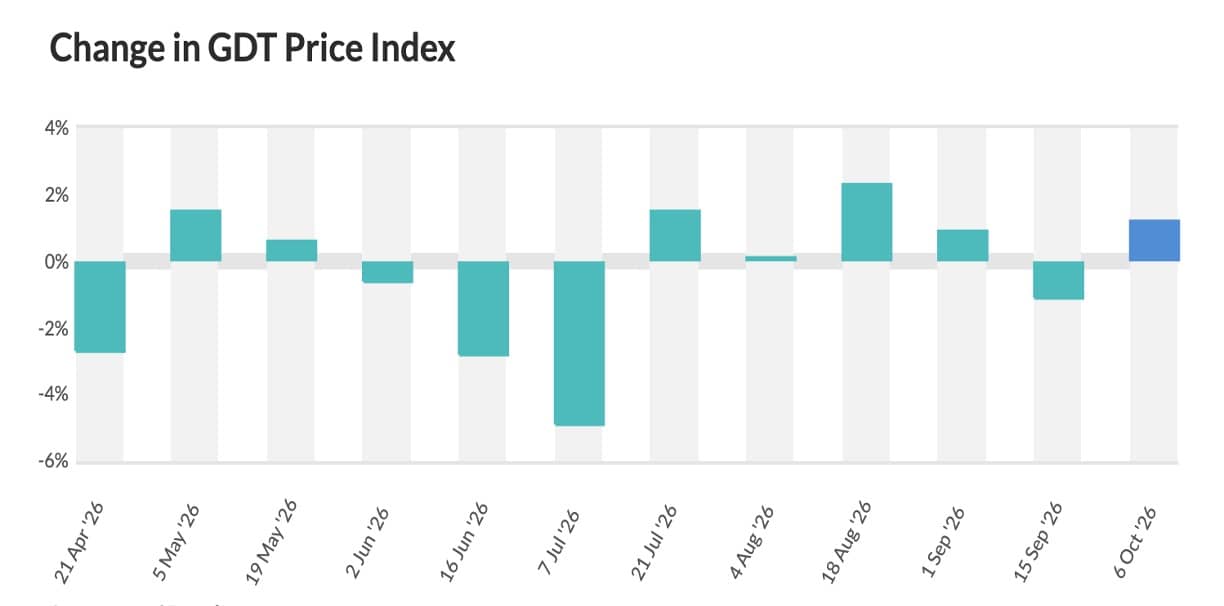
The Global Dairy Trade Event 413 held on 6 October 2026 has brought the global dairy market back into positive territory, with the GDT Price Index rising 1.2%, almost reversing the 1.1% decline recorded in Event 412. The average winning price increased to USD 3,928/MT. But the headline index once again hides a much more interesting story underneath. Milk powders strengthened decisively, led by SMP, while butter, AMF and both major cheese categories remained under pressure. This is increasingly looking less like one global dairy market and more like separate markets for protein, milk solids and fat.
Trading activity remained strong. 41,692 MT of product was sold against an offered supply range of 38,210–45,165 MT. There were 165 participating bidders, up from 155 in Event 412, while 124 emerged as winning bidders. The auction ran through 18 bidding rounds over 2 hours and 56 minutes. Volume sold was only 1.8% below the 42,444 MT traded in Event 412 despite Oceania moving deeper into its seasonal production period. The increase in participating bidders is perhaps equally significant because it suggests that demand has not disappeared even as more milk becomes seasonally available.
The strongest signal once again came from Skim Milk Powder (SMP). SMP increased 4.3% to USD 3,847/MT, its highest level in around four years. Whole Milk Powder also strengthened, rising 1.2% to USD 3,605/MT. SMP is therefore now trading at a remarkable USD 242/MT premium to WMP. What first appeared in Event 411 as an unusual inversion has not corrected itself—it has widened substantially.
This SMP-WMP relationship deserves more attention than the 1.2% headline increase. SMP was USD 3,695/MT in Event 411, held around USD 3,689 in Event 412 and has now jumped to USD 3,847. WMP, meanwhile, has moved from USD 3,585 to USD 3,565 and now USD 3,605. The global market is therefore paying an increasingly visible premium for skim solids and protein while assigning considerably less value to the fat component of milk.
Milk fats continue to tell precisely the opposite story. Butter slipped another 0.3% to USD 4,740/MT, while Anhydrous Milk Fat declined 1.1% to USD 5,683/MT. The apparently small decline in butter in Event 413 should not obscure the larger correction already underway. Butter was USD 5,028/MT at Event 411 before falling 5.7% to USD 4,760 in Event 412 and has now slipped further to USD 4,740. The GDT recovery is therefore clearly not being driven by milk fat.
Cheese also remained weak. After its extraordinary 16.5% jump in Event 412, Cheddar corrected 3.7% to USD 3,925/MT. Mozzarella declined another 3.9% to USD 3,833/MT, following its 6.0% fall in Event 412. This volatility suggests that cheese demand is currently more product and contract specific rather than part of a broad-based dairy rally.
Among the remaining products, Butter Milk Powder increased 0.7% to USD 4,123/MT, while Lactose fell sharply by 6.9% to USD 1,677/MT. The complete Event 413 picture is therefore: GDT Index +1.2%, average winning price USD 3,928/MT; SMP +4.3% at USD 3,847; WMP +1.2% at USD 3,605; BMP +0.7% at USD 4,123; Butter −0.3% at USD 4,740; AMF −1.1% at USD 5,683; Cheddar −3.7% at USD 3,925; Mozzarella −3.9% at USD 3,833 and Lactose −6.9% at USD 1,677/MT.
The supply-side explanation is interesting because New Zealand is not short of milk today. August milk collections reached a record 131.2 million kgMS, 3.3% above last year, while season-to-date production was running 4.3% ahead. Fonterra itself expects another strong milk season. Normally such numbers would be expected to pressure commodity prices as New Zealand approaches peak production. Instead, powders have strengthened. This suggests that the present powder rally has a genuine demand component rather than being simply a supply-shortage story.
There is, however, another element entering the market—weather risk. Fonterra has warned that an intensifying El Niño could affect milk volume growth later in the 2026/27 season. Buyers therefore face an unusual situation: plenty of milk today but greater uncertainty about milk availability several months ahead. This could partly explain why buyers are prepared to secure powder positions even as seasonal Oceania production rises.
The demand story is perhaps even more important. Fonterra recently raised its 2026/27 Farmgate Milk Price midpoint from NZD 9.25 to NZD 9.50/kgMS, specifically citing improvement in global commodity prices and continued strength in global demand. At the same time, the company is investing heavily in advanced protein capacity as demand for nutrient-dense and higher-value proteins expands. The exceptional strength in SMP therefore sits within a wider global movement towards protein-rich dairy ingredients rather than being an isolated auction phenomenon.
Are newer demand pockets emerging? The public Event 413 results do not provide enough buyer-by-country information to make that claim specifically for this auction, and it would be wrong to infer individual countries simply from the price movement. The broader trade pattern, however, is becoming more diversified. Southeast Asia is becoming increasingly important in products such as cheese and dairy ingredients, while Middle Eastern markets have previously increased purchases at GDT events. China remains crucial, particularly for New Zealand dairy, but the global market appears progressively less dependent on China alone to establish every dairy commodity price.
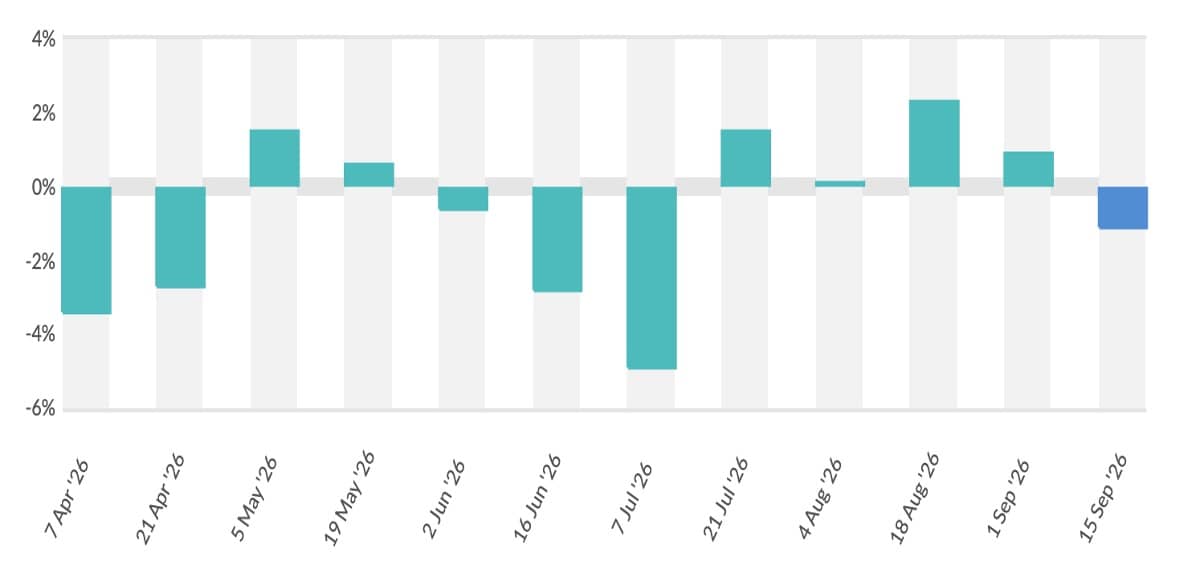
The behaviour of the GDT Index during 2026 puts Event 413 into perspective. The year began with an extraordinary rally: +6.3% on 6 January, +1.5% on 20 January, +6.7% on 3 February, +3.6% on 17 February and +5.7% on 3 March. The market then corrected, including declines of 3.4% and 2.7% in April, followed by another weak phase through June and the sharp 4.9% fall on 7 July. Four consecutive increases followed from 21 July through 1 September before Event 412 interrupted the recovery with a 1.1% decline. Event 413's 1.2% rise has effectively recovered that loss. The market has therefore moved from an early-year rally to correction and is now entering a more selective consolidation phase.
For the next two to three months, I would remain positive on powders but cautious about calling a broad dairy rally. NZX futures on 6 October were pricing WMP at USD 3,710 for November, USD 3,785 for December and USD 3,870 for January, while SMP futures stood at USD 3,940, USD 3,960 and USD 3,980 respectively. In contrast, November Butter futures were only USD 4,535 and AMF USD 5,450. The futures market is therefore sending almost exactly the same message as GDT 413—powders are expected to remain firm while fats may require more time to establish a convincing floor.
My base case for the next two to three months would consequently place WMP broadly around USD 3,600–3,900/MT and SMP around USD 3,750–4,000/MT. Butter could remain around USD 4,500–4,900/MT, while AMF may trade broadly between USD 5,400–5,800/MT. These are analytical ranges rather than formal forecasts. A stronger return of Chinese buying, worsening El Niño conditions or supply disruptions could push powders higher; conversely, strong New Zealand peak-season milk production without matching demand could cap the rally.
For India, SMP at USD 3,847/MT is now becoming strategically relevant. Only three months ago, at Event 407 on 7 July, GDT SMP had fallen to USD 3,135/MT. It has therefore recovered more than USD 700/MT in roughly three months. This significantly improves the global reference price for Indian SMP and deserves attention from Indian exporters, particularly if domestic powder availability improves during the coming flush. The opportunity, however, must still be tested against Indian procurement cost, exchange rate, freight, export specifications and destination-market prices.
The fat side gives India a different message. Global Butter at USD 4,740 and AMF at USD 5,683 are substantially softer than their mid-year levels, but Indian butter and ghee prices need not follow them mechanically. India's fat market remains largely driven by domestic milk availability, procurement cost, buffalo milk contribution and seasonal demand. The widening global SMP premium nevertheless creates an interesting strategic question for Indian processors: is the marginal litre of milk currently more valuable through its protein and skim solids than through its fat?
Event 413 therefore deserves to be read beyond its 1.2% increase. The real story is SMP at USD 3,847 and its extraordinary USD 242 premium over WMP, even while New Zealand milk production is seasonally expanding. Butter and AMF remain soft and cheese remains volatile. The market is increasingly assigning different values to the individual components of milk rather than moving the complete dairy basket in one direction.
The next two or three GDT events will tell us whether this represents a structural change or merely a temporary imbalance. If SMP moves towards USD 4,000 while WMP also strengthens beyond USD 3,700–3,800, the global powder market may be entering a more durable bullish phase. If fats remain weak simultaneously, however, 2026 may ultimately be remembered not as another dairy commodity cycle, but as the year when protein, skim solids and milk fat decisively started following different price trajectories.
Source : Editorial by Kuldeep Sharma chief editor Dairynews7x7 on GDT event 412
Never miss an important dairy update
Follow DairyNews7x7 on Google to get live milk prices, policy alerts, and daily headlines directly in your feed.