Amit Shah Launches Major Dairy Infrastructure and Cooperative Projects in Ladakh
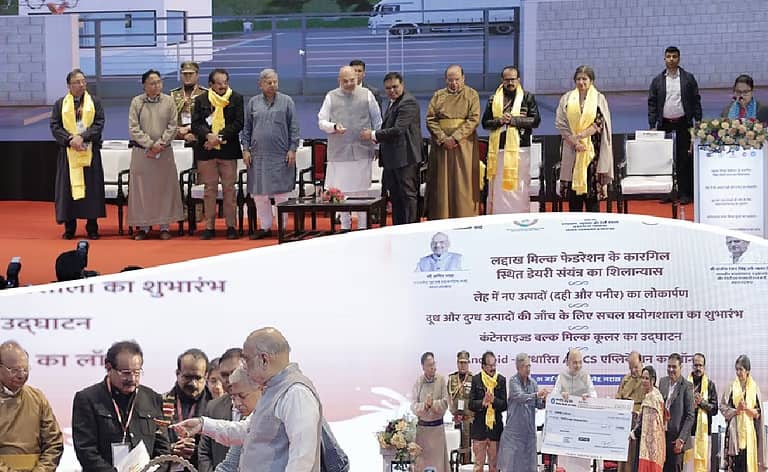
Union Home and Cooperation Minister Amit Shah has inaugurated and launched a series of dairy infrastructure and cooperative initiatives in Ladakh, marking a major step towards strengthening the region’s dairy ecosystem, improving milk procurement and expanding livelihood opportunities for local producers.
The initiatives include a ₹25 crore dairy processing plant in Kargil, digital milk collection systems, mobile milk testing facilities, improved cold-chain infrastructure and plans for a much larger processing facility in Leh. The programme is aimed at connecting local milk producers with organised markets while strengthening the cooperative model in the Union Territory.
₹25 Crore Dairy Plant Planned in Kargil
A key announcement was the foundation stone laying of a dairy plant in Kargil with a processing capacity of 10,000 litres per day (10 TLPD), at an estimated cost of ₹25 crore.
The facility is expected to strengthen local milk processing and create additional income opportunities for dairy farmers, particularly women. The project is being supported under the National Programme for Dairy Development, with a reported grant of ₹12.74 crore.
The plant is also planned to operate using a 350-kilowatt solar energy-based system, an important consideration for a high-altitude region with challenging energy and logistics requirements.
Leh Dairy Infrastructure Gets a Boost
Alongside the Kargil project, dairy operations in Leh are being strengthened through the introduction of value-added products, including paneer and curd.
The existing Leh milk plant has resumed operations, with its processing capacity expanded from 5,000 to 10,000 litres per day. A further expansion plan envisages a new dairy plant with a capacity of 50,000 litres per day at an estimated investment of ₹70 crore.
The proposed facility is expected to support higher milk procurement and meet growing demand for dairy products in the region.
Digital Procurement and Milk Quality Monitoring
Technology is another major component of the initiative.
An Android-based Automatic Milk Collection System (AMCS) application has been introduced to improve transparency in milk procurement. The platform enables producers to digitally track their milk accounts and procurement-related information.
A mobile milk and milk-products testing laboratory, valued at approximately ₹45 lakh, has also been launched to strengthen quality assurance at the grassroots level.
In addition, a 4,000-litre Bulk Milk Cooler has been inaugurated in Kargil to improve milk storage and handling. These interventions are particularly relevant for Ladakh, where long distances, difficult terrain and extreme weather can complicate milk collection and transportation.
Mother Dairy Agreement to Strengthen Market Linkages
The Ladakh Milk Federation and Mother Dairy have signed an agreement aimed at strengthening market connectivity and dairy-sector development.
The National Dairy Development Board (NDDB) is also expected to facilitate wider market linkages for Ladakh’s products, including exploring access to major consumer markets such as Delhi.
The agreement announced at the event also provides for the supply and retail distribution of selected Mother Dairy products in Ladakh. Together, these efforts are intended to strengthen the organised dairy market and improve the availability of products in the region.
Milk Procurement Targeted to Triple
The cooperative dairy network in Ladakh has expanded significantly under NDDB’s management.
According to NDDB, the network has grown from 74 milk producers in one village in 2022 to approximately 1,700 producers across 28 villages. Daily milk procurement has reached around 7,000 litres.
The government has set a target of increasing daily procurement to 21,000 litres over the next four years. This expansion will require wider village-level cooperative coverage, improved collection infrastructure and greater participation from livestock farmers.
Climate-Suitable Livestock to Support Production Growth
Improving animal productivity is another priority.
Given Ladakh’s extreme cold conditions and high-altitude environment, the government plans to introduce approximately 500 improved, high-yielding animals annually, selected for suitability to the region’s climatic conditions.
The longer-term objective is to nearly triple the livestock population over the next decade, supported by improved breeding, animal husbandry practices and stronger cooperative networks.
The government has also outlined plans to establish cooperative societies in other sectors, including pashmina, organic products and honey, extending the cooperative development model beyond dairy.
What This Means for the Dairy Industry
Ladakh’s dairy development programme highlights the importance of building an integrated supply chain in regions where geography and climate create significant operational challenges.
The combination of local processing, milk cooling, quality testing and digital procurement can help reduce supply-chain inefficiencies while improving transparency for producers.
The proposed 50,000-litre-per-day plant in Leh, if implemented alongside the Kargil facility and expanded village-level procurement, could create a stronger foundation for organised dairy production in the region.
However, the long-term success of these investments will depend on consistent milk supply, farmer participation, animal productivity, infrastructure utilisation and commercially viable market access.
For Ladakh, the next phase of dairy growth will not depend on processing capacity alone. It will depend on building a reliable connection between livestock farmers, cooperative institutions, quality infrastructure and consumers.
Source: Read full story here 06 Nov, 2026 Edited and Reported by
#DairyIndustry #DairyCooperatives #LadakhDairy
Never miss an important dairy update
Follow DairyNews7x7 on Google to get live milk prices, policy alerts, and daily headlines directly in your feed.