The Ayurveda major is riding its health credentials while also relying on the health aspect of ghee to differentiate in the highly fragmented market.
What does Dabur have to do with dairy? Very little, apart from the fact that the top Ayurveda player has just launched ghee. It is the second most consumed dairy product in India, only after milk. Dabur’s newly-launched cow ghee marks the brand’s entry in India’s dairy segment, treading into Amul territory.
Ghee in India is as old as Hindu mythology. It is popularly believed that the creator God ‘Prajapati’ first created ghee by rubbing his hands. However, Indians have been making their own ghee since much before dairy brands turned ghee into a CPG (consumer packaged good), and they still do.
Ghee will be Rs 4653 Billion market by 2024
According to market research firm IMARC, the Indian ghee market was valued at Rs 2,273 billion in 2019. It is expected to reach Rs 4,653 billion by 2024. The market is mainly segmented into cow and buffalo ghee, and is dominated by milk co-operatives. States like Uttar Pradesh, Rajasthan and Madhya Pradesh are the top ghee consumers.
Also Read : Dabur 100% Pure Cow Ghee launched exclusively on Grofers
Ghee, as a segment, is also among the most crowded. Apart from leading national players like Amul, Gowardhan, Nestle Everyday, etc., there are many strong regional brands, like Jharna/Monorama in West Bengal, Saras in Rajasthan, etc. Other popular names include Anik, Milkfood, Madhusudhan, Ananda, Parag, Aashirvaad (ITC), Mother Dairy, etc.
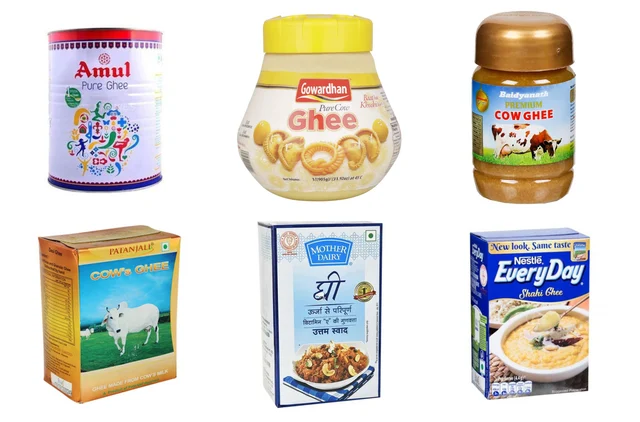
A one-litre pack of ghee costs around Rs 500. It also happens to be the most consumed SKU. Dabur Ghee is priced at Rs 599 per litre. Apart from the large brands, the space also includes several smaller brands offering quality differentiators like ‘organic’, ‘traditionally made’ and ‘made of milk from specific Indian cow breeds’.
ALSO READ : Ananda and Amul stood first in cow ghee quality
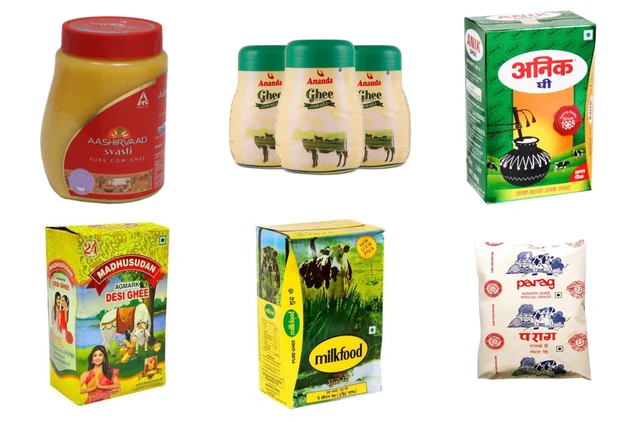
Traditionally, ghee is prepared by churning curdled milk, unlike the popular process of making it from separated milk fat. ‘Organic’ means that the cows were ‘grass-fed’ and raised in organic farms (brands like Organic India, Akshayakalpa) without hormones, etc.
Vedic ghee a new entrant
Then, there is ‘vedic’ ghee, which is produced from Indian cow milk (A2 milk) from breeds like Gir and Tharparkar via traditional processes as prescribed in Ayurveda (Kesariya Farm, Shri Radhey and Kapiva). The prices of these variants range upwards of Rs 700 and go up to a few thousand rupees per litre.
Dabur claims that its ghee can be traced back to “indigenous cows bred in Rajasthan.”

Dabur will be competing in the former group of popular brands. The brand has latched on to ghee’s strong and ancient connection with Ayurveda, which prescribes ghee for general well-being. It is also used as an ingredient in many Ayurvedic preparations, including Dabur’s flagship product Chyawanprash. Other major Ayurveda players that offer ghee are Baidyanath and Patanjali.
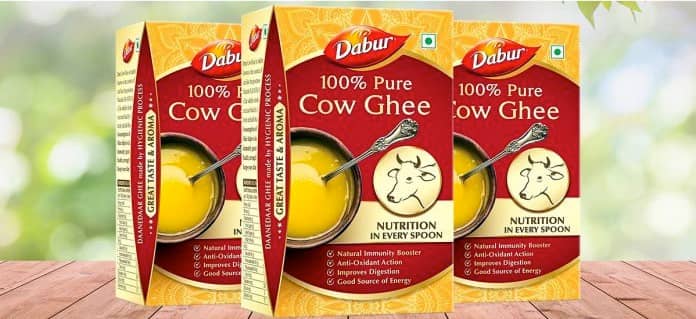
To stand out in the crowd, Dabur is highlighting the health aspect of ghee. Apart from the regular quality parameters, like taste, texture, source and aroma, the pack puts forth ghee’s nutrition and health benefits – like, boosting immunity, digestion and antioxidant properties. The tagline reads, ‘Nutrition in every spoon.’ Dabur has also prominently highlighted its ‘100% pure’ assurance on the pack.
Ghee as a healthy food
K Ganapathy Subramaniam, DGM marketing (innovations), Dabur India, tells afaqs! that due to the health aspect, the move into the ghee segment was a seamless transition for the brand. “We have brought alive the health credentials prominently. I’m not sure if there are any other players out there that have done that.”

However, ghee is only one of the two main ingredients of milk. Apart from water, milk primarily contains non-fat milk solids (which turns into powdered milk) and fat (ghee is made from it). A ghee brand usually also offers milk powder. Dabur is less likely to worry about the powder since manufacturing is being taken care of by a Jaipur-based dairy manufacturer (Jhandewalas Foods).
On being asked if Dabur has interest in other dairy products, Subramaniam says that it is not about the larger dairy category but ghee alone. “It’s not that we didn’t understand ghee. We understand good quality ghee and have been using it as an ingredient in many Ayurvedic formulations. Since we had a great ingredient/product, we decided to bring out the values of ghee to the consumer.”
Challenges ahead for Dabur
We also asked if it was a cause of concern that the consumers may not be able to quickly connect Dabur with a dairy product due to the absence of strong dairy credentials. “We are unlocking a dimension of a product which is very intrinsic to the product itself. So, I don’t expect the consumers to see a disconnect,” Subramaniam responds.
Speaking on the possible challenges of creating a space in the large, but extremely fragmented ghee market, he says that the competition has always been there. “It’s not from the lens of competition. Instead, we would like to bring alive new dimensions of the product.”
Interestingly, Dabur has been selling ghee globally much before it launched the product in India. Dabur Organic Ghee is Dabur’s UK-focused ghee brand, which has been around for several years now. The brand caters to the emerging group of global consumers, who are looking at ghee (aka clarified butter) as a better cooking medium. Ghee is gaining popularity for its health benefits and high smoke point (burns in high temperatures).
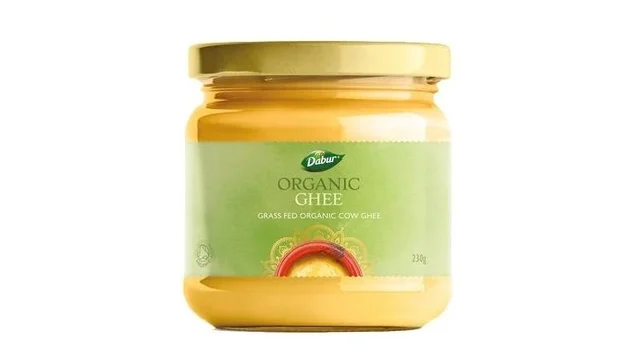
Subramaniam says that much like the way the yoga culture flowed back to India from the west, the ghee segment is also seeing a lot of benefit-driven adoption due to its gaining popularity globally.
“From a global perspective, clarified butter is a novelty. A large part of the western world doesn’t even know ghee. These days, we see a lot of master chefs cooking in ‘clarified butter’. For an Indian grandmother, it would be a natural choice. It is not an alien product in our kitchens.”
However, healthy or not, ghee, as a food product, has for long been judged on basic taste parameters, like aroma, ‘daanedaar’ (grainy) texture, colour, etc.
True differentiation
Speaking on the differentiated health proposition, Subramaniam says, “We have also emphasised on how ghee gets valued on our packaging. But why should a product only be evaluated on the elementary parameters, which enable the purchase? The consumers should also be educated in terms of what it can do to them…”
And rightly, Dabur is riding its health credentials for its new launches. A couple of months back, it entered the mustard oil category with its ‘cold-pressed’ variant. These new ‘staple’ launches could get Dabur deeper into the Indian homes, and particularly the kitchens.
“It was pretty natural for us to look at categories which are health-oriented. We are very conscious of the fact that we get looked at from a health and wellness angle. We want to extend it into households, and enter segments where people will find it more relatable,” Subramaniam says.
Dabur Ghee has been launched specifically on grocery e-commerce platform Grofers. E-commerce launches have doubled up as a testing ground for new launches before actually hitting the offline retail shelves.
Subramaniam however maintains that it’s not about experimenting, but about being “purposive towards bringing a product.” “It is about the nature with which you want to service the product and then scale up distribution – without compromising on your first to the scaled up consumer.”