FSSAI Milk Logo Mandatory from July 2028: The Blue Drop Every Dairy Pack Needs
Seven years after it was first promised, India's milk logo finally has a date. July 2028 sounds far away. In packaging time, it is next year.
By Kuldeep Sharma, Chief Editor, DairyNews7x7
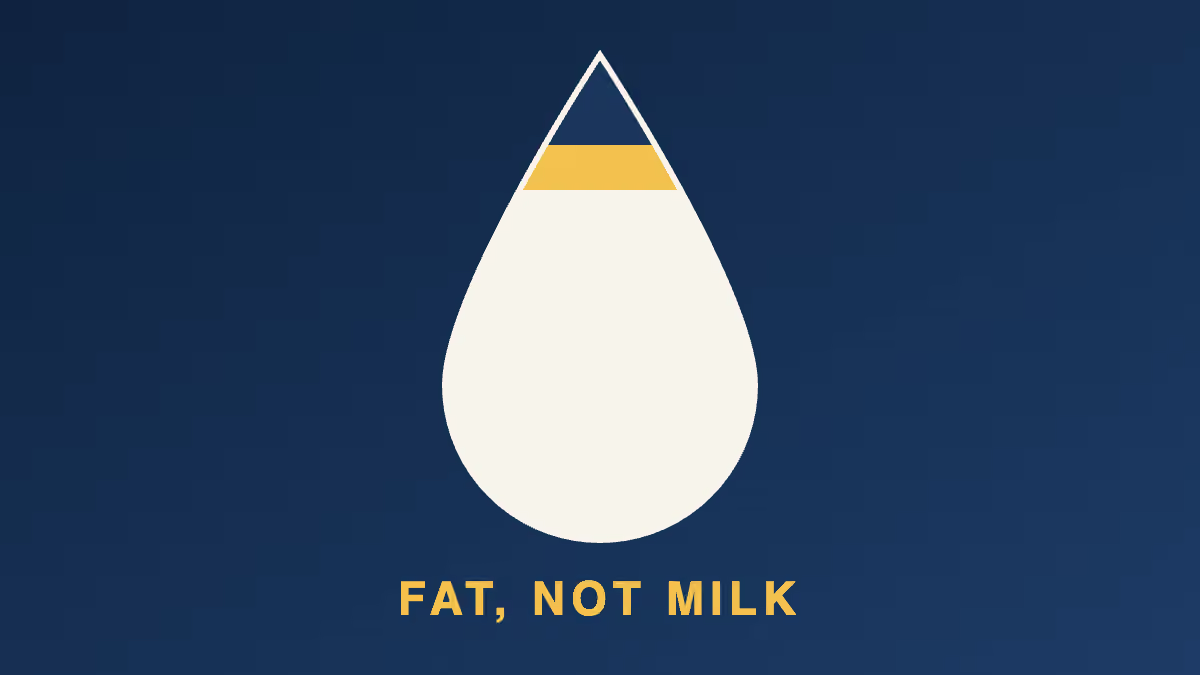
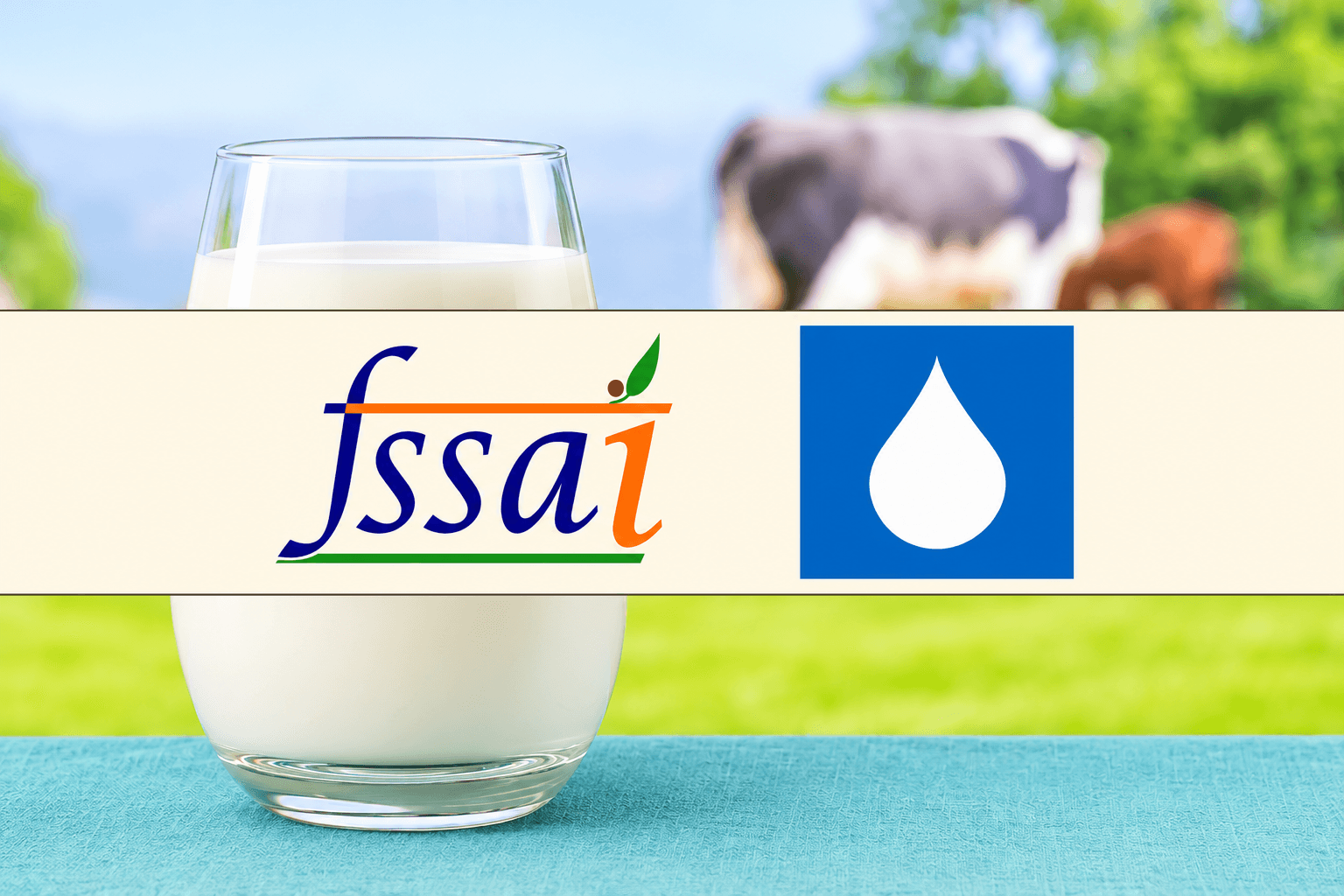
The Food Safety and Standards Authority of India (FSSAI) has made the FSSAI milk logo, a white milk drop in a blue square, mandatory on all milk and milk products from 1 July 2028. The requirement comes through the Food Safety and Standards (Labelling and Display) Second Amendment Regulations, 2026, dated 6 November and published in the Gazette of India on 9 November 2026. One paragraph changes every dairy pack in India: all milk and milk products, including composite milk products, shall carry the logo.
The industry has heard this before. The milk logo was first written into the standards in December 2021, with compliance due by 1 July 2022. That date moved to 31 December 2022, and then indefinitely, because FSSAI had not yet fixed the logo's dimensions and colours. A draft with those specifications came in February 2025. The final rule took another twenty months.
So the first reaction in many boardrooms will be: we have time, and it may slip again. That would be a mistake. This time the specification is final, the date is in the Gazette, and the clock that matters is not FSSAI's. It is your printer's.
What the FSSAI milk logo rule says
The amendment inserts a new paragraph (3) into Schedule I of the Labelling and Display Regulations, 2020. It is short, and every word of it counts.
- Who must comply: all milk and milk products, including composite milk products, as defined in regulation 2.1.1(5)(a) of the Food Products Standards and Food Additives Regulations, 2011. That covers liquid milk, curd, paneer, ghee, butter, cheese, milk powders, ice cream and flavoured milk, and also composite products such as milk-based sweets and beverages.
- What: a white milk drop in a blue square. The colour is fixed at C 89, M 58, Y 0, K 0.
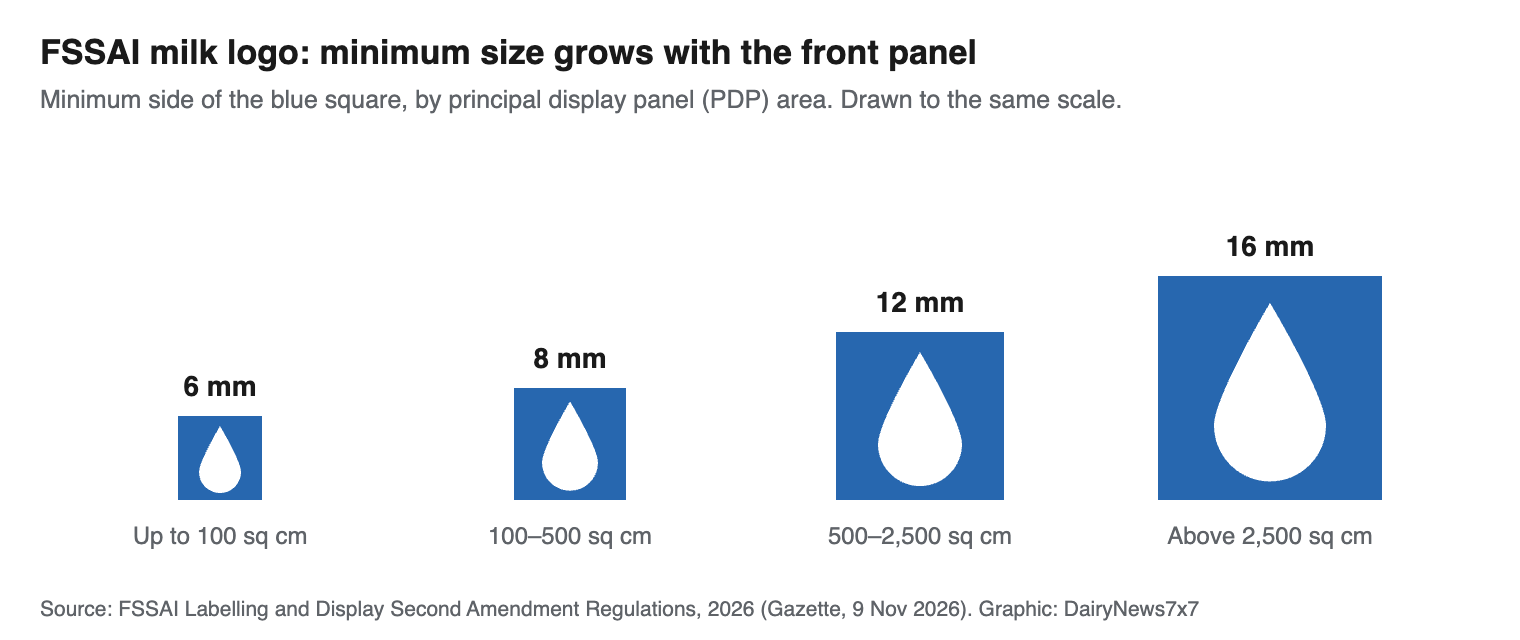
- How big: the minimum size depends on the area of the principal display panel (PDP).
- When: 1 July 2028.

| Principal display panel area | Square, each side (min) | Drop height (min) | Drop width (min) |
|---|---|---|---|
| Up to 100 sq cm | 6 mm | 4.56 mm | 3 mm |
| 100 to 500 sq cm | 8 mm | 6.08 mm | 4 mm |
| 500 to 2,500 sq cm | 12 mm | 9.12 mm | 6 mm |
| Above 2,500 sq cm | 16 mm | 12.16 mm | 8 mm |
Just as important is who may not use the FSSAI milk logo. Dairy analogues are, by FSSAI's own definition, not milk, milk products or composite milk products, and FSSAI has said plainly that analogues shall not use the logo. The blue drop is therefore not a decoration. It is a legal statement that what is inside came from an animal, not a palm tree.
Why the FSSAI milk logo matters now
For a decade the honest dairy has competed on the same shelf, and the same menu card, as products that look like paneer, taste like malai and are built on SMP and palm oil. This year state after state banned analogue paneer, and FSSAI's festive drive seized adulterated ghee and mawa by the tonne. Enforcement catches the cheat after the sale. A logo helps the consumer catch him before it.
India already trusts this kind of signal. The green dot and the brown dot work because a shopper reads them in half a second, in any language, without reading the ingredients list. The blue drop can do the same for dairy. It also gives the genuine dairy, cooperative or private, something it has never had: a mark that an analogue cannot legally carry.
I must admit this one is personal. The milk logo was recommended for exactly this reason: so that genuine dairy products would carry a differentiated mark against analogues. The final design was co-created through a competition held for students of NDRI, Karnal, and our team. Seeing that blue drop in the Gazette of India, I am emotional. The one-time dream of Indian dairy having its own logo is now becoming a reality.
Let me concede the obvious objections, because the industry will raise them.
- A logo is only as honest as the person printing it. The operator who sells palm-oil paneer as paneer will not hesitate to print a blue drop. The logo raises the cost of cheating; it does not end it. FSSAI must treat a fake blue drop as misbranding with serious penalties, and link it to licence data so an inspector can check a pack against what the licence permits.
- It is one more thing on a crowded label. A 200 ml pouch already carries nutrition facts, veg logo, FSSAI number, MRP, batch, dates and now front-of-pack declarations. At 6 mm the drop is small, but it still needs space and contrast.
- It costs money. Every pouch, cup, carton, laminate and label needs new artwork, and gravure printers need new cylinders. For a large dairy with hundreds of SKUs, that is a real bill. For a small dairy it is a bigger share of its margin.
None of these is an argument against the logo. They are arguments for planning it properly. As I have argued before, the regulator should label what we add, not what the cow gives. The blue drop is the positive half of that principle: it labels what the cow gave.
A packaging plan for the FSSAI milk logo: start in 2027
Work backwards from the deadline. Packs on the shelf on 1 July 2028 were printed in spring 2028. Laminates and cartons for those packs are ordered in early 2028. Artwork has to be approved and cylinders cut before that. That puts the real start date in the first half of 2027, which is why I say this is next year's job.
- Map every SKU (by March 2027). List every pack that carries a milk or milk product, including the ones people forget: composite sweets, flavoured milk, ice cream, institutional and HoReCa packs, private-label and co-packed products, and export packs sold in India. Separate genuine milk products from frozen desserts, analogues and fat spreads, which must not carry the logo.
- Measure the principal display panel of each pack. The PDP area sets the minimum logo size: 6, 8, 12 or 16 mm. Treat these as minimums. A drop sized at the bare limit will fail an inspector's ruler the day the print shifts.
- Fix one artwork standard across the company. Lock the drop's proportions, the C89 M58 Y0 K0 colour, a clear zone around the square, and its position on the front panel. Have your printer match the blue on each substrate (poly film, paperboard, foil lid, cup) and agree a tolerance in writing, because flexo and gravure on milk film rarely hit CMYK exactly.
- Bundle the change with other label changes (2027). Front-of-pack nutrition declarations, the analogue rules and any brand refresh should go into the same artwork revision. Cut gravure cylinders once, not twice.
- Control old stock (late 2027 to mid-2028). Stop ordering laminates and printed cartons without the logo by late 2027. Pre-printed film bought in bulk to save money becomes scrap on 1 July 2028 unless FSSAI allows a sell-through period, and nothing in this notification promises one.
- Bring your suppliers and co-packers along. Small converters and job-work dairies supply most of India's paneer, curd and sweets packs. If they are not ready, your brand is not ready.
- Go early where it pays. The notification fixes when the logo becomes compulsory, not a ban on using it earlier. For paneer, ghee and khoa, where the analogue threat is greatest, putting the blue drop on pack in 2027 is a marketing advantage, not just compliance. Confirm with FSSAI before you print, but do not wait for July 2028 to tell your consumers you are genuine.
One more thing for the smaller dairies. A 200-litre-a-day unit selling curd in printed cups will find a new cylinder a bigger burden than a large cooperative will. Industry associations and State federations should negotiate common artwork and pooled print runs now, while there is time.
What FSSAI still needs to do
The regulator has done the hard part. Three small steps would make the FSSAI milk logo work from day one:
- Publish ready-to-use artwork files (vector, with the colour reference and clear zone), so 50,000 small dairies do not each redraw the drop slightly differently.
- Clarify the edge cases now: multi-pack outer cartons, tiny portion packs, bulk HoReCa packs, and whether early adoption is welcome. Every FAQ issued in 2027 saves a dispute in 2028.
- State the penalty for misuse in advance. The blue drop on an analogue or adulterated pack should be treated as deliberate misbranding, not a labelling slip.
FSSAI milk logo: quick answers
From when is the FSSAI milk logo mandatory? From 1 July 2028, under the Food Safety and Standards (Labelling and Display) Second Amendment Regulations, 2026.
Which products must carry the FSSAI milk logo? All milk and milk products, including composite milk products, covered by regulation 2.1.1(5)(a) of the Food Products Standards and Food Additives Regulations, 2011.
Can dairy analogues or frozen desserts use it? No. Analogues are not milk products under FSSAI's definitions, and FSSAI has said they shall not use the logo.
What size should the FSSAI milk logo be? At least 6 mm, 8 mm, 12 mm or 16 mm a side, depending on whether the principal display panel is up to 100, 100–500, 500–2,500 or above 2,500 sq cm.
What colour is it? A white drop on blue, specified as C 89, M 58, Y 0, K 0.
The drop that tells the truth
In a year when India ran short of milk fat and long on imitations, the blue drop arrives at the right moment. As I wrote this week in Milk Fat Shortage, the analogue crackdown is pulling real milk into paneer, ghee and khoa. The FSSAI milk logo will let the consumer see which side of that line a pack is on.
So my message to the industry is simple. Do not treat 1 July 2028 as a deadline. Treat it as a launch date. Map your packs, fix your artwork and talk to your printers in 2027. The dairies that wear the blue drop first will be the ones consumers learn to trust first.
Source: SCC Online, 13 November 2026 | DairyNews7x7. Analysis and editorial by Kuldeep Sharma, Chief Editor, DairyNews7x7.
References
- FSSAI, Food Safety and Standards (Labelling and Display) Second Amendment Regulations, 2026, F. No. SS-T017/1/2023-Standard-FSSAI, 6 November 2026; Gazette of India, Extraordinary, Part III, Section 4, No. 673, 9 November 2026
- FSSAI Notification
- SCC Online: FSSAI mandates logo for milk and milk products
- UNI India: FSSAI makes dairy logo mandatory from July 2028
- DairyReporter: India proposes mandatory milk product logo (February 2025 draft)
- Lexplosion: milk logo compliance extended to 31 December 2022
- FSSAI Digest: dairy analogues shall not use the milk logo
Never miss an important dairy update
Follow DairyNews7x7 on Google to get live milk prices, policy alerts, and daily headlines directly in your feed.