FSSAI cited Canada before the Supreme Court. It left behind everything Canada wrote to protect milk.
Kuldeep Sharma, Chief Editor, DairyNews7x7
There is a halwai in Old Delhi whose family has made kalakand on the same bhatti since before Partition. Last month he asked me a question I could not answer honestly: "Sir, they are saying my box will now carry a red mark. Like on cigarettes?"
I told him I would find out.
Twelve years, seven drafts, one impatient bench
Front-of-pack labelling was first recommended in India in 2014. The 2018 draft adopted the WHO SEARO nutrient profile model and industry rejected it. In December 2019 FSSAI quietly delinked FOPL from the general labelling regulations. In September 2022 it notified the Indian Nutrition Rating, half a star to five, voluntary for forty-eight months. An expert committee was formed in February 2023 to review the comments. It reviewed. And reviewed.
Webinar by IDA on challenges with health star ratings
Then the courts arrived. On 10 February 2026, the bench of Justices J.B. Pardiwala and K. Vinod Chandran put a visual mock-up of a warning label inside its own order, recorded that twelve years of exercise had yielded no positive result, and tied the matter to the right to health.
On 13 August it lost patience entirely. The Additional Solicitor General argued that international thresholds would put a red mark on namkeen, and that even two eggs carry eleven grams of fat. The Court's reply deserves to be read by every regulator in this country: "Should India remain as an undeveloped country?" It asked whether FSSAI was bowing to corporate pressure, gave two weeks, and said next time it would dictate the judgment.
Two weeks later, on 28 August, FSSAI folded and proposed the strongest label India has ever seen.
What is on the table
A red hexagon carrying HIGH FAT, HIGH SUGAR, HIGH SALT or HIGHLY SWEETENED BEVERAGE, in a font one point larger than the back-of-pack table. Phase I catches products high in two or more of added saturated fat, added sugar and salt. Phase II extends it to even one.
The working thresholds, visible in FSSAI's August school-food draft, are 4.2 g added fat, 3 g added sugar and 0.625 g salt per 100 g of solid food.
Two exemptions are proposed: single-ingredient products, and products inherently rich in fat, sugar or salt, namely ghee, edible oil, salt, sugar, jaggery and honey.
Read that list again. Ghee is in. Paneer is not. Butter is not. Cheese is not. Dahi is not. Khoa is not.
What FSSAI took from Canada, and what it left
Reports of the affidavit say FSSAI cited international precedent for warning labels, naming Chile and Canada. That citation deserves examination, because on the record India has borrowed the warning and left behind the architecture around it.
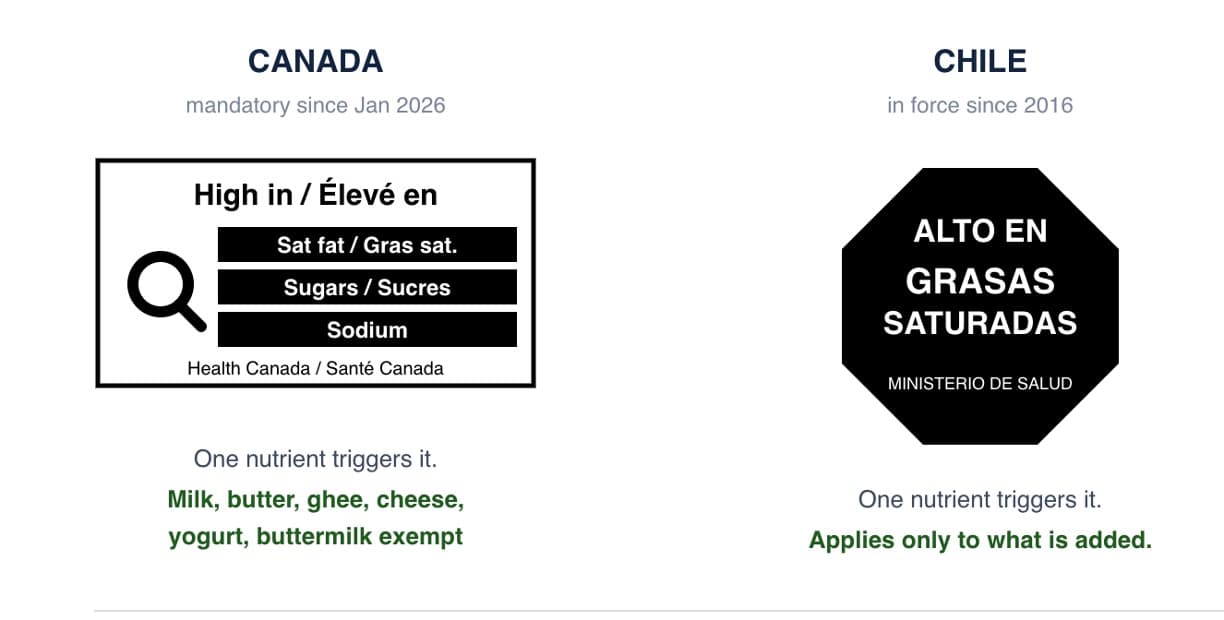
Canada's symbol is a black-and-white magnifying glass, not a red hexagon. Canada triggers on any one nutrient; FSSAI's Phase I requires two, a weaker bar than Canada, Chile, Mexico or Israel, and weaker than what the Court itself had pointed to. Canada measures total saturated fat, sugars and sodium against percentage of Daily Value; FSSAI proposes added fat, added sugar and salt on ICMR-NIN thresholds.
And Canada exempted dairy. FSSAI has not
Health Canada exempts plain milk, plain yogurt and cheese, in its own words, "because they are important sources of calcium that is needed to promote bone health and reduce the risk of osteoporosis." Butter is exempt. Cheese is fully exempt from the sodium symbol, on the reasoning that salt is functionally required in cheesemaking.But Canada did not simply exempt cheese. It made cheese earn the exemption by clearing a calcium threshold, originally 10% to 15% of the Daily Value per serving. That test punished exactly the wrong products. Calcium in cheese tracks how the curd was set, not how much fat it carries. Rennet-set hard cheeses retain colloidal calcium phosphate in the curd. Acid-set fresh cheeses lose it to the whey. Feta, ricotta, cottage cheese and fresh mozzarella kept their saturated fat and salt but failed the calcium bar. Health Canada's own assessment was that without targeted exemptions, almost all cheese made from dairy would have required a symbol.
So in May 2024 it lowered the bar to a flat 5% DV. Affected cheeses fell from roughly 27% to 13%, 538 cheese SKUs came off the list, and processors avoided some CAD 6.78 million in relabelling. Ten submissions from health bodies and academics opposed the move. The regulator overruled them, because calcium is a shortfall nutrient.
Indian dairy should read that sequence very carefully. Paneer and chhena are acid-coagulated fresh cheeses. They belong to precisely the category that failed Canada's first test and passed only after the amendment.
Now the part that should settle the dairy-versus-plant-based argument here. During that consultation an industry body asked Health Canada to extend the same exemption to fortified plant-based beverages, since calcium can be added to them. Health Canada refused, on the ground that they are not consumed in volumes that make them meaningful calcium contributors.
A developed-country regulator, under public health pressure, looked at dairy and its imitators and drew the line in dairy's favour on consumption evidence. That is the regulator FSSAI has chosen to cite.
Let me be exact about what I am not asking for
I am not asking that dairy be spared the label. I am asking that milk fat not be treated as an added ingredient when it is the product itself.
The line I am drawing is between inherent and added, and it cuts through my own industry.
Plain milk, dahi, paneer, chhena, cheese, unsweetened lassi and buttermilk carry saturated fat because that is what milk is. Nobody put it there.
Peda, barfi, gulab jamun, kalakand, sweetened flavoured milk, ice cream, sweetened yoghurt and every dairy-based mithai are high because sugar and additional fat were added to them. On my own test, they take the hexagon. My halwai's box gets the red mark, and it should. So should a sweetened lassi at 12 g sugar per 100 ml. So should a ghee-laden mithai crossing both triggers. I am not asking for one inch of relief for any of them, and any dairy body that tries to smuggle that relief in under cover of the calcium argument will discredit the argument for everyone.
Blog on FSSAI Nutrition ratings
The exemption I am asking for must be conditional and self-cancelling: it applies to the plain dairy matrix, and it disappears the instant added sugar or added vegetable fat enters the formulation. That is not my invention. It is exactly how Canada drafted FDR B.01.350(9), where the exemption is lost the moment ingredients contributing saturated fat or sugars beyond the permitted list appear.
A rule written that way protects nutrition and punishes addition. A rule written without it punishes the cow.
And what did Canada actually gain?
Let me be as honest against my own case as against FSSAI's. Canada's rule is eight months old and there is no measured outcome yet, only modelling. The University of Toronto study estimates 2,148 to 7,047 diet-related NCD deaths averted, between 2.3% and 7.6% of the total, with the upper figure assuming every adult changes behaviour.
Look inside the number. Of deaths averted, 88% came from reduced calories and 15% from sodium. Saturated fat contributed zero. The model returned a slightly negative value, and saturated fat as a share of energy rose marginally under every scenario.
The deeper evidence is Chile, ten years in, and it is genuinely good. A 2026 Lancet study found Chile's package of black octagons, school sales bans and child marketing limits plausibly reduced overweight risk in young schoolchildren. But the gain came from the package, not the label alone, and one documented consequence was a rise in artificial sweetener intake among preschoolers, because reformulation goes where the label points.
The fair verdict: warning labels demonstrably work on sugar, salt and calories. On saturated fat, the best modelling of the very system FSSAI has cited shows nothing. Saturated fat is precisely the nutrient on which Indian dairy would be convicted.
Why this lands differently here
A biscuit maker facing a HIGH FAT hexagon swaps palm olein for an interesterified blend and the symbol disappears by Tuesday. A paneer maker cannot swap milk fat. Under FSS product standards, the moment he does, he is no longer selling paneer. Every other category can reformulate its way out. Dairy can only reformulate its way into becoming something else.
Sit with the irony. State after state is banning analogue paneer this year, and rightly. A label rule with no dairy exemption simultaneously attaches a commercial penalty to milk fat and none to an engineered vegetable-fat blend sitting just under the threshold. One arm of the state bans the substitute. The other writes the business case for it.
And the shortfall nutrient. Canada exempted dairy over calcium. India's position is far worse. ICMR sets adult calcium RDA near 1,000 mg; Indian intakes run at 400 to 500 mg. Published NNMB analysis shows 80% to 95% of the population consuming under half the recommended intake of milk and milk products, with roughly 85% vitamin D deficient, crippling absorption of what little goes in. In a largely vegetarian, high-phytate country, milk is not one calcium source among many. It is the source.
One word decides this
The affidavit says added saturated fat, added sugar. If "added" survives into the gazette with a hard definition, plain milk, dahi, paneer, chhena and unsweetened lassi are safe, because their fat is inherent. If it softens to "total" during drafting, as thresholds have quietly shifted in every draft since 2018, the dairy shelf turns red overnight. That word is worth more to Indian dairy than any amount of lobbying.
What I am asking
Keep "added", and define it in the rule, not an FAQ. Write a conditional calcium-qualified exemption for plain milk, dahi, paneer, chhena, cheese and buttermilk, which falls away the instant added sugar or vegetable fat enters — and calibrate it to Canada's amended 5% DV bar, not its original one, or write a compositional provision for acid-set Indian varieties. A threshold designed for a cheddar-heavy market will fail paneer. Do not extend the exemption to plant-based analogues on fortification alone, because Canada examined that exact request and refused it. Publish the nutrient profile model and an SKU-level impact analysis before notification. Do not let Phase II trigger automatically. And pair the label with school sales restrictions, because that is where Chile's gain actually came from.
Back to the shop
Eight crore dairy farming households sit behind that halwai's kalakand. For eight years this fight has run as activists versus multinationals, with the Court refereeing. Dairy has not been in the room. The cooperatives, NDDB and the IDA should be filing now, in the drafting window, not after the gazette.
I support warning labels. India has waited twelve years, and the Court is right that we should not be the country arguing it is too undeveloped to tell citizens what is in their food. But a label is a scalpel, not a hammer. Canada understood that well enough to carve out the milk, and FSSAI has cited Canada in the nation's highest court. Citing a regulator's warning while discarding its exemptions, its nutrient basis and its evidence tests is not adoption. It is selection. We will have imported the instrument and left behind the intelligence.
My halwai will get his red mark. I would like to be able to tell him it means something.
Source : Editorial by Kuldeep Sharma Chief Editor Dairynews7x7 Aug 30th 2026
Views are personal. The FSSAI compliance affidavit of 28 August 2026 in W.P.(C) 437/2024 has not been made public; its particulars here are drawn from contemporaneous reporting of the filing.