India’s smallholder dairy farms—responsible for the majority of the country's milk supply—are critical to reducing global dairy-related greenhouse gas emissions. However, their low productivity makes Indian dairy among the most carbon-intensive worldwide.
-
The average milk yield per cow in India is just 1,700 kg per year, which is only 16% of North America’s and 25% of Europe’s yield .
-
Producing one kilogram of fat-and-protein corrected milk in India generates approximately 1.73 kg CO₂e, compared to 0.74 kg in New Zealand and 0.96 kg in the U.S. —highlighting the efficiency gap.
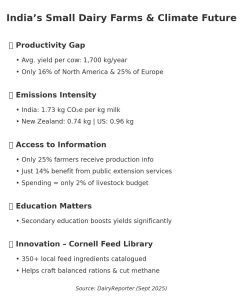
Experts say improving productivity is key. Currently, only 25% of livestock farmers receive production-related information, and just 14% benefit from public extension services—spending which makes up a mere 2% of India’s livestock sector budget. Yet access to quality information alone could boost productivity by 15%, and combining multiple information sources could multiply gains more than fourfold .
Education also plays a crucial role. Farmers with secondary education or higher consistently achieve significantly better milk yields .
A promising initiative comes from Cornell University, which is developing a feed library of over 350 common ingredients used by smallholders. The goal is to help farmers craft balanced rations that minimize enteric methane emissions using available feeds .
Source : Dairynews7x7 Sep 11th 2025 Read full story here