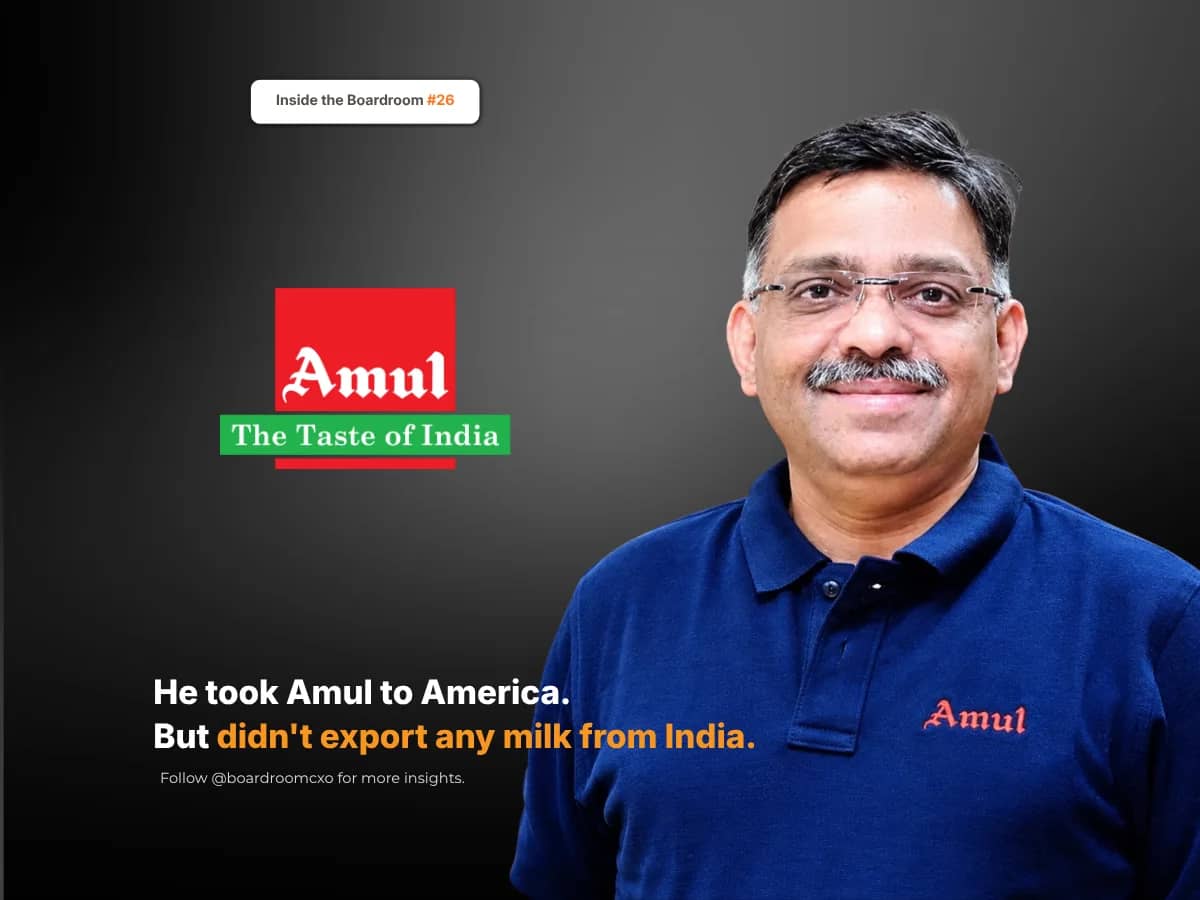
Amul is expanding internationally without shipping milk from India. Under Managing Director Jayen Mehta, the dairy cooperative has adopted a partnership-led strategy in the United States, combining its brand and product expertise with local milk production.
The approach reflects a distinctive business model: Amul's growth is designed around farmer ownership, consumer value and cooperative collaboration rather than shareholder returns.
Amul Crosses ₹1 Lakh Crore Brand Turnover
Amul crossed ₹1 lakh crore in brand turnover in FY26, becoming the first Indian FMCG brand to reach this milestone, according to the Boardroom CXO report.
The Gujarat Cooperative Milk Marketing Federation (GCMMF), which markets Amul, reported turnover of ₹73,450 crore in FY26, an increase of 11.4% from ₹65,911 crore in the previous year. The larger brand turnover figure includes sales generated through district cooperative unions.
Amul is owned by approximately 3.6 million dairy farmers in Gujarat, organised through 18 district cooperative unions. Its cooperative structure places milk producers at the centre of business decisions.
How Amul Entered the US Dairy Market
Amul announced its fresh milk launch in the United States in March 2024 through a partnership with Michigan Milk Producers Association (MMPA), a long-established American dairy cooperative.
The US range included four milk variants:
- Amul Gold
- Amul Shakti
- Amul Taaza
- Amul Slim
The products were introduced in gallon and half-gallon packaging, initially targeting the East Coast and Midwest markets.
The crucial element of the strategy is that the milk is sourced and processed locally by MMPA's farmer members. GCMMF contributes the Amul brand, product formulations and marketing expertise.
By October 2024, Amul Gold had entered Costco's US retail network, with plans to expand distribution further. <Cite refs={["turn168700view0"]}/>
Why Amul's Cooperative Model Matters
Jayen Mehta has repeatedly emphasised that Amul's business purpose differs from that of a conventional listed company.
At the Business Today India@100 summit in August 2025, when asked about a potential IPO, Mehta responded:
"Buy a cow, become a member of the cooperative."
The statement reflects Amul's ownership philosophy. Rather than prioritising shareholder returns, the cooperative seeks to provide competitive value to consumers while maximising benefits for milk producers.
According to Mehta, approximately 80–85% of what consumers pay goes to producers within the cooperative model.
Amul's Expansion Strategy: Brand, Partnerships and Local Production
Amul's US entry highlights a model of international expansion that does not necessarily depend on exporting finished dairy products.
The approach combines three strategic elements:
- Brand strength: Amul leverages its established identity and consumer trust.
- Local partnerships: Collaboration with MMPA provides access to local milk procurement and processing infrastructure.
- Market access: Retail partnerships, including Costco, help bring products to American consumers.
This strategy offers a potential pathway for dairy businesses seeking international growth while adapting to local supply chains and market conditions.
Jayen Mehta's Leadership: Thinking Like an IT Company
Mehta's management philosophy also reflects an emphasis on technology, innovation and anticipation of consumer demand.
In an April 2026 interview with Financial Express, he described Amul's organisational approach as thinking and working like an IT company—a philosophy the federation adopted in 1995.
Amul has expanded into areas such as protein-rich products, organic offerings, probiotics and dark chocolate while investing in digital tools for farmers. Its AI initiative, Sarlaben, is designed to support Gujarat's farmers through feature phones.
Mehta has also highlighted cooperation among dairy brands, including Amul's collaboration with Karnataka's Nandini in manufacturing and technology-related areas.
What India's Dairy Industry Can Learn
Amul's international expansion offers important lessons for dairy businesses and cooperatives:
- International growth does not always require exporting milk: Brand licensing, partnerships and local production can create alternative routes to market.
- Ownership can shape business strategy: Farmer-owned structures can prioritise producer returns alongside consumer affordability.
- Technology is becoming central to dairy competitiveness: Digital services, AI and operational innovation can support farmers and improve business processes.
- Cooperation can strengthen the dairy ecosystem: Knowledge-sharing among cooperatives may help expand organised dairy markets and compete with private and multinational players.
Amul's US strategy demonstrates how an Indian dairy brand can expand globally while retaining its cooperative identity.
The bigger takeaway: Amul is not merely selling dairy products overseas. It is extending its brand and business model into new markets while keeping local farmers and cooperative ownership central to its growth strategy.
Source: Read full story here 03 Nov, 2026 Edited and Reported by
#Amul #IndianDairy #DairyIndustry #DairyBusiness #CooperativeDairy
Never miss an important dairy update
Follow DairyNews7x7 on Google to get live milk prices, policy alerts, and daily headlines directly in your feed.