The Global Dairy Trade (GDT) Event 411, held on 1 September 2026, has delivered a more interesting signal than the headline 0.9% rise in the GDT Price Index suggests. The market has now recorded four consecutive increases, taking the index from 1,140 at Event 409 to 1,166 at Event 410 and now 1,177, but the real story is that Skim Milk Powder (SMP) has traded above Whole Milk Powder (WMP) for the first time since August 2022.
The auction itself showed strong market participation. 157 bidders participated, 115 became winning bidders and 43,976 MT was sold through 17 bidding rounds over 2 hours and 46 minutes. Sellers had indicated a supply range of 39,005–46,146 MT, meaning the quantity actually sold was towards the upper end of the available range and was about 7.1% higher than the previous auction. The average winning price across products rose to USD 3,910/MT, up from the previous event.
What makes Event 411 particularly significant is the divergence within the powder market. SMP jumped 5.3% to USD 3,695/MT, while WMP slipped marginally by 0.1% to USD 3,585/MT. SMP is therefore now USD 110/MT more expensive than WMP, an unusual reversal because WMP normally commands a premium due to its fat content and stronger demand profile. Historical analysis of GDT results indicates that SMP has exceeded WMP only nine times in more than ten years, with the previous occurrences concentrated around the exceptional 2022 market.
The SMP movement is arguably the strongest signal from this auction. The 5.3% rise takes SMP to USD 3,695/MT, suggesting that buyers are increasingly willing to pay for skim solids even while WMP remains relatively well supplied. Fonterra's forecast offer quantities for Event 411 were 9,138 MT of SMP compared with 23,898 MT of WMP, and the forward supply profile indicates considerably more WMP availability than SMP. This difference in supply structure is one reason why SMP is currently outperforming WMP.
The rest of the commodity basket reinforces the selective nature of the recovery. Butter Milk Powder rose 4.6% to USD 4,136/MT, while Lactose increased 2.0% to USD 1,910/MT, reaching a new high according to market reporting. Mozzarella was almost stable, increasing 0.3% to USD 4,244/MT. These movements suggest that demand for certain specialised ingredients remains resilient even though the broader dairy market has not entered a uniform upswing.
The fat and cheese markets, however, continue to tell a different story. Anhydrous Milk Fat (AMF) declined 1.3% to USD 5,917/MT, while Butter fell 0.8% to USD 5,028/MT. The sharpest decline came from Cheddar, down 6.6% to USD 3,503/MT. This confirms that the recovery in the GDT index is being driven primarily by powders and selected ingredients rather than by a broad-based strengthening of dairy commodities.
The underlying market message from the developed exporting regions is therefore becoming clearer. Milk supply and product availability are sufficient to keep pressure on milk-fat products, while the supply-demand balance for skim solids appears tighter. Fonterra's Event 411 forecast supply was higher than Event 410 for WMP, SMP, AMF and Butter, but the absolute volume of WMP remains much larger; this helps explain why additional WMP availability can cap its price even while SMP attracts stronger buying interest.
On the demand side, I would interpret the current movement as replenishment rather than aggressive speculative buying. The four consecutive increases show that buyers are no longer waiting for substantially lower prices, but the fact that WMP has barely moved while SMP has risen sharply indicates that buyers are discriminating between products rather than simply returning to the market with a blanket buying programme.
There is also an interesting geographical dimension emerging. GDT connects suppliers with buyers from more than 60 countries, and the resilience of powders is consistent with continuing demand from Asia, the Middle East and Africa, where milk powders remain important for recombination, food manufacturing and consumer dairy products.
For me, however, the most important question is whether China returns as a stronger buyer or whether demand from other importing regions can sustain this recovery. A broad-based Chinese inventory rebuild would materially change the outlook for WMP; without it, the present market could remain characterised by strong SMP and ingredient demand but relatively restrained WMP buying.
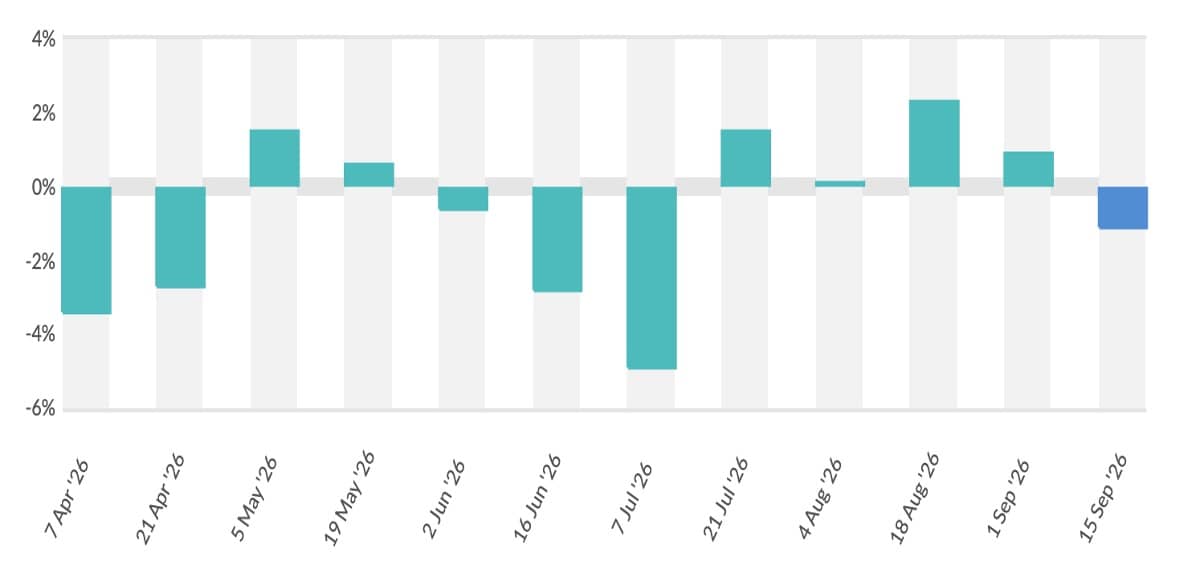
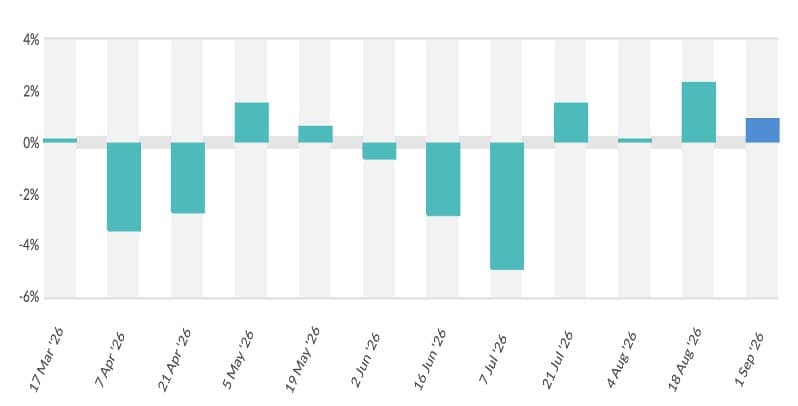
Looking at the GDT index since the beginning of 2026, the pattern has been anything but linear. The market strengthened sharply through February and early March, with increases of 3.6% on 17 February and 5.7% on 3 March, before correcting through April. It then recovered modestly in May, weakened again in June and July, including a 4.9% fall on 7 July, and has since produced four consecutive increases: 1.5% on 21 July, 0.1% on 4 August, 2.3% on 18 August and 0.9% on 1 September. The latest sequence indicates that the market has moved from correction towards consolidation, but it is still too early to call it a new commodity super-cycle.
My assessment for the next two to three months is cautiously positive for SMP and moderately positive for powders overall, but much more cautious for fats and Cheddar. The NZX futures curve on 1 September was also pointing towards stronger powder values: WMP futures moved from around USD 3,705/MT for September to USD 3,900 in November and USD 4,095 in March 2027, while SMP moved from around USD 3,665 in September to USD 3,800 in November and USD 3,820 in March. This does not guarantee higher GDT prices, but it does indicate that market participants are currently pricing in a firmer medium-term powder market.
I would therefore expect SMP to remain the strongest major powder over the next quarter, with WMP likely to move more gradually unless Chinese demand accelerates. Butter and AMF could remain range-bound or under pressure if milk-fat availability stays comfortable, while Cheddar needs a meaningful improvement in cheese demand before a sustained recovery can be expected.
For India, Event 411 deserves close attention. SMP at USD 3,695/MT materially strengthens the international reference price for skim solids at precisely the time when India's domestic milk availability is moving towards the leaner part of the cycle. This can provide support to Indian SMP realisations and improve the economics of converting surplus skim solids into powder, although the benefit will depend on domestic milk procurement costs, inventories and the rupee-dollar exchange rate.
The picture for milk fat is different. AMF at USD 5,917/MT and Butter at USD 5,028/MT are substantially softer than their earlier levels, which reduces the international replacement-cost pressure on Indian butter and ghee. But Indian dairies should not assume that cheaper global fat automatically means cheaper domestic milk: buffalo milk availability is declining across many parts of India and cow milk is also approaching the lean season, so domestic procurement economics could remain firm even while global fat prices soften.
There is another important implication for Indian dairy processors. The unusual inversion of SMP above WMP indicates that the global market is increasingly valuing the individual components of milk differently. For India, where buffalo milk provides a relatively high-fat stream, this could reinforce the importance of deciding carefully between fat-rich products such as ghee/butter and protein/solids-oriented products such as SMP and high-protein dairy ingredients, rather than relying on a single global dairy commodity trend.
In short, GDT 411 is not simply another positive auction. It may be signalling a change in the structure of the global dairy market. Four consecutive increases indicate that the correction may have found a floor, but the extraordinary performance of SMP versus WMP suggests that the next phase could be driven more by protein demand and skim-solid availability than by the traditional milk-fat cycle.
The next two or three GDT events will be crucial. If SMP remains above USD 3,600 and WMP begins moving decisively above USD 3,600–3,700, the recovery will look increasingly structural. If WMP remains flat and fats continue falling, however, Event 411 may ultimately prove to be a selective powder-led recovery rather than a broad global dairy bull market.
Source: Global Dairy Trade, Event 411, 1 September 2026. GDT Product Results
Event 411 — key numbers at a glance
GDT Price Index: +0.9%; index level 1,177; average winning price USD 3,910/MT.
SMP: +5.3%, USD 3,695/MT | WMP: −0.1%, USD 3,585/MT | BMP: +4.6%, USD 4,136/MT | Lactose: +2.0%, USD 1,910/MT | Mozzarella: +0.3%, USD 4,244/MT | AMF: −1.3%, USD 5,917/MT | Butter: −0.8%, USD 5,028/MT | Cheddar: −6.6%, USD 3,503/MT.
Transactions: 43,976 MT sold; 157 participating bidders; 115 winning bidders; 17 bidding rounds; 2 hours 46 minutes; supply range 39,005–46,146 MT.
Source : Review of GDT 411 event by Kuldeep Sharma Chief Editor Dairynews7x7 Sep 02nd 2026