The Cow Was Not Domesticated With the Idea That There Is Divinity in It
Kharwas, a pudding made from the colostrum of cows, is, or should be, a nation-defining artefact. It’s a sort of steam-cooked, coagulated, first milk dhokla: an amuse-bouche that’s very slightly, lactically sweet, dressed in a negligee of saffron, that starts off smelling of the insides of the udder and the saliva of the new-born calf, and then gives off on the palate the corrupting flavours of the fruits of rapine, of the taking of something precious that isn’t rightfully yours.
Colostrum is the foremilk of a mammal, the slightly yellowish first milk produced after birthing a new-born. It is an evolutionary product for the nourishment of the infant, a rich, creamy elixir that is the coalition of lipids and lactoferrin and immune cells and signalling peptides that give natural immunity to the new-born calf, which it must receive within six hours of life. For there is no transfer of immunity from the placenta in the cow.
Scientific dairy farming practices must be instilled
Article 48 of the constitution of India makes it a duty of the state, while making laws, to organise animal husbandry on modern and scientific lines, and in particular, to preserve, protect and improve the stock of the exalted Mother-Goddess Bos indicus and her male companions and offspring. The other half of the same article exhorts the state to legislate against its slaughter. In the constituent assembly debates, it’s clear that the insertion of the article and its phrasing is made to look like it had little to do with the avowed sacredness of the cow and everything to do with her inguinal teats and lactational biology. And draft animal power for her kindred males (the tractor was unknown then).
A farmer uses cattle to till his land. Photo: Ananth BS/Wikimedia Commons CC BY 2.0
What was invoked was the secular and economic ‘use-value’ of cattle in a predominantly agrarian economy. There were calls from a few members of the constituent assembly to install an article banning cow slaughter in the fundamental rights of the constitution, which would have given the cow a distinctive constitutional protection, but it was on Ambedkar’s leaning on the fulcrum that the article was inserted as a directive principle of state policy (not enforceable by any court) and not as a fundamental right. Even so, at least two Muslim members felt that getting the article in was a double move – of slaking Hindu sentiment while seemingly not doing so by using the whole economic ‘use-value’ argument.
Cattle population growth
In 2016-17, the secretions of lactating bovines in India crossed 165 million tonnes. That’s more than three times the milk produced in China and about a fifth of the milk in the world. Milk has become the motherland’s no. 1 agricultural produce. For the first time in the history of the republic, the value of milk produced exceeded the total value of food grains i.e. cereals plus pulses. At Rs 6 lakh crore, milk alone, officially, contributes one fifth of agricultural GDP by value. The milch animal population of India is a little over 13.5 crore. As the number of teats in an animal vary by mammalian species to correspond to the size of the average litter for that animal, at four teats to the female adult bovine, that explains the 50 crore milk drinkers of our country. In our multitudes, every day, we are drinking a secretion which has the only evolutionary purpose of turning a 65-pound calf into a 400-pound cow as soon as possible.
Like all animals, cows raised for milk need to be pregnant in order to produce milk. The optimal lactation period for Indian breeds is about 260 days. Within three months of giving birth, the cow is made pregnant again. That means they’re pregnant and lactating for at least seven months a year. And then, pulling on the plasticity of bovine reproductive function, they’re made to calf once a year for maximum profit. So that we could drink the milk that was intended for the calf, which is only allowed a bit of a suckle every time to make the teat erect for milking and for the ‘let-down’ reflex. Then it is separated but kept in sight.
Breed improvement
To make plain the meaning of the constitutional phrase ‘improvement of stock along scientific lines’ aka nasal sudhar would call for disclosure of something mildly scandalous to those not familiar with dairying practices. This isn’t really meant as an expectorant for your loathing, but as anyone from the field of animal husbandry will tell you – if you wish to maintain your piety for the cow or your appetite for her produce, you’ll be well-advised not to be present while they’re being impregnated or milked.
The most inexpensive way of impregnating a cow is by artificial insemination (AI). A straw of semen costs anywhere between Rs 30 to 200 depending on the breed of the bull and the yield of its mother. The AI ‘worker’ is an itinerant technician who arrives on a motorcycle with a briefcase (that has his kit) and a thermos flask (that has a bunch of semen straws in liquid nitrogen). It starts with the immobilisation of the cow in a frame that PETA calls a rape rack. The other way is just tying the hind legs to each other and four people restraining the animal with a series of chains and ropes. The AI worker puts on a plastic glove all the way to the left shoulder and shoves his left arm into the rectum of the cow. The rectum in cows is a thin walled, pliant tube directly above the vagina. The left-hand inside is meant to use the rectum as a sleeve to hold and manipulate the underlying cervix while a steel AI gun loaded with the straw is blindly pushed into the vagina and then onwards through the cervix into the uterus to make the deposit. Notwithstanding the Rabelaisian flow of the procedure, AI is an incredibly efficient way of getting a cow pregnant. Whether it qualifies as sexual assault of the cow I shall leave till you’ve seen the YouTube tutorial. In 2017-18, the Department of Animal Husbandry of the Ministry of Agriculture had an ambitious target of 100 million AIs. It could only manage 26 million. It laid the blame on the worker who averaged just 1.92 inseminations a day against a target of five.
Milk productivity shall be the focus
All nasal sudhar is to increase the milk yield. To bring it as close to the 25 litres a day produced by the eminently instagrammable Holstein Friesians (HF) and the Jerseys. So, the more expensive semen is that belonging to the crossbred HF-Gir and HF Sahiwal, engineered to double the productivity of the non-descript, desi, poor milchers, to make their udders shapelier and more resistant to mastitis. But the most expensive semen (at 2000 rupees a straw), the one that’s about to bring forth the true revolution, is the sexed semen. It’s a truism that the biggest problem of the dairy sector is the male calf, considered a waste product. A sperm cell sorting technology is being used to isolate gender skewed sperm that promises a 90% success at producing female calves. It seems ‘only cows’ is how we’re set to meet our national goal of 300 million tonnes of annual milk production by 2024.
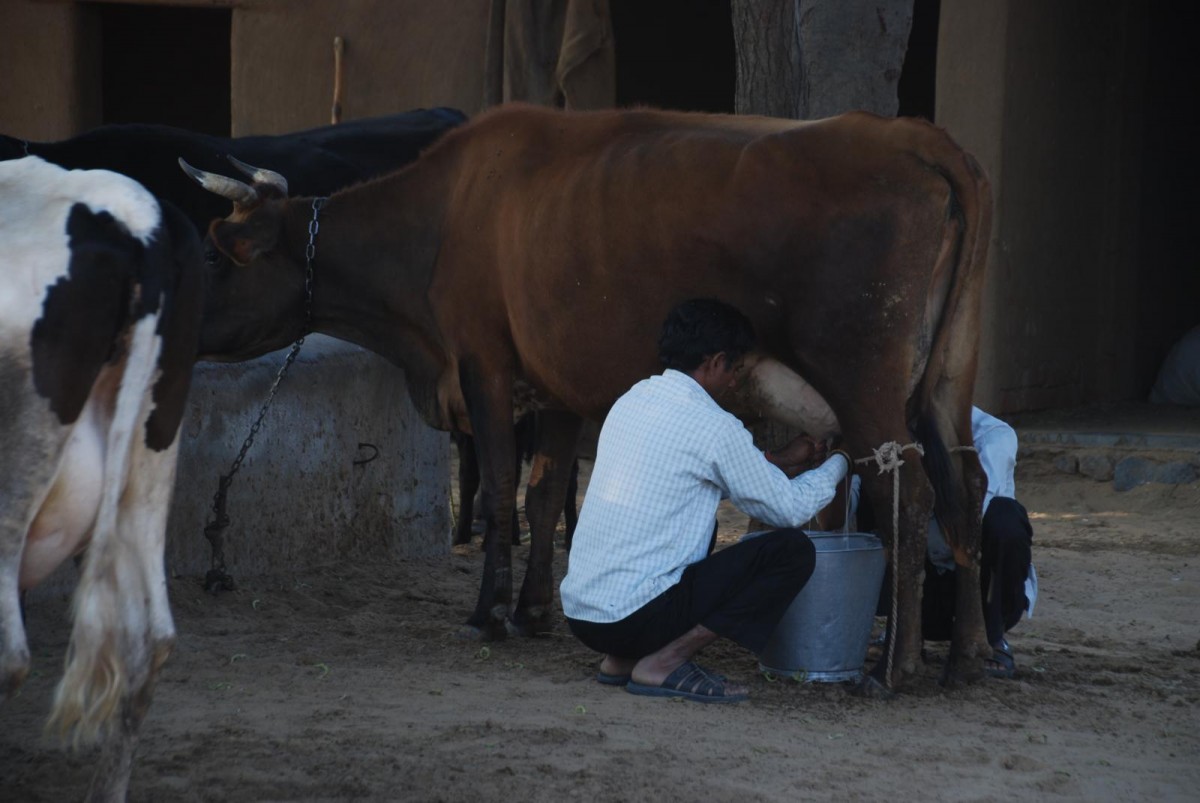
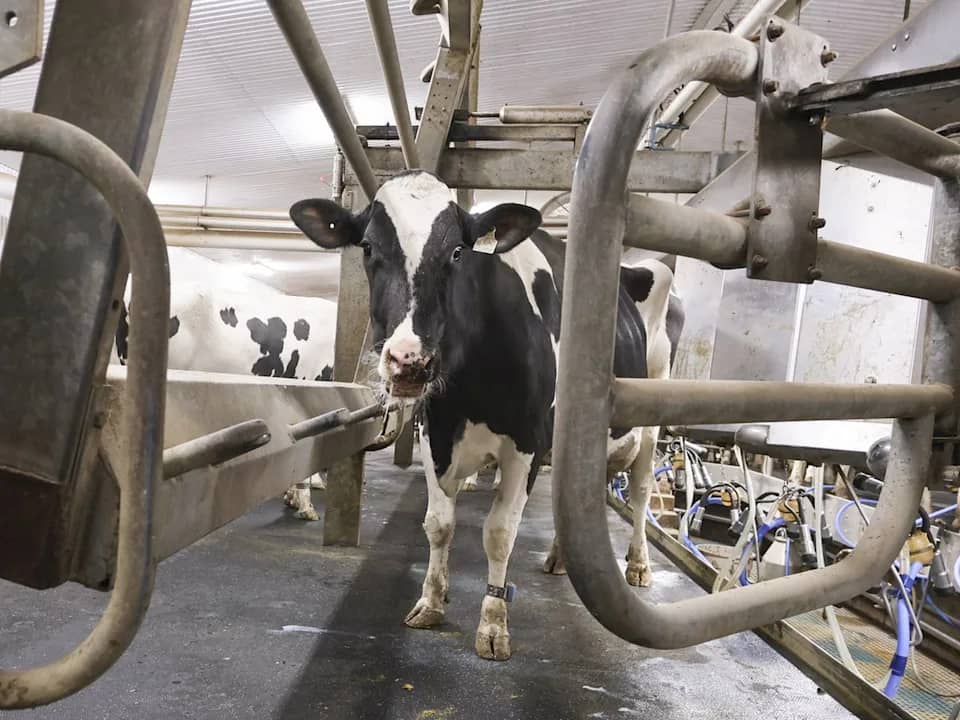
A man milking a cow. Photo: Matthew Stevens/Flickr CC BY NC ND 2.0
From thence would arise the question of whether the cow is a person or a thing? Or a sentient non-person? Is this nomination based on policy, theology, biology? Would the pious allow the cow to be entitled to the rights and protections afforded by the writ of habeas corpus?
It’s entirely possible that the founding fathers of our constitution had a sense of humour, that article 48 was indeed a double move, written in the format of a parable, with an inbuilt irony and ambivalence, hoping that the zoosadism of ‘improvement of stock’ along scientific lines will provide the orthogonal view to the worship of the cow. That she cannot be the sacred embodiment of Kamdhenu. That ‘33 crore Gods in her anatomy’ was a caricatured form, a special subdivision of fiction that has done terrific damage to Hindu intelligence.
Financial and Nutritional security
That she’s not a Mother-Goddess, not even a person. To unreservedly use the cow for profit would mean being sane, secular, realistic. And smart enough to realize that we did not, do not domesticate the cow with the idea that there is divinity in it, but to satisfy human needs and aesthetic values and the economy.
It’s not the farmers who are quaveringly pious about the cow. For what god-fearing piety will allow the breeding of a mother goddess to keep her pregnant (in succession) only to steal her lactational secretions for profit. And then send her to a milking competition. And call her inviolable.
Ambarish Satwik is a Delhi based vascular surgeon and writer. His debut novel Perineum: Nether Parts of the Empire, a rogue sexual history of the British Raj, was published in 2007 by Penguin.
Published in The wire on Dec 19th 2020 ,written by Ambarish Satwik and This article was first published by BusinessLine in 2018 and is republished in The wire with the author’s permission.