For five years, the story of India dairy exports was ghee, butter and cheese. In the first half of FY27, the baton passed to milk powder. Now the trade has to decide whether to sell that powder in the flush or keep it for a summer that may bring record SMP prices.
By Kuldeep Sharma, Chief Editor, DairyNews7x7
Picture two plant owners this week. One in Maharashtra dries cow milk that costs him about ₹48 a kilo. The other in western UP dries buffalo milk at ₹67–68. A buyer in Dhaka offers both of them SMP at $3,700 a tonne, and the flush has still not come. Should they sell?
It is the right question, and the whole industry is asking it. Between April and September 2026, India shipped 11,952 tonnes of skimmed milk powder. That is more in six months than in any full year since FY23. September alone sent 3,110 tonnes overseas. And on 17 November, Global Dairy Trade cleared SMP at $4,190 a tonne, while butter fell to $4,200 and AMF to $4,880.
Powder is now worth as much as butter in the world market. That does not happen often. This piece is about what that means for India dairy exports: what we exported, at what price, to whom, and whether we should keep selling.
India dairy exports: fat and cheese ran the last rally, powder runs this one
For five years, our dairy export story was a fat story. Between FY22 and FY25, exports of butter, ghee and milk fats nearly doubled, from US$197 mn to US$380 mn, on the back of Gulf butter tenders and steady diaspora ghee. Cheese grew every single year, from US$37 mn to US$61 mn. SMP did the opposite. It fell from 46,293 tonnes in the surplus year FY22 to barely 5,000–7,000 tonnes a year after that.
The first half of FY27 has turned that pattern on its head. Total India dairy exports barely moved in value, at US$220.7 mn against US$219.5 mn. Underneath, the basket changed completely.
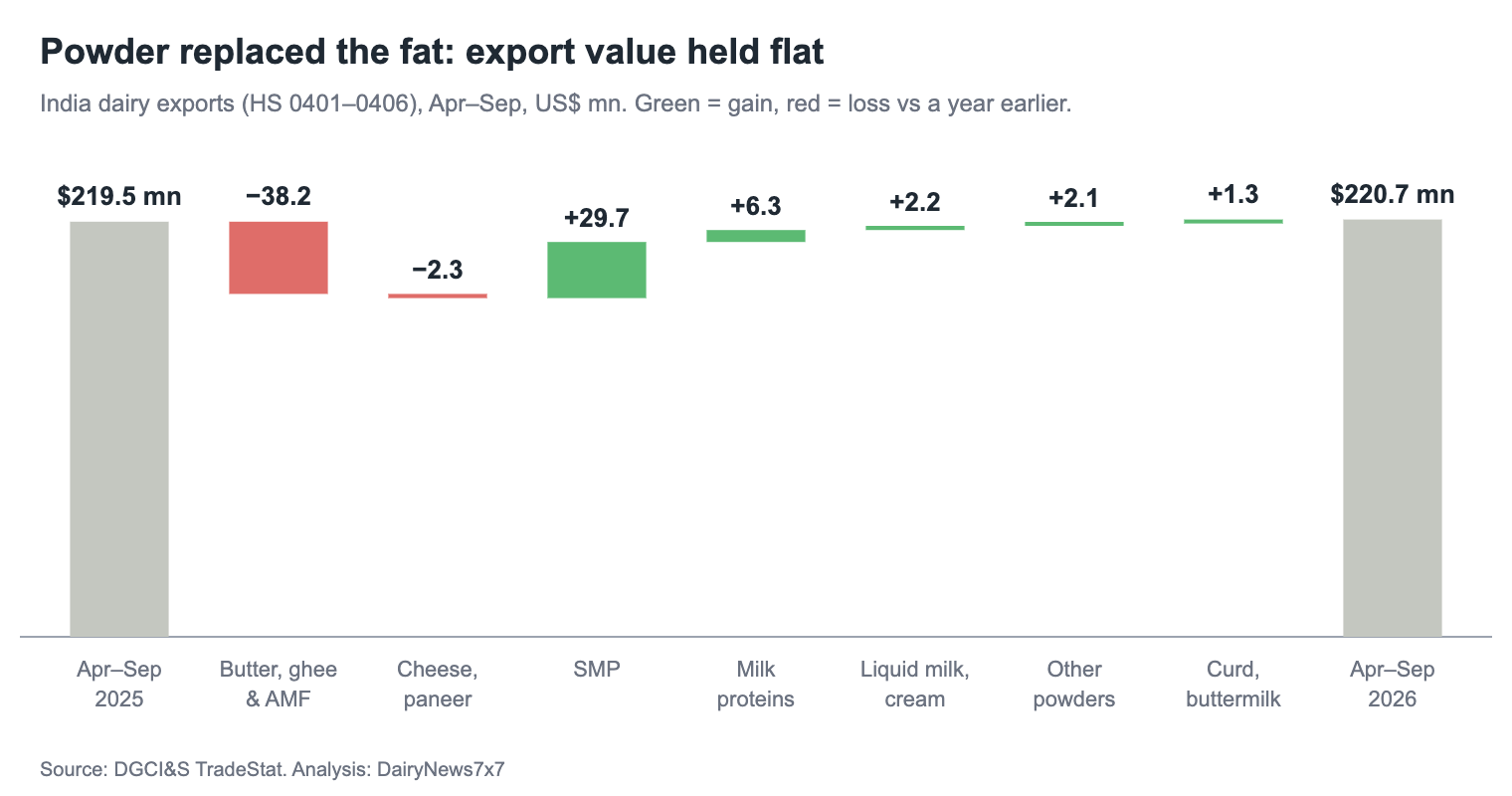
The US$38 mn lost in fats came almost entirely from butter. The bulk tender buyers of FY25 did not return: Bahrain fell from 2,049 to 280 tonnes and Saudi Arabia from 2,064 to 757. Powders filled the hole. Milk fats' share of export value fell from 73% to 55%, and milk powders rose from 6% to 21%. Ghee, at US$58.5 mn, is still our largest single line. SMP, at US$36.7 mn, is now second.
Cheese held its tonnage (6,310 tonnes, up 1%) but lost 7% in value, mainly because processed cheese got cheaper. September was its best month, up 20%. Cheese has not lost its way; it has simply been overtaken.
We now sell at New Zealand's price, and in one product, above it
For years we told ourselves Indian dairy was too costly to export except in a glut. The numbers no longer say that. In 2025, Indian SMP sold within 2% of New Zealand's export price, Indian cheese 2% above it, and our milk fats (mostly ghee) within 4%. Butter is the one exception: a 34% discount, because most of it goes as bulk cooking butter into Gulf and North African tenders.
| Product | India export price, Apr–Sep 2026 (US$/t) | India vs New Zealand, 2025 | GDT, 17 Nov 2026 (US$/t) | Where India stands today |
|---|---|---|---|---|
| SMP | 3,069 | −2% | 4,190 | At parity on what we shipped; Indian offers near 3,700 now trail GDT |
| Ghee | 7,557 | −4% (all milk fats) | AMF 4,880 | A diaspora premium the world price cannot touch |
| AMF and other milk fats | 6,631 | −4% (all milk fats) | AMF 4,880 | Priced out: world AMF has fallen below Indian cost |
| Butter | 5,387 | −34% | 4,200 | Priced out: domestic butter near ₹540/kg is about US$5,700 |
| Cheese | 4,675 | +2% | Cheddar 3,820 | At or above the world price |
India export prices: DGCI&S. India vs New Zealand: UN Comtrade unit values, calendar 2025. GDT: event 416. Rupee at about ₹95 to the dollar.
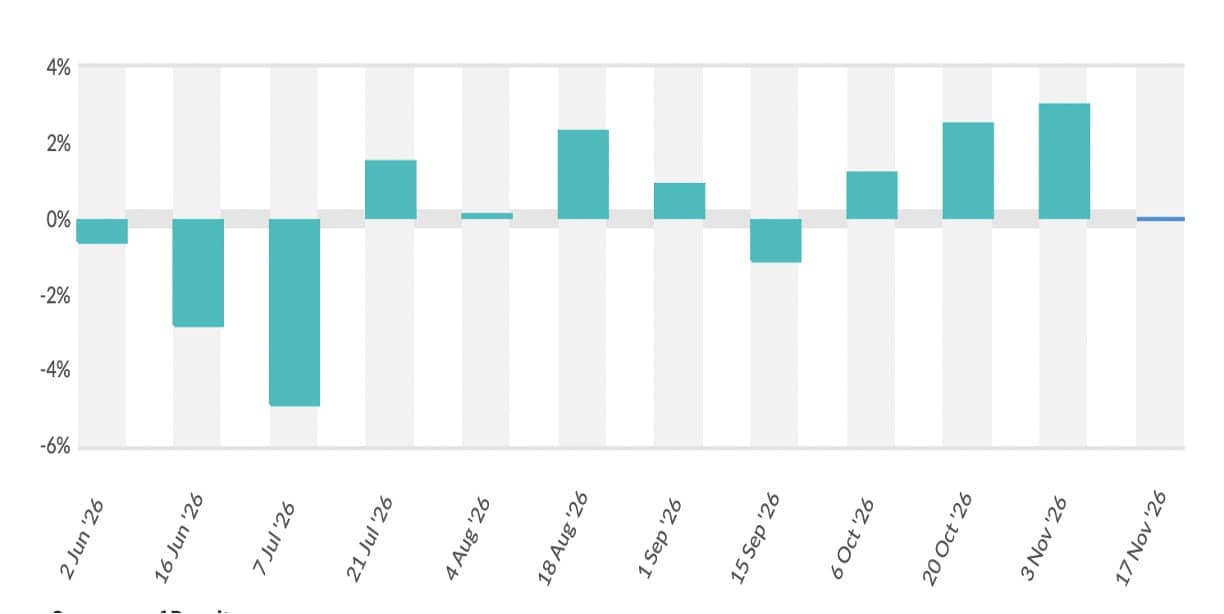
Read the last column twice. Our powder is cheap against the world today, and our fat is dear. In March, GDT butter stood near US$6,700; since then it has lost 37.5% in 11 straight auctions, while SMP has climbed a third since July. That one flip explains most of this year's export table.
The ghee line deserves a moment of pride. At US$7,557 a tonne, Indian ghee in Dubai, New Jersey and Sydney earns 55% more than New Zealand AMF at GDT. That is not a commodity price. That is a brand, built by households who would not cook with anything else.
New markets for India dairy exports are opening, quietly
The headline numbers hide a more hopeful story. Indian SMP exports now go to 20 countries, against 12 a year ago. Bangladesh still takes 54% of them, and that dependence worries me as much as ever. But the UAE has become a real second buyer at 3,486 tonnes, much of it for re-export, and Yemen has appeared from nowhere as the third.
| Market | Product | Apr–Sep 2026 | A year earlier |
|---|---|---|---|
| Yemen | SMP | 1,092 t | New |
| Bahrain | Milk proteins and dairy ingredients (0404) | 519 t, US$3.9 mn | New |
| Saudi Arabia | Milk proteins and dairy ingredients (0404) | 391 t, US$2.6 mn | New |
| Russia | AMF and other milk fats | 601 t | 100 t |
| Egypt | Butter oil | 580 t | 151 t |
| Bahrain | Cheese | US$2.8 mn | +78% |
| Philippines | Cheese; liquid milk | US$0.9 mn; 960 t | Doubled; 175 t |
| USA | Paneer | 39 t | 2 t |
| Saudi Arabia | Curd, lassi and buttermilk | 100 t | New |
Source: DGCI&S TradeStat, commodity-wise exports by country.
The two Gulf lines for milk proteins excite me most. At about US$7,700 a tonne, Gulf processors are buying Indian dairy ingredients, not just commodity powder. That is the direction our plants should be pulling: protein, not just skim.
The paneer number is tiny. But 2 tonnes to 39 tonnes suggests Indian paneer is finding its way into the American cold chain. Many more diaspora cities could follow.
What SMP, butter and AMF futures are telling us
The Singapore-traded NZX futures are the closest thing the dairy world has to a weather forecast. Here is what they said this week.
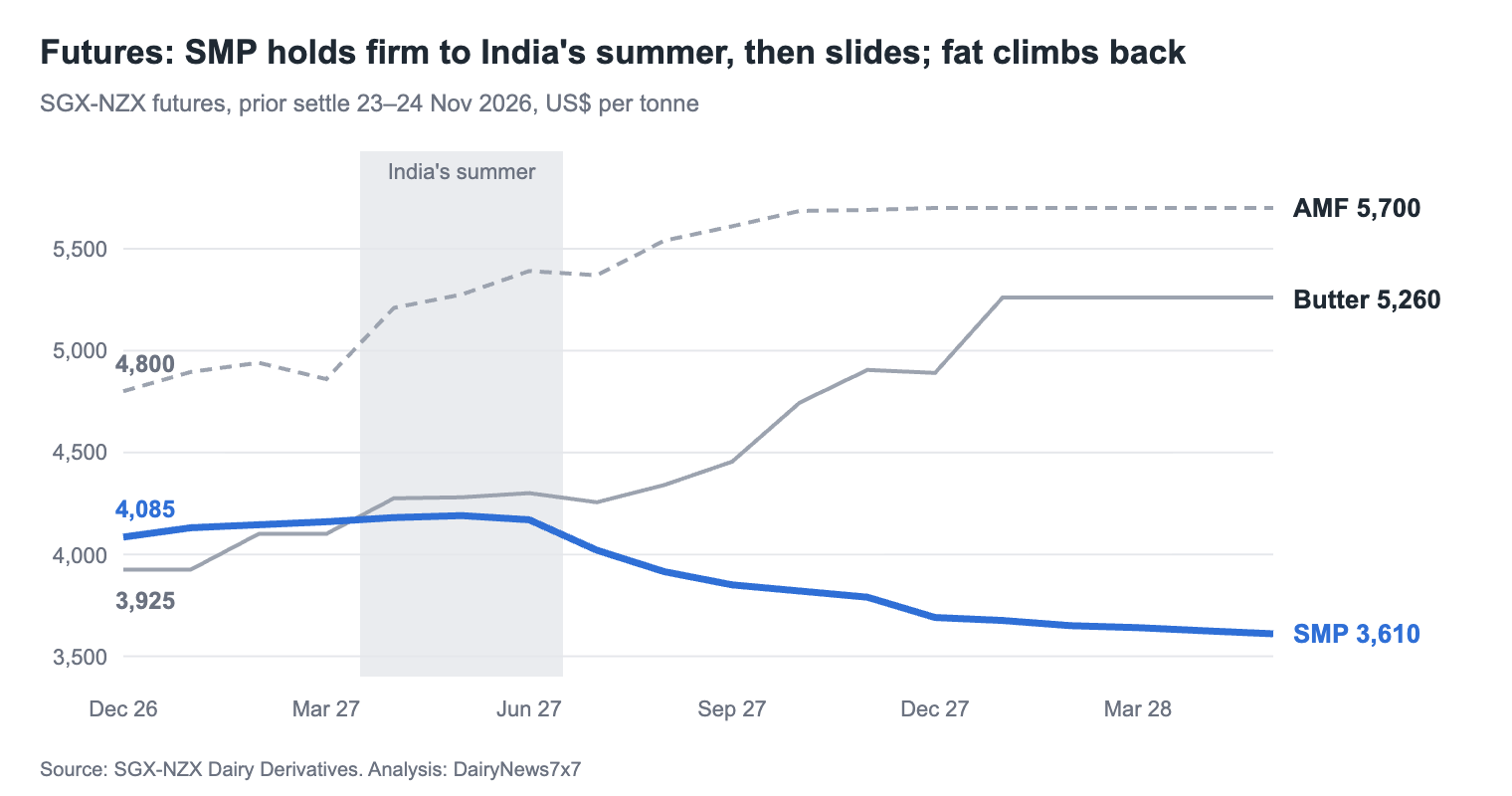
SMP stays strong right through our summer, then falls. The curve sits between US$4,085 and US$4,190 from December to June 2027, almost exactly today's GDT price. After that it slides to about US$3,600 by early 2028. The market is not betting on a further rise. It is betting that today's tightness lasts about seven months.
Butter and AMF have probably found their floor. Butter futures for December and January sit at US$3,925, below today's GDT. From there the curve climbs to US$4,900 by late 2027 and US$5,260 in 2028. AMF follows the same path, from US$4,800 to US$5,700.
In plain words, the world is telling us: sell protein now, and do not dump fat now. That happens to be exactly the opposite of what India did in FY25, when we shipped butter by the shipload while powder sat in godowns.
Sell SMP now, or wait for summer?
Now to our two plant owners. Milk is not cheap anywhere. Amul now pays ₹1,000 for every kilo of fat. The flush, which normally runs from October to February, is late and thin. Domestic SMP averaged ₹295 a kilo in October, 15% above a year ago. But the two plants live in very different markets.
Here is my back-of-envelope arithmetic, done the way a plant manager would do it. Take 100 kg of milk, split it into powder and butter, value each at the market, take off the conversion cost, and compare with what the milk cost.
In Maharashtra, cow milk at 3.5% fat and 8.5% SNF costs about ₹48 a kilo. It gives 8.7 kg of SMP, selling at about ₹300, and 4.15 kg of butter at ₹540. In UP, buffalo milk at 6.5% fat and 9.0% SNF costs ₹67–68. It gives 9.2 kg of SMP, which fetches about ₹330 there, and 7.68 kg of butter at ₹550. Conversion costs about ₹20 a kilo of SMP and ₹7.5 a kilo of butter.
Work it through for the Maharashtra plant selling at home. Powder brings ₹2,610 (8.7 × ₹300) and butter ₹2,239 (4.15 × ₹540).
Conversion takes ₹205 (₹174 for drying, ₹31 for churning). That leaves ₹4,644, or ₹46.4 for each kilo of milk that cost ₹48. The plant loses ₹1.6 on every kilo it dries.
| Route | Maharashtra cow milk (cost ₹48/kg) | UP buffalo milk (cost ₹67–68/kg) |
|---|---|---|
| SMP and butter both sold at home | earns ₹46.4: −₹1.6 | earns ₹70.2: +₹2.2 to +₹3.2 |
| SMP exported at US$3,700 (₹352), butter at home | earns ₹50.9: +₹2.9 | earns ₹72.2: +₹4.2 to +₹5.2 |
| Both exported (AMF at GDT US$4,880, ₹464) | earns ₹44.3: −₹3.7 | earns ₹59.1: −₹7.9 to −₹8.9 |
| SMP price needed to break even at home | about ₹318/kg (today ₹300) | about ₹295–306/kg (today ₹330) |
Earnings per kg of milk, after conversion costs of ₹20/kg SMP and ₹7.5/kg butter (₹2.05 per kg of cow milk, ₹2.42 per kg of buffalo milk). Indicative only, at late-November 2026 prices and about ₹95 to the dollar. Export freight and port costs are not deducted; at ₹8–15 a kg of SMP they would trim the export margin by about ₹1 a kg of milk.
Three things jump out.
First, the fat stays home. Separated fat earns 35–40% more in India than at GDT today. Indian butter near ₹540 a kilo is about US$5,700 a tonne; world butter is US$4,200. Our ghee shelves are thin and our festival demand is strong. Exporting bulk fat now would be selling our scarcest product at the world's cheapest price. The one exception is ghee in diaspora packs, which still fetches US$7,500 and should keep flowing.
Second, the cow-milk plant needs the export market. The buffalo-milk plant does not. In Maharashtra, selling everything at home loses ₹1.6 on every kilo of milk. Exporting the powder turns that into a profit of about ₹3, a swing of ₹4.5. That is the difference between running the dryer and switching it off. In UP, buffalo milk still earns ₹2–3 a kilo at home, and exporting the powder adds only about ₹2 more, because UP SMP at ₹330 is already close to export parity.
The reason is fat. In the buffalo plant, butter brings in ₹42 of every ₹73 earned before conversion, nearly 60% of the revenue. In the cow plant it brings in only ₹22 of ₹48.
A cow-milk plant is really a powder business and lives or dies by the SMP price. It needs about ₹318 a kilo just to break even, against ₹300 today and a previous peak of about ₹330. A record SMP price this summer is not a speculator's dream; at today's milk price, it is roughly what Maharashtra needs to stay afloat. A buffalo-milk plant is a fat business that covers its milk even with powder at ₹295–306. That is the milk fat shortage I wrote about two weeks ago, seen from the plant floor.
Third, waiting for summer is a bet, not a plan. Yes, Indian SMP may well touch prices never seen before. The previous peak was about ₹330 a kilo in late 2022, and stocks today are thinner than they were then. But to beat a US$3,700 sale today, powder held until May has to fetch roughly ₹365–370 a kilo at home, once six months of interest and storage are added. That is more than 10% above anything we have seen. And the futures say the world price will not follow us up; it starts falling from July.
My own view is to do both, in measure. Sell part of the flush powder forward now, while buyers pay US$3,700 or more and the curve supports it to June. Keep the rest for our own summer, because a country that exports its powder in December and imports it in May has learned nothing from 2022–23. And keep every kilo of fat at home until the world price climbs back above ours.
That is why I keep asking for a national stock register. A plant owner in western UP should not have to guess how much SMP the country holds before he decides to sell 500 tonnes to Dhaka.
The lesson in the baton change
In our five-year export review I called SMP a flush-season outlet, not a growth engine, and said that India's real export strengths are ghee and cheese. This half-year does not change that. It adds a footnote: when the world pays a protein premium and the home market pays a fat premium, a smart dairy sells each component where it earns most.
That is what the first half of FY27 shows for India dairy exports. Our powder is at the world price, our cheese is level with New Zealand, our ghee earns a premium, and we have quietly found buyers in Yemen, Bahrain, Saudi Arabia and Russia. None of this was true five years ago.
What we still lack is a view of our own stocks. The futures screen in Singapore tells us what the world thinks SMP will be worth next May. Nobody can tell us how many tonnes of SMP sit in Indian godowns tonight. Until we fix that, every export decision this winter will be half judgment and half gamble.
Sell the powder in measure. Keep the fat at home. And let us start counting.
Source: Editorial by Kuldeep Sharma, Chief Editor | DairyNews7x7
References
- DGCI&S TradeStat: monthly HS-level exports, Apr–Sep 2026
- UkrAgroConsult: GDT event 416, 17 November 2026
- SGX-NZX: SMP futures, butter futures and AMF futures
- CLAL: India average SMP price
- Dairy Desk: dairy ingredient market prices
- The Hans India: India's white revolution meets a hard winter
- Dairy News Today: Amul fat-linked procurement rate
- UN Comtrade: dairy export unit values, 2021–2025
Never miss an important dairy update
Follow DairyNews7x7 on Google to get live milk prices, policy alerts, and daily headlines directly in your feed.