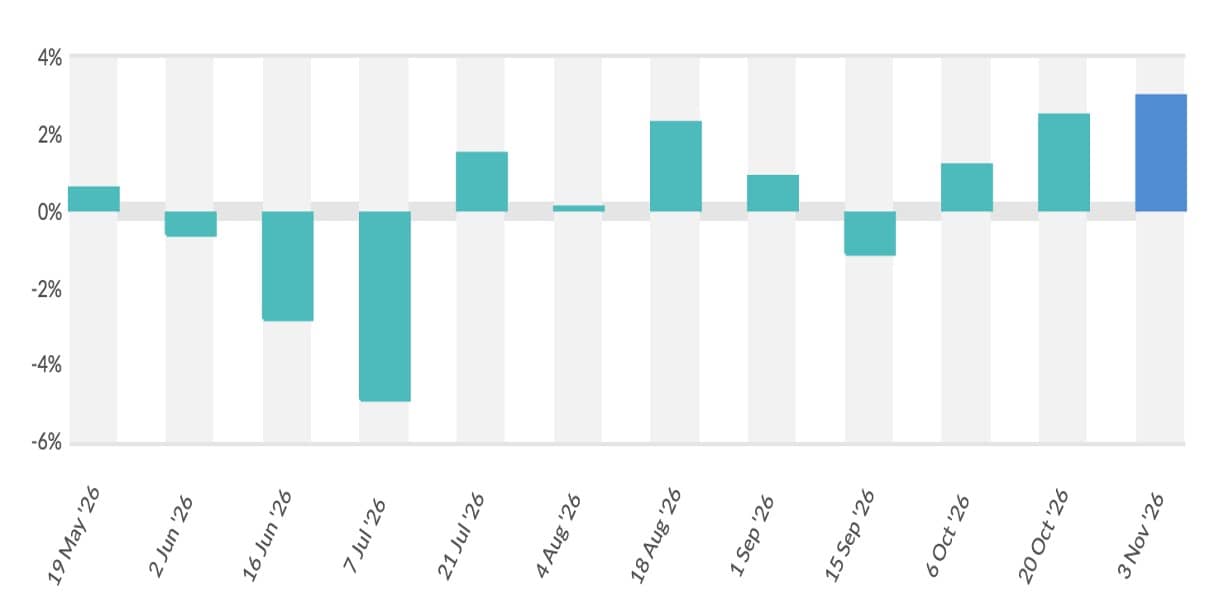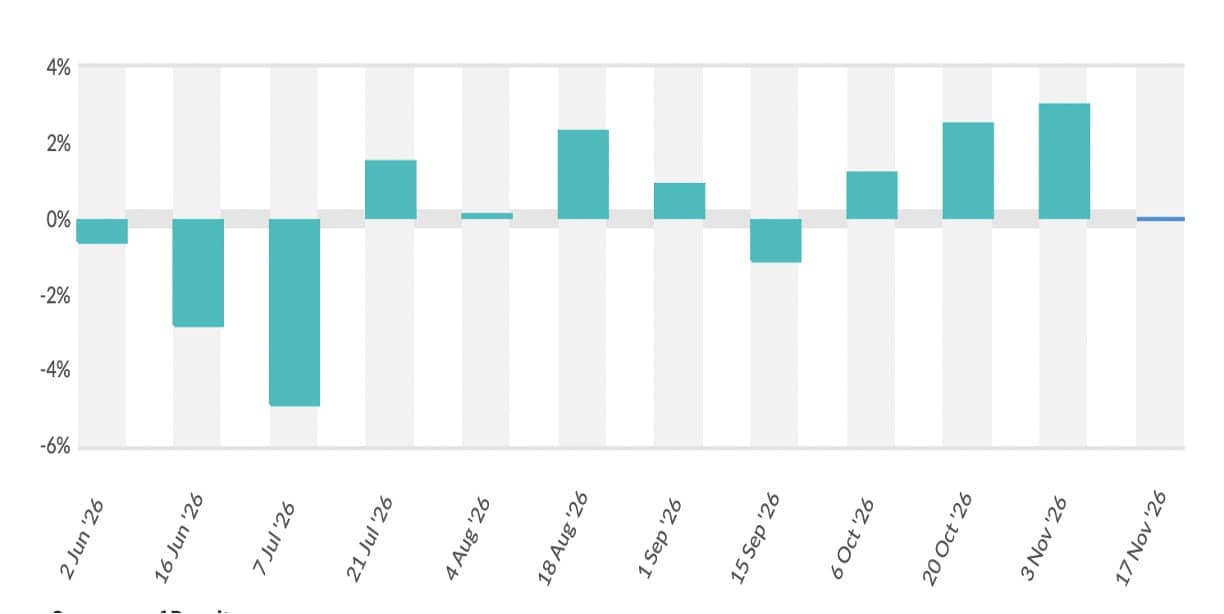
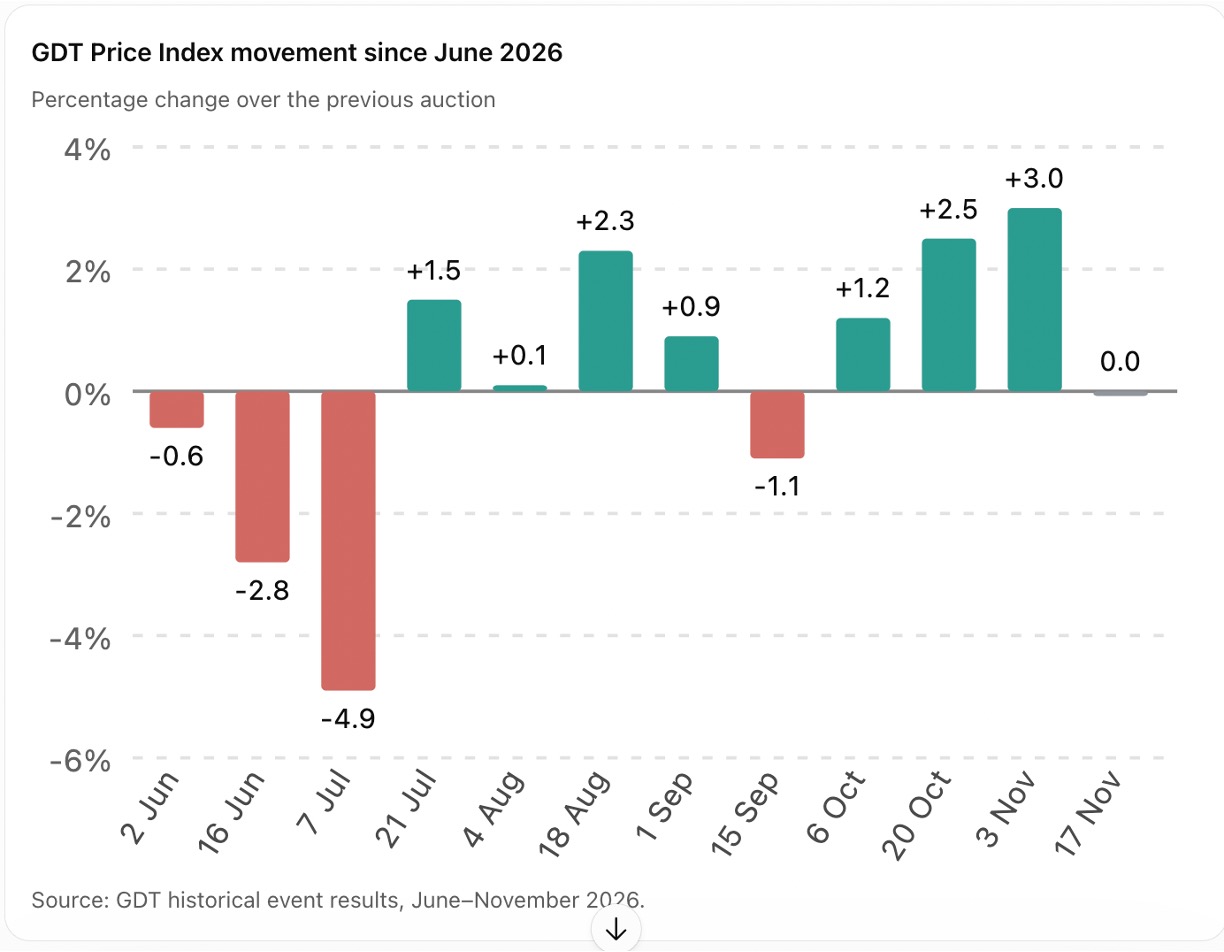
The Global Dairy Trade Event 416, held on 17 November 2026, ended with the GDT Price Index remaining unchanged at 0.0%, although the average winning price increased marginally from USD 4,166/MT to USD 4,182/MT. The headline index, however, hardly reflects the turbulence underneath. While both major milk powders crossed the psychological barrier of USD 4,000/MT, Butter and Anhydrous Milk Fat (AMF) registered sharp declines. The divergence between the global markets for milk fat and skim solids is becoming increasingly pronounced.
The auction witnessed trading of 39,777 MT of dairy commodities against a minimum and maximum offered quantity of 36,115 MT and 43,311 MT, respectively. A total of 152 bidders participated, of whom 120 emerged as successful buyers. The auction concluded after 15 bidding rounds lasting one hour and 58 minutes. Interestingly, despite fewer participating bidders than in the previous auction, the number of successful bidders increased from 111 to 120, while the traded volumes remained almost unchanged.
Milk powders continue their dream run
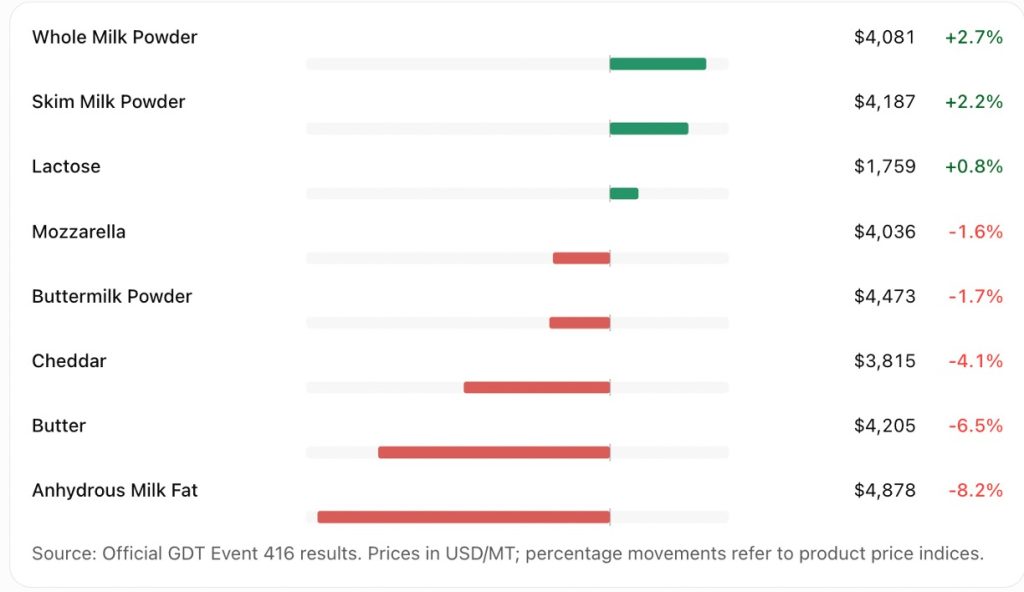
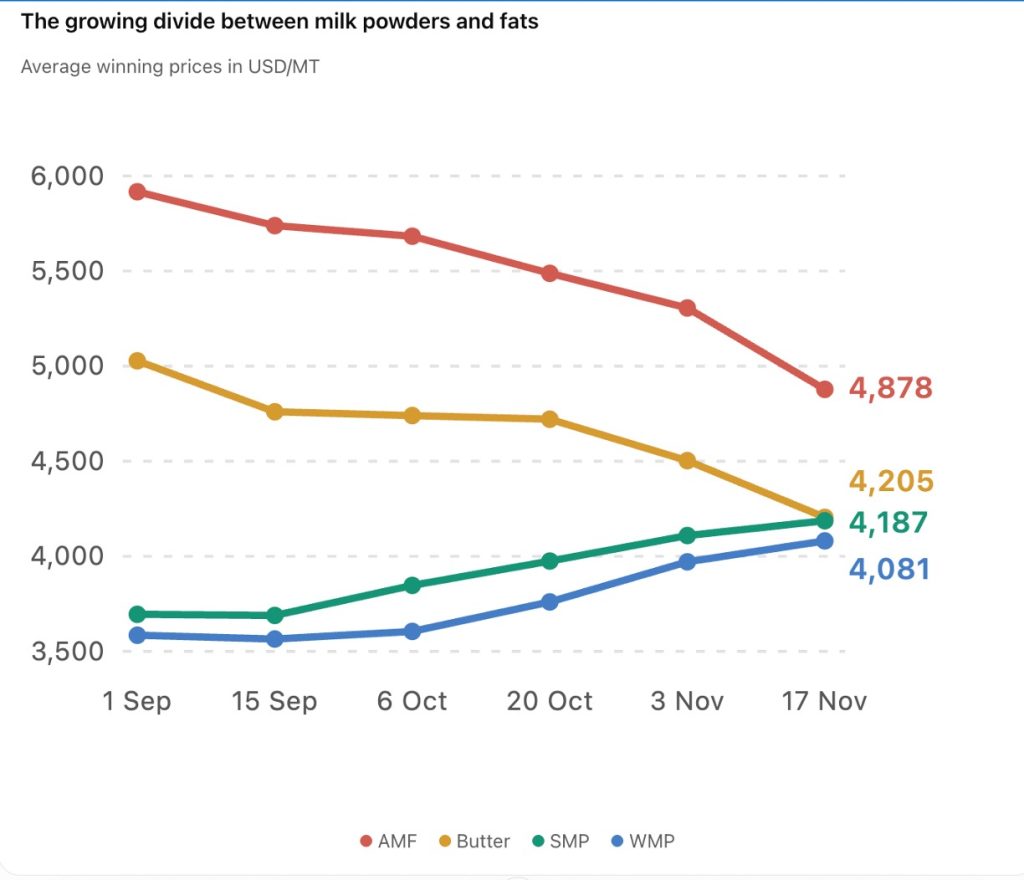
Skim Milk Powder (SMP) increased 2.2% to USD 4,187/MT, while Whole Milk Powder (WMP) registered an increase of 2.7% to USD 4,081/MT. Both commodities are now trading above USD 4,000/MT. Interestingly, the premium commanded by SMP over WMP has gradually narrowed from USD 242/MT in Event 413 to USD 215 in Event 414, USD 138 in Event 415 and now USD 106/MT.
SMP has been trading above WMP for six consecutive main auctions since September. However, WMP has been gaining faster than SMP in the last three auctions, suggesting a broader recovery in global milk powder demand.
Is milk fat searching for a bottom?
The biggest surprise of the auction came from milk fats. AMF declined 8.2% to USD 4,878/MT, while Butter fell 6.5% to USD 4,205/MT. Both commodities have been experiencing sustained downward pressure over the past few months.
Since Event 411 on 1 September, SMP average winning prices have appreciated by approximately 13.3%, while Butter and AMF have lost around 16.4% and 17.6%, respectively. It is not often that we see such contrasting movements in the commodity values of different components of the same litre of milk.
Cheese also failed to sustain the recovery witnessed during the previous auction. Cheddar declined 4.1% to USD 3,815/MT, while Mozzarella fell 1.6% to USD 4,036/MT. Buttermilk Powder registered a negative price index movement of 1.7%, with an average winning price of USD 4,473/MT, while Lactose increased 0.8% to USD 1,759/MT.
GDT Event 416 – Complete commodity results
0.0%
Unchanged$4,182
USD/MT39,777 MT
120 / 152
What is happening in the developed dairy world?
The latest data from the European Commission's Milk Market Observatory provides some answers to this unusual behaviour of global dairy prices. During January–August 2026, milk production in the European Union increased by 3.0%, while Butter production increased by 7.7%, SMP by 9.0% and Cheese by 3.6%. WMP production, however, declined by 4.4%.
During the same period, milk production in New Zealand increased by 5.0%, the United States by 2.6% and Australia by 3.8%. The major dairy exporting economies are therefore not experiencing any widespread shortage of milk.
What is possibly creating pressure on milk fats is the expansion in their availability coupled with aggressive export competition. EU Butter exports during January–July 2026 increased by 38%, while Butteroil exports increased by 40% over the corresponding period last year.
As of 8 November, the European Commission reported US Butter quotations at USD 2,843/MT against USD 4,438/MT in Europe and USD 4,625/MT in Oceania. Although these quotations are not directly comparable in terms of specifications and delivery conditions, they indicate the competitive pressure on global milk fat markets.
Are newer demand pockets emerging?
The resilience of milk powder prices despite rising milk production in major exporting countries suggests that demand, rather than supply shortages alone, is contributing to the rally.
Interestingly, EU SMP exports increased by 14% and WMP exports by 7% during January–July 2026. The international markets appear to be absorbing additional volumes of milk powders even at strengthening price levels.
China seems to be regaining its influence over international dairy commodity prices. According to HighGround Dairy's analysis of Event 415, Chinese buyers had returned strongly, while some buyers from Southeast Asia and the Middle East were exhibiting greater resistance to elevated price levels.
Southeast Asia, the Middle East and North Africa remain important demand pockets for milk powders because of their dependence on imported dairy ingredients for recombination and food processing. However, it would be premature to attribute the latest increase to any particular emerging market in the absence of Event 416's regional buying data.
The journey of GDT during 2026
The GDT Index began 2026 on an exceptionally bullish note, followed by a prolonged correction between April and early July. The market started recovering in the second half of July and, barring a minor correction on 15 September, has remained largely positive.
The latest auction has brought this recovery to a temporary halt after three consecutive positive auctions in October and November.
The underlying commodity trends, however, are far more interesting than the overall movement of the GDT Index.
Outlook for the next two to three months
I expect the global dairy market to enter a phase of consolidation over the next two to three months. Milk powders may remain relatively firm, while milk fats could experience some further correction before finding a sustainable bottom.
My tentative price expectations for December 2026 to February 2027 are as follows:
These are indicative editorial forecasts and not futures market quotations. Much will depend on the sustainability of Chinese demand, the seasonal decline in Oceania's milk production and the ability of European and American exporters to liquidate their available milk fat inventories.
What is in it for the Indian dairy industry?
For India, the timing of this global commodity cycle could not have been more interesting. We are entering our traditional flush season at a time when international SMP prices are trading above USD 4,100/MT.
At an illustrative exchange rate of ₹89 to a dollar, international SMP at USD 4,187/MT translates into approximately ₹373/kg, before adjustments for logistics, quality specifications and other export-related expenses.
On the other hand, international Butter and AMF prices are creating a completely different scenario.
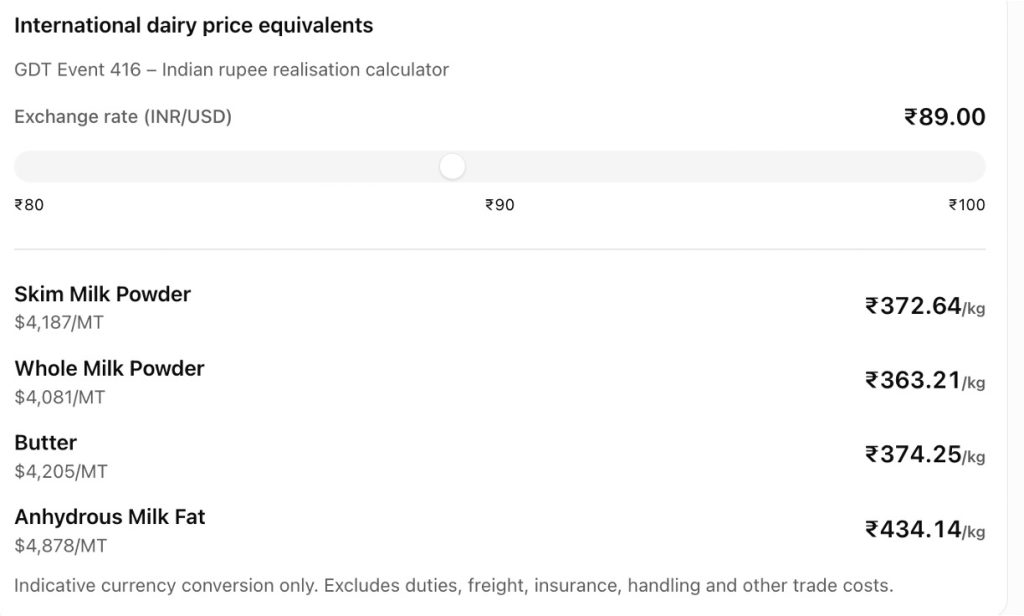
Indian dairy processors may find an opportunity to explore international markets for SMP while retaining milk fat for domestic consumption, subject to prevailing domestic prices and export regulations. With the increasing availability of buffalo milk during winter, the industry may have to revisit its product mix and inventory management strategy.
A strong SMP market can also provide some support to milk procurement prices during the flush season, provided the industry can find profitable avenues for liquidating its surplus milk solids.
One litre of milk and two different markets
The developments during the last three months raise a larger question for the global dairy industry. Are we witnessing a temporary mismatch in the supply and demand of milk components, or is the world gradually changing its preferences in favour of skim solids and dairy protein over milk fat?
While it may be too early to establish any structural shift, one thing is becoming increasingly clear. For dairy processors, managing the economics of fat and SNF separately may become far more important than merely tracking the overall movement of milk prices.
The GDT Index may have remained unchanged, but the economics of milk certainly have not.
Source: Official Global Dairy Trade Event 416 results, European Commission Milk Market Observatory and HighGround Dairy.
Analysis by Kuldeep Sharma, Chief Editor, Dairynews7x7.
Never miss an important dairy update
Follow DairyNews7x7 on Google to get live milk prices, policy alerts, and daily headlines directly in your feed.