The Great Paneer Panic: India's State Bans on Analogue Paneer, Explained
A look at the spreading bans on analogue paneer, cream, butter and ghee, what FSSAI's own rules actually say, and whether a one-year prohibition can really settle the question.
A ban that is spreading fast
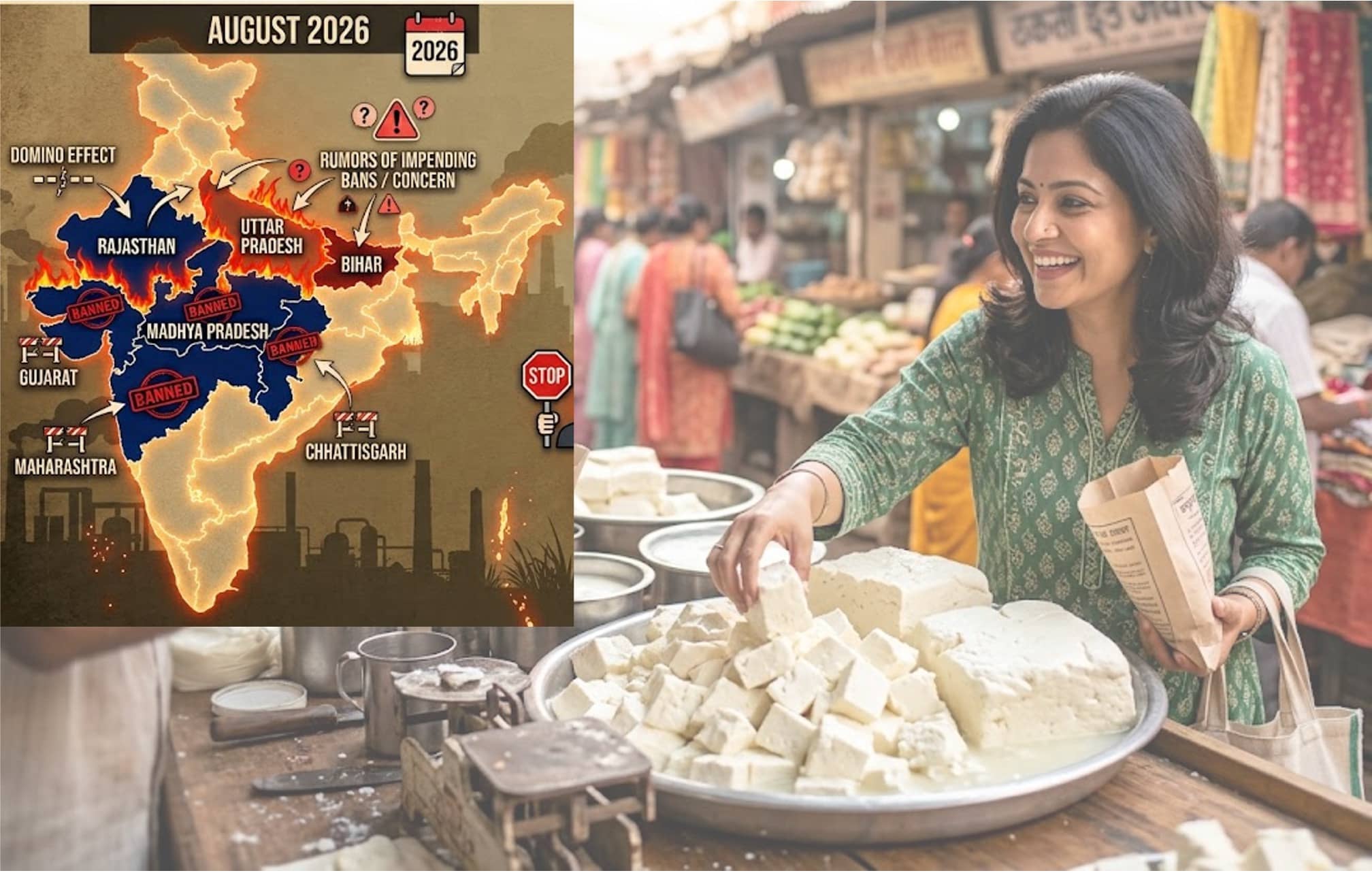
In the space of about two weeks in August 2026, "analogue paneer" went from a niche labelling dispute to a full-blown regulatory wave. Chhattisgarh moved first, ordering an immediate ban on the manufacture, sale and use of analogue paneer, cream and butter on August 1, following a high-level meeting led by the state's health minister. Maharashtra followed on August 5 with a one-year, statewide prohibition on the manufacture, processing, storage, distribution and retail sale of analogue paneer, issued after its Food and Drug Administration (FDA) tested 308 paneer samples between April 2025 and March 2026 and found that more than one-third failed to meet prescribed quality standards, with several samples found to contain vegetable fats in place of natural milk fat.Gujarat announced a similar ban the same day, covering paneer, cheese and butter, and said it had become the third state, after Chhattisgarh and Maharashtra, to prohibit unstandardised analogue dairy products. Madhya Pradesh, Uttarakhand and, most recently, Uttar Pradesh have joined the list, with UP's ban on August 16 covering paneer, ghee and khoya and citing the position that the Food Safety and Standards Act, 2006 requires milk and dairy products to be sold in their genuine form.
The pattern in each order is similar: a definition of analogue dairy as a product made with vegetable oils, starches and emulsifiers instead of milk fat; evidence from state food-testing labs of high failure rates; and an invocation of consumer deception, since the product is frequently served or sold as if it were real paneer without disclosure.
What "analogue paneer" actually is — and what FSSAI says about it
This is the part that tends to get lost in the news coverage: analogue paneer is not, by itself, an illegal product under national food law. FSSAI's own regulations recognise and define it. Under the Food Safety and Standards (Food Product Standards and Food Additives) Regulations, 2011, a "dairy analogue" is defined, per Sub-regulation 2.1.1(1), clause (aa), as a product where ingredients not derived from milk replace milk constituents in part or whole, while the finished product resembles milk or a milk product in appearance, taste or function. FSSAI's West Region office reiterated this in an April 2026 public notice, which drew a sharp — but narrow — line: the product itself may be manufactured and sold, but selling a cheese or dairy analogue under the name "paneer" amounts to a serious legal violation that must stop immediately, and manufacturers were directed to use accurate, unambiguous product names, particularly when supplying food-service establishments.So the regulator's own position, going into this year's controversy, was essentially: analogue dairy can exist, but it must be labelled and named for what it is — not sold or served as "paneer." Business Standard's summary of the rules captures this well: the sale of analogue paneer is permitted under FSSAI regulations, but only when the product is clearly disclosed and correctly labelled.
This labelling-first approach had already been under active review before the state bans began. FSSAI had, as early as March 2025, directed states and Union Territories to step up surveillance of dairy analogues — including testing and label checks — over concerns about adulteration and misrepresentation as genuine dairy. It followed this in April 2025 with a formal consultation paper proposing that restaurants and caterers using dairy analogues be required to prefix terms like "non-dairy" or "analogue" before the dairy description on menus and display material, along with restrictions on selling loose (unpackaged) analogues. FSSAI's own internal note on the subject records that industry, consumer groups and MSME representatives were consulted on this in April 2025, and that the regulator was even considering restricting FSSAI registration for food businesses that manufacture dairy analogues altogether.
In other words, the Centre's regulator had chosen a disclosure-and-labelling framework, not a product ban — right up until individual states began overriding that approach in August 2026.
Cream, butter and ghee: a murkier picture than paneer
Most of the coverage has focused on paneer, but several of the state orders go noticeably wider. Chhattisgarh's original order covered analogue paneer, cream and butter together. Gujarat's ban explicitly named paneer, cheese and butter. Uttarakhand's order swept in paneer, ghee and butter made with vegetable oils, starch and chemicals. Uttar Pradesh went furthest, banning analogue paneer, cream, ghee, chhena and khoya in one stroke, describing analogue ghee as a product designed to resemble ghee but built from non-milk-derived fat in place of milk fat.This is where the regulatory clarity genuinely thins out, and it's worth being precise about why. Paneer has a defined "dairy analogue" carve-out under Sub-regulation 2.1.1(1)(aa) — FSSAI's own rules contemplate a labelled, non-dairy version of it existing legitimately. Butter and ghee do not have anything close to that same flexibility built into their own product standards. FSSAI's compositional standard for butter requires a minimum 80% milk fat content and explicitly excludes vegetable oils, fats or substitute animal fats from the product altogether — not as a labelling condition, but as a condition of the product qualifying as "butter" at all. Ghee carries similarly strict compositional requirements: near-total milk fat content, tight moisture and free-fatty-acid limits, and mandatory purity and traceability disclosures, with no allowance for vegetable-oil substitution baked into the standard. Cream's standard permits "recombined" or "reconstituted" versions made from dairy ingredients, provided they're labelled as such — but this is recombination within dairy ingredients, not a vegetable-fat substitute.
The practical effect is that "analogue butter" or "analogue ghee" sit in a different legal position than analogue paneer. Where paneer's dairy-analogue category gives a manufacturer a legitimate labelled product to fall back on, a vegetable-fat product marketed as butter or ghee arguably isn't using a recognised "analogue" category at all — it may simply fail to meet the compositional definition of butter or ghee outright, which would make it a case of misbranding or adulteration under the existing standards, not a labelling gap FSSAI needs to fill. If that reading is right, states banning analogue butter and ghee may be on firmer ground procedurally than the paneer bans, since they're not really displacing a Centre-sanctioned labelled category — they're enforcing standards that arguably already prohibit the product by definition.
Cream sits somewhere in between: the standard doesn't obviously contemplate a vegetable-fat "cream analogue" either, but the terminology in state orders (often just "imitation cream") is looser than the technical language used for paneer, which makes it harder to say precisely what is and isn't being restricted. This is one more reason the NHRC's request for clarity extends beyond paneer to the sector as a whole — the compositional rules genuinely differ product by product, but the state orders tend to bundle them together under one blanket "analogue dairy" ban.
How states are legally able to ban it anyway
States are not writing new food law when they issue these orders; they are using an emergency power that already exists inside the central Act. Maharashtra's order, for instance, was issued by Food Safety Commissioner Tukaram Mundhe under Section 30(2)(a) of the Food Safety and Standards Act, 2006. That section gives a state's Commissioner of Food Safety the power to prohibit, in the interest of public health, the manufacture, storage, distribution or sale of any article of food across the whole state or part of it, for a period not exceeding one year, through an order notified in the Official Gazette.Two things stand out about this power. First, it is explicitly capped — no state Commissioner can use Section 30(2)(a) to impose a permanent ban; one year is the statutory ceiling. Second, courts have read real constraints into how it must be exercised. A review of prosecutions under the Act notes that Section 30 must be read alongside Section 34 (which covers a Designated Officer's power to issue emergency orders), and that in at least one instance the Patna High Court held the Commissioner must rely on objective evidence establishing a regulatory violation, and can only issue a prohibition order once a Designated Officer's report confirms an actual health risk.
That is a meaningful procedural check: a state cannot invoke Section 30(2)(a) on suspicion or public pressure alone — it needs a documented evidentiary basis, which is presumably why Maharashtra, Chhattisgarh and others have been citing specific lab failure rates (Maharashtra's 35.4%, and reports of even higher failure rates in Noida, where 83% of tested paneer samples failed quality checks and 40% were declared unsafe) rather than issuing blanket orders without data.Tellingly, even the officials issuing these orders seem aware of the limits of their own power. A Maharashtra government official told PTI plainly: "The law itself has a provision of banning such items for one year only... there is no legal support for us to put a complete ban on such types of paneer." That is a candid admission that this is a time-boxed public-health intervention, not a permanent prohibition — and that a genuinely durable fix would have to come from FSSAI notifying binding, enforceable standards, not from repeated state-level orders.
So what is the "sanctity" of a one-year ban?
This is really the heart of the question, and it cuts two ways.On one hand, the one-year cap is a real legal safeguard, not a formality. Parliament built it into Section 30(2)(a) precisely so that emergency public-health powers, which bypass the normal, more deliberative standard-setting process, cannot become a backdoor for permanent bans on products that haven't gone through full regulatory scrutiny. Chhattisgarh's order makes this logic explicit: it states that the prohibition will last for one year, or until FSSAI notifies final regulatory standards for dairy analogue products, or until the order is amended, revoked or replaced — whichever happens first. That framing treats the state ban as a stopgap, buying time for the central regulator to do the more durable work of rule-making, not as a substitute for it.
On the other hand, "one year" is not self-enforcing finality. Nothing in the Act stops a Commissioner from issuing a fresh Section 30(2)(a) order at the end of the year, based on a new round of sampling data, effectively rolling the prohibition forward indefinitely — a pattern regulators in other jurisdictions have used with similar "temporary" emergency powers. Whether that would be legally sound would likely depend on whether the state can again show objective, current evidence of a public-health risk, rather than simply re-issuing the same order on the same old data. This is exactly where a court challenge would likely focus, given the Patna High Court's insistence on an evidentiary basis for each such order.
There is also a directly relevant precedent for what happens when these food bans are challenged: the 2015 Maggi episode. FSSAI ordered Nestlé to recall all nine variants of Maggi noodles nationwide, and Uttarakhand, Gujarat, Tamil Nadu, Delhi and Jammu & Kashmir imposed their own state-level bans, several of which were explicitly time-bound (Gujarat and J&K for one month, Tamil Nadu and Uttarakhand for three months).
Nestlé challenged the national ban in the Bombay High Court, which found the order procedurally defective — the Court's reasoning was that no show-cause notice had been issued before a complete ban on the product was imposed, which is a breach of natural justice. The Supreme Court later upheld that finding and allowed Maggi to return to shelves once it passed fresh testing. The lesson for the current wave of paneer bans is that the speed and evidentiary care of the process matters as much as the underlying public-health concern — a ban built on solid, current lab data and proper process (as Maharashtra and Chhattisgarh appear to have documented) is much more likely to survive judicial scrutiny than one issued reactively under public pressure without a paper trail.
A regulatory tension worth watching
There is an unresolved friction sitting underneath all of this. FSSAI's national framework treats analogue paneer as a legal product subject to labelling discipline. Several states have now gone further and banned it outright, at least temporarily. The National Human Rights Commission has stepped into this gap: it has issued notices to all states, Union Territories and FSSAI, seeking clarity on analogue paneer's nutritional composition, labelling adequacy, and even questioning why such products are permitted at all given several states have now restricted them. The NHRC's brief also flags a nomenclature problem that goes to the root of the dispute — that FSSAI's own framework treats dairy analogues as products that are explicitly "not milk, milk products or composite milk products," which raises the question of why the term "paneer" continues to appear in their naming and marketing at all.That is arguably the more interesting regulatory question than the ban itself: not whether a vegetable-fat-based paneer substitute should exist (few of the state orders actually claim it is unsafe when properly made and disclosed — Maharashtra's own findings distinguish "sub-standard" from "unsafe" samples, with the latter being a minority), but whether "paneer" — a legally defined, standardised term — should ever be allowed to describe a product that structurally isn't one. If FSSAI resolves that naming question through a binding national standard, most of the current state-by-state patchwork of one-year emergency bans would likely become unnecessary, since accurate labelling combined with a ban on misusing the word "paneer" addresses the actual harm being cited: consumer deception, not the product's mere existence.
Could the state FDAs have handled this better?
Judged purely on optics, the last two weeks have worked: "analogue paneer" is now a household phrase, and every state health department that has issued an order has gotten a wave of front-page coverage. But optics and outcomes are not the same thing, and there's a reasonable case that the blanket, headline-grabbing ban was the blunter tool available, not the better one. A few things stand out. First, the sequencing looks backwards — FSSAI had already spent over a year (from its March 2025 surveillance directive through the April 2026 labelling notice) building the more precise, less disruptive fix: mandatory disclosure and a crackdown on misusing the word "paneer."States announcing outright prohibition mid-way through that process, without waiting to see if the labelling regime had teeth, effectively skipped past a solution that targeted the actual harm — deception — and reached instead for the one that generates the most public attention. Second, a statewide ban on manufacture and sale, covering everyone from large processors to small dhabas, punishes compliant businesses that were already labelling their products correctly alongside the ones that weren't, when the FDA's own data shows the problem was concentrated in that roughly one-third of samples that failed testing, not the entire category.
A more targeted response — naming and shutting down the specific non-compliant units, with visible enforcement, rather than banning the product line statewide — would likely have achieved the deterrence goal without the collateral disruption to a legitimate segment of the dairy-substitute market. Third, and perhaps most consequentially for the public, the messaging around these bans has emphasised the word "ban" far more than it has explained what consumers should actually watch for at the point of purchase — clear labelling, checking whether a restaurant discloses its ingredients, being wary of unusually cheap loose paneer.
A consumer-education campaign running alongside (or even ahead of) the enforcement action, paired with visible penalties for the offending units rather than a sweeping statewide prohibition, would likely have built the same public confidence without the current side effect: a genuine, if somewhat outsized, wave of anxiety among consumers who now aren't sure whether any paneer they buy is safe, even though the FDA's own findings show close to two-thirds of tested samples were perfectly compliant.The bottom line
- Analogue paneer is currently legal to manufacture and sell under FSSAI's central rules, provided it is clearly and accurately labelled as a non-dairy analogue and not marketed as "paneer."
- States are not overriding FSSAI when they ban it — they are using a specific, time-limited emergency power (Section 30(2)(a) of the FSS Act, 2006) that lets a state Commissioner prohibit an article of food for up to one year, on the basis of documented public-health evidence.
- The one-year limit is a genuine legal ceiling, not a suggestion, and several states have explicitly tied their bans to FSSAI notifying final standards — treating the prohibition as a bridge, not a permanent solution.
- Whether these bans hold up if challenged will likely turn on the same factors that decided the Maggi case a decade ago: the quality of the evidence and whether due process was followed, not just the seriousness of the underlying concern.
- The more durable fix everyone — including FSSAI, the NHRC and the industry — seems to be waiting for is a binding national standard on dairy analogue labelling and nomenclature, which would settle the question these one-year state orders can only postpone.
References
- Madhya Pradesh Bans Analogue Paneer — DairyNews7x7
- FDA Says Selling Cheese Analogues as 'Paneer' Illegal — DairyNews7x7
- FSSAI Crackdown Aims to Uplift India Dairy Quality Standards — DairyNews7x7
- "Justice Delayed Is Justice Denied": Why Delay the Law to Protect the Milk Label? — Blog by Kuldeep Sharma, Chief Editor, DairyNews7x7
- Maharashtra Govt Bans Analogue Paneer For One Year After 35.4% Of Samples Fail FDA Quality Tests — Free Press Journal
- Gujarat Bans Analogue Paneer, Cheese and Butter — Down To Earth
- Maharashtra bans analogue paneer for one year over adulteration, consumer fraud — Nagpur Today
- Maharashtra bans manufacture, sale of analogue paneer: What did FDA find? — Business Standard
- Maharashtra govt bans analogue paneer for a year over food safety concerns — Business Standard/PTI
- Chhattisgarh Bans Non-Standardized Dairy Analogue Products — FoodTechNetwork
- Several Indian states ban analogue paneer — WION Decodes
- Madhya Pradesh Becomes Fourth State to Ban Analogue Paneer — Dairy Industry Expo
- Uttarakhand Bans Fake Dairy Products — The Logical Indian
- UP cracks down on analogue dairy products, bans paneer, ghee and khoya — India.com
- India to force restaurants to disclose if they use 'analogue paneer' — The Independent/AOL
- FSSAI issues Public Notice on Correct Labelling of Cheese Analogues — PIB
- FSSAI Consultation Paper on Dairy Analogue (F.No. RCD-02001/2/2021) — fssai.gov.in
- FSSAI cracks down on fake dairy products: New rules, clear labels — India Business & Trade
- UP Bans Analogue Dairy Products: What Is Analogue Paneer, Ghee and Khoya? — Asian Mirror
- Categories and Standards of FSSAI Milk Products (butter, ghee, cream composition) — Kanakkupillai
- FSSAI Guidelines on A1/A2 Cow's Milk and Ghee (Clarified Butter) — TaxTMI
- NHRC asks FSSAI, states to explain analogue paneer rules, safety checks — Newsdrum
- NHRC issues notices to states, FSSAI over 'analogue paneer' — Telangana Today
- Section 30, Food Safety and Standards Act, 2006 — Indian Kanoon
- Taming the FSSAI Hydra: A Guide to Prosecutions under the FSS Act — Cyril Amarchand Mangaldas
- M/S Nestle India Limited vs FSSAI & Others, Bombay High Court, 13 August 2015 — Indian Kanoon
- Nestle India Limited v. FSSAI & Others (2015) — case summary — Medium
- India bans Nestle instant noodles after safety scare — Gulf News/AP