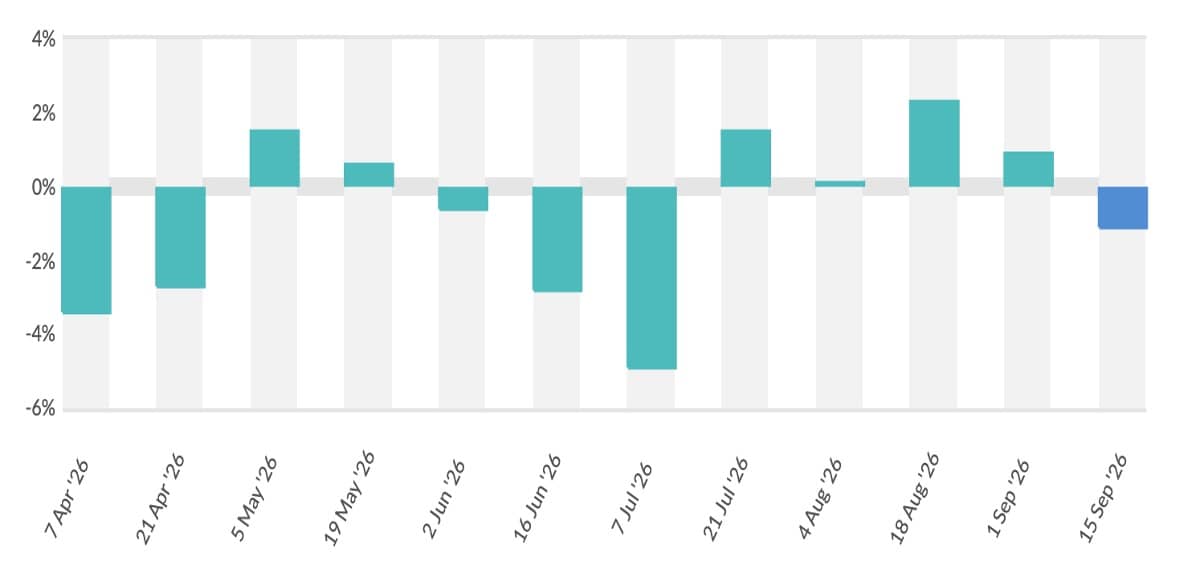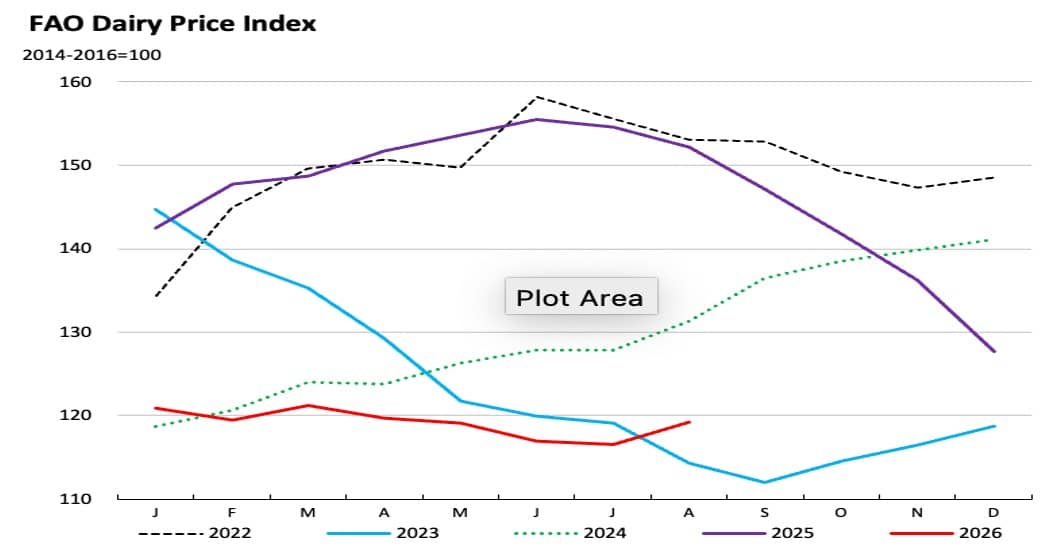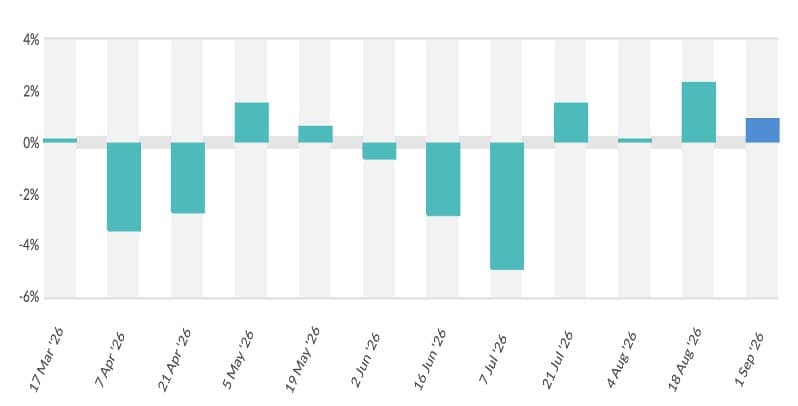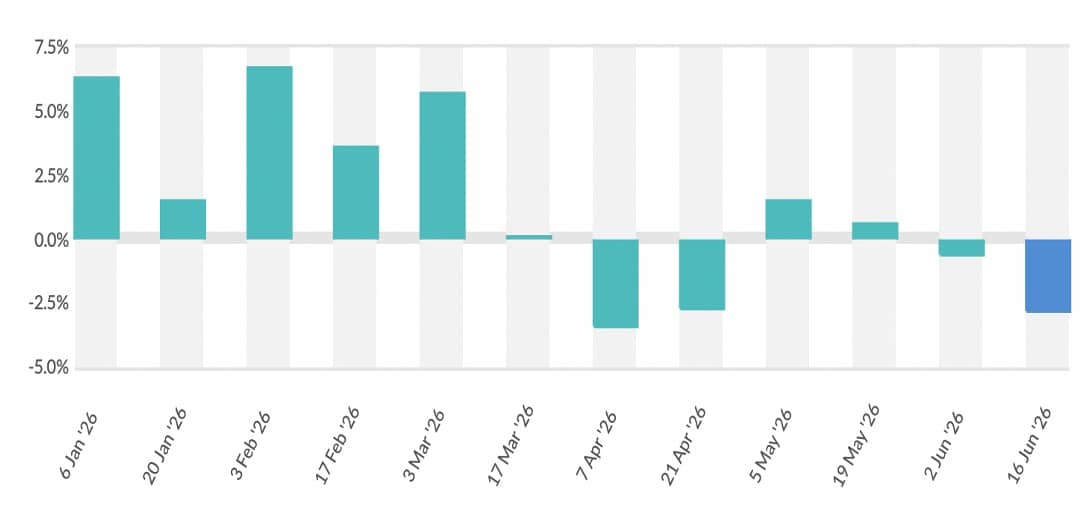
The latest Global Dairy Trade auction (Event 406 held on June 16, 2026) signals a broad-based correction in global dairy prices, with the GDT Price Index declining by 2.8% and the average winning price settling at USD 3,979/MT. Unlike Event 405, where fats had shown some recovery, Event 406 witnessed weakness across most major commodities, indicating that buyers are adopting a more cautious approach amid improving supply availability and slower inventory rebuilding.
The latest auction shows that the earlier recovery phase has lost momentum temporarily, and the market is moving towards a more balanced demand-supply equation.
The biggest correction came from the powder segment, which remains the backbone of global dairy trade. Whole Milk Powder (WMP) declined by 3.1% to USD 3,589/MT, while Skim Milk Powder (SMP) dropped by 3.6% to USD 3,368/MT. This suggests that buyers, particularly in Asia and Middle East markets, are becoming more selective after building some inventory during the previous restocking phase.
The fat segment also softened. Butter declined by 2.4% to USD 5,516/MT, while Anhydrous Milk Fat (AMF) decreased by 1.0% to USD 6,601/MT. Although fat prices remain at historically elevated levels, the correction indicates that buyers are resisting higher price levels and reassessing their procurement strategy.
Cheese markets also witnessed pressure. Cheddar declined by 3.4% to USD 4,471/MT, while Mozzarella corrected sharply by 5.0% to USD 3,750/MT. This reflects softer foodservice demand in some regions and improved availability from major exporting countries.
Among other dairy ingredients, the trend was mixed. Lactose was the only major commodity showing strength, increasing by 4.2% to USD 1,702/MT, reflecting continued demand from nutrition, pharmaceutical and food ingredient applications. Butter Milk Powder was not available in this auction.
Global dairy market: From rally to rebalancing
The GDT journey in 2026 has been a story of changing market leadership. The year started with a strong rally during January and February, driven by tight milk availability, strong fat demand and aggressive buying interest. The market then entered a correction phase during March and April as supply concerns eased and buyers became cautious. Events 403 and 404 brought some stability, but Event 405 and now Event 406 indicate that the market is still searching for equilibrium rather than entering a sustained bullish cycle.The important shift is that dairy commodities are no longer moving together. Fats, powders and cheese are responding differently based on their own demand-supply fundamentals. The current correction is not a collapse in demand but a normalisation after a period of strong price movement.
Demand side: Cautious buying, new pockets emerging
The demand story remains interesting. China continues to remain a key player but is buying strategically rather than aggressively. Importers are focusing on shorter procurement cycles and avoiding excessive inventory building.At the same time, newer demand pockets are becoming increasingly important. Southeast Asia, Middle East, North Africa and parts of Africa continue to support powder demand, especially for recombination, food processing and nutrition applications. The market is becoming less dependent on a single geography, which is helping create a stronger price floor.
The current demand environment can be described as: not aggressive, but stable and visible.
Developed dairy markets outlook
For major dairy exporting regions like New Zealand, Europe and the US, Event 406 reflects improving supply availability and changing product economics. Milk production conditions have improved compared to the beginning of the year, reducing the urgency among buyers.Processors are now focusing more on balancing product portfolios as margins between fats, powders and cheese become more dynamic. The earlier fat-led rally is cooling, while powder markets are adjusting to realistic demand levels.
Forecast: Next 2–3 months
The global dairy market is likely to remain range-bound with commodity-specific movements.- WMP: Expected range USD 3,500–3,700/MT
- SMP: Expected range USD 3,300–3,500/MT
- Butter: Likely to remain around USD 5,300–5,600/MT
- AMF: Expected to stay firm but volatile around current levels
A sharp correction appears unlikely unless demand weakens significantly, but a strong rally also looks difficult without a fresh supply shock.
What does it mean for India?
For India, Event 406 provides a mixed signal. Global SMP prices at USD 3,368/MT indicate that export competitiveness remains challenging compared to earlier expectations. Indian processors will need to carefully evaluate export opportunities, especially in SMP.However, the correction in global prices does not automatically translate into lower domestic dairy prices. India’s milk market continues to operate under different fundamentals, with procurement competition, strong domestic consumption and limited surplus availability supporting farmgate prices.
The softer global fat market may create some pressure on value-added dairy exports, but domestic demand remains the key driver for Indian dairy companies.
Bottom line
Event 406 confirms that global dairy markets are moving from a high-price cycle towards a more balanced phase. The rally has cooled, but the market is not weak.The new reality is a dairy market where demand is broader, buyers are more disciplined, and each commodity is finding its own price direction.
Source : Review of GDT 406 event by Kuldeep Sharma Chief Editor Dairynews7x7 June 16th 2026