

Viewing labour as an asset not a cost
Farming in Urlingford, Co. Kilkenny, Brendan and Fiona Joyce milk a herd of 150 high EBI cows under a spring-calving system. Their farm is very much grass focused; the herd produced 560kg of milk solids per cow last year, while concentrate input is targeted at 750kg/cow.
As part of the recent Teagasc National Dairy Conference, Brendan highlighted the importance of labour to his family’s farm. Additionally, he outlined the steps that have been taken to streamline the system and make it a more attractive place for people to work.
Labour on the farm consists of Brendan, some family help from Brendan and Fiona’s sons and two part-time employees – Michael and Maureen, with both starting on the Joyce’s farm as students on placement from Kildalton Agricultural College in 2015 and 2017, respectively. Michael works on the farm five or six mornings a week from October through to the end of May, while Maureen returns to the farm once the cows start calving in the spring and, on average, completes five or six milkings – mostly in the evening – each week.
“Labour is probably the next highest cost on the farm after feed and fertiliser, but I consider good labour a very important asset,” Brendan told delegates. “I know the farm wouldn’t be as productive as it is only for the two people I have with me.”
Facilities, breeding and calf management
Previously home to a dairy herd of 40 cows, a beef enterprise and a tillage enterprise, Brendan noted that the farm has always been busy. Over the years, the family’s attention has turned to dairy and with this came a focus on the facilities to help with labour efficiency.“Having good facilities on the farm is a big help,” Brendan explained. “Getting labour is one thing, but retaining labour is another and the easiest labour to get is the labour you already have.”
He added: “Good facilities take the physical labour out of dairy farming. I have no regrets with purchasing the automatic calf feeder, straw chopper and cubicle bedding machine. They all contribute to making the farm a nicer place to work in.”
Giving a brief overview of the working day, Brendan said: “Milking times are early at 6:30am and 3:15pm. A lot of that is to facilitate staff and it’s all about creating a routine.”
“I think the main thing with employees is to be flexible. If I need them for a specific day, I will tell them whatever days I need them and it’s the same with either Maureen or Michael. If they are busy themselves, once we know, we can plan around,” Brendan said.
In the spring, both Brendan and Michael milk in the morning for the first couple of months and then either one turn their attention to feeding calves, liming cubicles and bedding. Michael is also present on the farm for the first four weeks of breeding, which enables Brendan to focus on artificially inseminating the herd.
“I usually start breeding around April 20th and Michael is with me for the first four or five weeks of AI. That usually means most of the AI is out of the way by the time Michael leaves. I also try to keep the AI simple. Cows are bred in the morning, Michael milks and I AI. I haven’t gone down the sexed semen route yet for the simple reason that I don’t want to be breeding cows in the morning and the evening. I am just dead consistent with morning AI and it’s working for me. Friesian is used for the first 4-5 weeks, then three weeks of Angus AI, before Angus bulls are left out,” he said.
A compact breeding season results in a compact calving period and Brendan has focused on the streamlining of calf rearing to help with labour efficiency. The first ~35 dairy females are kept. These being the oldest and strongest calves means that by the time the breeding season commences, these calves are usually weaned and out at grass. At that stage, the only calves that require feeding are those waiting to be sold.
Although an outbreak of TB on the farm did alter this process slightly one year, the resulting construction of a new calf shed – equipped with an automatic feeding and four stalls – has aided greatly in the management of calves and the labour required in calf rearing.
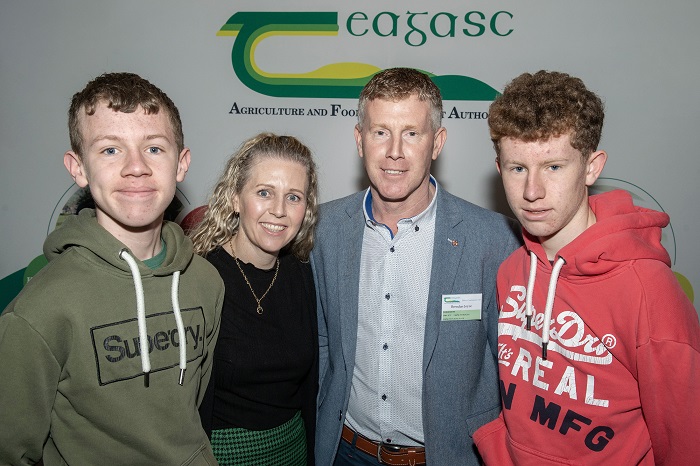
Brendan Joyce pictured with his wife Fiona and their sons Adam and Cormac at the Teagasc National Dairy Conference
Stocking the farm appropriately and contractors
Another area Brendan highlighted that was an aid to the labour efficiency on the farm was having an appropriate stocking rate to maximise grass utilisation and to minimise buffer feeding in the shoulders of the year.“The sweet spot is probably at 160 cows on our farm. At that stocking rate, it usually means I don’t have to feed silage during a dry summer, as the farm is made up of mixed ground – 80% of it is good and dry and 20% would be wettish ground. Additionally, having an appropriate stocking rate means you can extend the grazing season both early and late in the year. If you are overly stocked, that is hard to do,” he said.
Over the years, the farm has undergone a level of consolidation with an out block being switched for ground adjoining the milking platform. This, along with the construction of an underpass in 2008, has been another huge labour saving as the furthest cow paddocks are now within 1km of the parlour. Turning animals out to grass early is also employed and this provides a labour saving on feeding housed animals.
Additionally, Brendan uses the services of contractors to ease some of the labour demand. Contractors are hired to carry out ~90% of the slurry spreading and all pit silage harvesting. Any paddocks identified as being surplus are mown and tedded by Brendan before the contractor completes the task.
Source : Teagasc Ireland Dec 10th 2023