Latest Blogs
See More
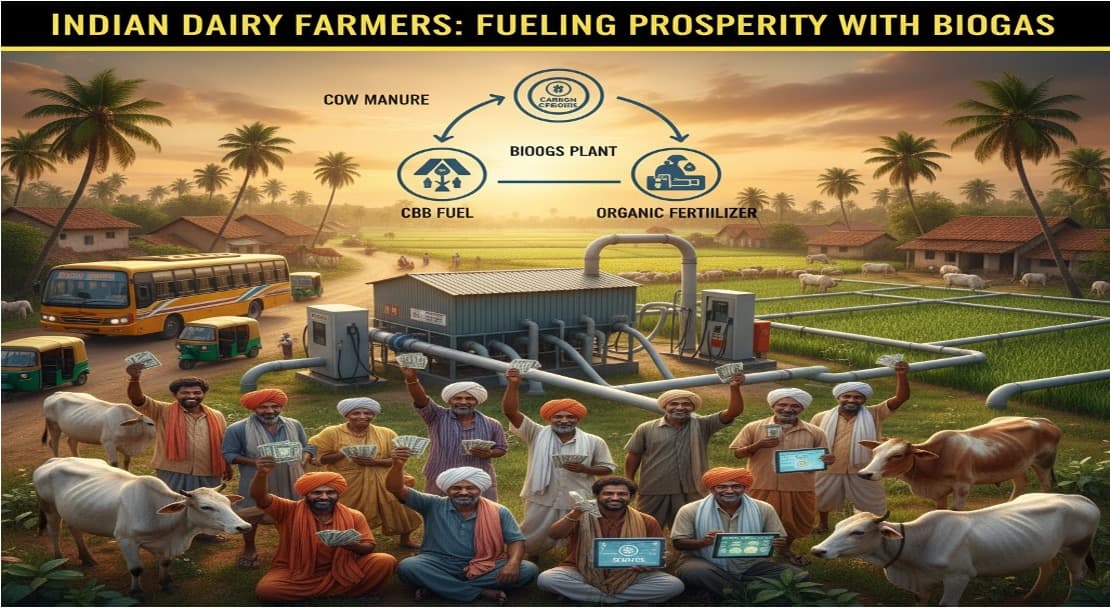
This week, I had the opportunity to attend an Agri Carbon Masterclass conducted by CII FACE. The deliberations, case studies, and discussions presented during the session were both insightful and thought-provoking, particularly on how agriculture—and specifically dairy—can transition from being a greenhouse gas emitter to a climate solution. As someone deeply engaged with India’s dairy sector and rural entrepreneurship ecosystem, I was compelled to explore the profound potential of biogas plants at dairy farms—not just for clean energy, but as a critical pillar in carbon finance, farmer income enhancement, and rural sustainability.
This report integrates learnings from the masterclass with meticulous cost-benefit analysis, field insights, and a review of global and Indian policy frameworks. It aims to bring attention to a key opportunity: positioning biogas from cattle waste as a climate-positive, economically viable strategy that links climate finance directly to small and medium dairy farmers. The current moment—marked by India’s leadership in renewable energy and climate-smart agriculture—creates a compelling case for policymakers, financial institutions, and cooperatives to act under white revolution 2.0.
Policy and Global Commitments: The Indian Shield
The Indian government's stand provides a protective policy buffer while simultaneously creating a domestic market opportunity:
The opportunity to generate carbon credits exists across two main pathways: Enteric Methane Reduction (Feed) and Manure Management (Biogas/Bio-slurry). India is already showing global leadership here:
Zakariyapura Cow Manure Cooperative Society (NDDB/Kaira Model):
This showcases how a village-level cooperative can successfully integrate waste-to-wealth models within the dairy ecosystem. Under NDDB’s Manure Management initiative, Zakariyapura organized farmers to collect and supply cow dung to a village-level biogas plant, where it is processed into biogas and bio-slurry. The slurry is further converted into high-value organic fertilizers.
The Opportunity:
More than 27,000 household biogas plants have been installed in 19 states across the country under various schemes in the dairy sector, according to an official statement issued on Thursday. Further, the household biogas initiative has also helped in generating carbon credits for the dairy cooperative sector. Under the first such initiative, a total of 11,000 carbon credits have been earned by 1,040 farmers, giving a boost to both farmer incomes and contributing to the aim of achieving a circular economy, the statement said.2. Enteric Methane Reduction: Feed Innovation
India’s dairy sector is the largest in the world, producing over 240 million tonnes of milk annually and supporting over 8 crore farm families. While dairy is a source of livelihood and nutrition, it is also one of the key contributors to agricultural methane emissions.
Methane emissions from enteric fermentation and manure mismanagement are significant contributors to India's agricultural greenhouse gas footprint. However, this challenge is also an opportunity—dairy waste can be converted into biogas, which not only offsets fossil fuel consumption but can generate valuable carbon credits, contributing to a revenue stream previously inaccessible to small farmers. Let us assess the potential cost–benefit for small and marginal farmers when biogas access is made available at home or through a nearby community unit.
Cost-Benefit Economics of a Dairy Biogas Plant
Based on a model dairy biogas plant with a 500 kg cattle dung per day capacity (equivalent to a herd of about 100 cattle producing 4–5 tonnes of milk per day), the following investment and operational overview emerges:
Investment & Setup Cost
Operational Revenue Streams
Opportunity: Carbon Credits for Dairy Farmers
The masterclass revealed how structured climate action frameworks, including those under voluntary carbon markets, are increasingly facilitating crediting of methane avoidance through anaerobic digestion of manure. However the credits must be of good quality and verified.
By aggregating multiple dairy farms under a Program of Activities (PoA) structure, third-party project developers can enroll thousands of rural households into a unified carbon program, thus reducing transaction costs and ensuring fair benefit sharing.
Key Insight: A well-planned biogas system of 50 m³ capacity can reduce up to 129 tonnes CO₂e per year, equivalent to planting 2,000 trees annually.
Policy Gaps and Regulatory Needs
Despite technical feasibility and profitable economics, adoption remains slow. Several gaps persist:
Success stories Under Cooperative Models
Projects in Gujarat and Maharashtra demonstrate how dairy cooperatives are leveraging biogas for energy self-sufficiency. Through strategic partnerships, some cooperatives have already piloted methane-to-electricity models to run chilling centers, drastically reducing reliance on diesel and grid power.
These examples must be replicated at scale through a time-bound national mission with private sector involvement in financing and certification.
EKI Energy Services, in partnership with NDDB and Sustain Plus Energy Foundation, has enabled India’s first-ever carbon credit payments to dairy farmers from Rajasthan and Assam last year. Over 1,000 farmers across nine sites in seven states benefited from payments generated by biogas plants under NDDB’s manure-management program.
This initiative is registered under the Voluntary Carbon Standard, showing India’s capacity to link rural dairy practices with global carbon markets. NDDB highlighted that this model not only reduces methane emissions but also provides farmers with clean cooking fuel, slurry-based organic fertiliser, and extra income.
The disbursement was made during NDDB’s Diamond Jubilee celebrations in the presence of dignitaries like Amit Shah, underlining government support for climate-smart dairy. EKI says it will scale this model further with NDDB to expand access to carbon credit revenue for smallholder dairy farmers.
NDDB’s sustainability page confirms ongoing plans to connect additional biogas plants to the carbon credit program across the country.
India must urgently create its own livestock carbon calculator, developed by NDDB, ICAR and state cooperatives, to accurately measure emissions from diverse breeds, feeding systems and smallholder practices. Without this, India risks losing millions in carbon revenues due to misrepresentation by Western models.
A dedicated Livestock Carbon Fund (LCF) should be set up with government, private and climate-finance support to incentivize biogas adoption, Balanced Ration Program , silage-based feeding, methane-reducing supplements and improved waste management. The fund must aggregate and trade credits so that smallholder farmers receive fair returns.
Government schemes like DIDF should mandate methane-reduction technologies, and India should launch a Green Dairy Index to benchmark and reward climate-positive performance among dairy federations.
India must register its own livestock carbon methodologies with Verra, Gold Standard or an Indian marketplace, reflecting indigenous breeds, rotational grazing, composted manure and low-input systems—ensuring global acceptance and fair credit valuation.
A national strategy should scale proven climate-smart interventions such as biogas plants, Harit Dhara, balanced ration programs, and cooperative-led biogas models like Banas Dairy–Suzuki and Zakariyapura Biogas Cooperative. Government-backed facilitation of carbon credit registration and trading is essential to unlock the true value for farmer collectives.
Indian livestock keepers have long sustained the nation’s food system and rural economy. Far from being climate offenders, their traditional low-input practices position them as key contributors to climate solutions. With scientific measurement, validation of indigenous systems, and targeted incentives, India can unlock ₹5,000–20,000 crore annually in livestock carbon credits while strengthening farmer incomes.
India’s cows and buffaloes are no longer just sources of milk—they are strategic assets in a climate-constrained world. By combining political will, scientific integrity and cooperative action, India can lead a global shift toward climate-smart dairying, proving that livestock and sustainability can advance together. The moment to act—and to lead—is now.
Therefore, I repeat what I said at the beginning—Stop blaming. Start claiming.
The conversation must shift from pointing fingers at livestock to enabling farmers to earn from every kilogram of carbon they save.
Source : Blog by Kuldeep Sharma Chief Editor Dairynews7x7
References (key)