

Logo
IndianGlobalBlogsPublicationsPodcastsMarketAboutContact
Logo
IndianGlobalBlogsPublicationsPodcasts
7News
TN Minister Urges Farmers to Adopt Tech for Value Addition in DairyListen to the Farm, Not the Farmer—The New Productivity LensWhat’s Driving Change In Beverages, FMCG And Dairy in 2025ED begins money laundering probe in dairy investment fraud caseIndo-Brazil pact aims to boost cattle genetics and dairy yield

Indian Dairy News

TN Minister Urges Farmers to Adopt Tech for Value Addition in Dairy
Dec 12, 2025

TN Minister Urges Farmers to Adopt Tech for Value Addition in Dairy

In Coimbatore this week, Tamil Nadu’s Minister for Milk and Dairy Development, Mano Thangaraj, called on dairy farmers to embrace modern technologies to boost productivity and value addition across th...Read More

Listen to the Farm, Not the Farmer—The New Productivity Lens
Dec 12, 2025

Listen to the Farm, Not the Farmer—The New Productivity Lens

India’s dairy sector, valued at nearly $30 billion, has reached a point where incremental changes will not deliver the next breakthrough. For decades, improvement programs have focused on what farmers...Read More

What’s Driving Change In Beverages, FMCG And Dairy in 2025
Dec 12, 2025

What’s Driving Change In Beverages, FMCG And Dairy in 2025

India’s retail landscape in 2025 was marked by a decisive shift in how consumers choose, consume and connect with brands. From beverages to daily nutrition and even the most essential dairy products,...Read More

Latest Blogs

See More
More Milk, Less Money: India’s Dairy Crisis
Dec 01, 2025

More Milk, Less Money: India’s Dairy Crisis

With the release of the BAHS 2025 summary report, I felt compelled to deep dive into its findings and reflect on the real progress and challenges facing India’s dairy sector. Over the last six years,...Read More

India Milk Prices: Cost Shock and Procurement Pressure
Nov 28, 2025

India Milk Prices: Cost Shock and Procurement Pressure

Milk prices in India face upward pressure as rising feed costs and procurement hikes reshape farm economics. Insight on dairy procurement, feed costs, and market outlook. Official government and coope...Read More

Stop Blaming, Start Claiming: Livestock’s Carbon Credit Future
Nov 16, 2025

Stop Blaming, Start Claiming: Livestock’s Carbon Credit Future

This week, I had the opportunity to attend an Agri Carbon Masterclass conducted by CII FACE. The deliberations, case studies, and discussions presented during the session were both insightful and thou...Read More

India Powers the Gulf’s Dairy Revolution -Gulf Food 2025
Oct 31, 2025

India Powers the Gulf’s Dairy Revolution -Gulf Food 2025

As Gulf Food Manufacturing prepares to open its doors from November 4–6 in Dubai, Indian dairy product and equipment manufacturers have a unique opportunity to explore one of the most promising region...Read More

Global Dairy News

Why the global milk business needs a structural shake-up
Dec 08, 2025

Why the global milk business needs a structural shake-up

The New Zealand dairy stalwart Fonterra has sold its consumer dairy-brands (milk, butter, cheese) — including “Anchor” and “Mainland Cheese” — to French agribusiness giant Lactalis in late October 202...Read More

Raw-milk prices in Europe hit 5-yr low; ripple effect looms
Dec 07, 2025

Raw-milk prices in Europe hit 5-yr low; ripple effect looms

European raw-milk prices have plunged to their lowest in five years, as oversupply and weak demand weigh on dairy markets across the region. According to recent data from DCA Market Intelligence B.V.,...Read More

Global food prices ease; FAO dairy index slips — impact looms
Dec 06, 2025

Global food prices ease; FAO dairy index slips — impact looms

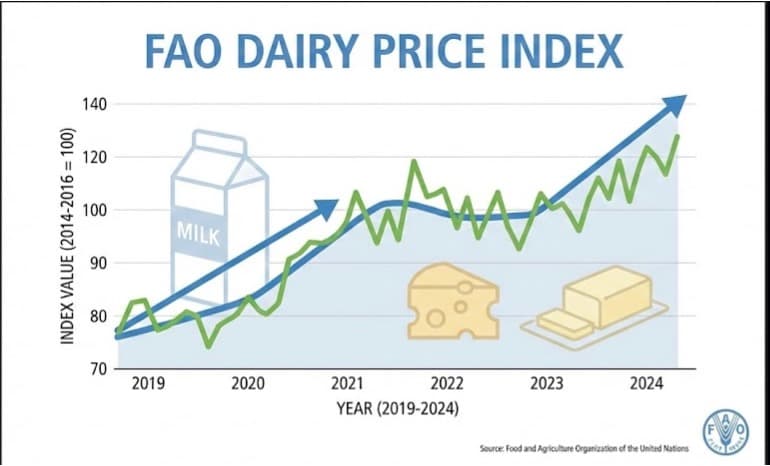
The FAO Dairy Price Index averaged 137.5 points in November, down 4.4 points (3.1 percent) from October and 2.4 points (1.7 percent) from its value a year ago. International dairy prices fell for the...Read More

Dairy News 7x7

Your trusted source for all the latest dairy industry news, market insights, and trending topics.

FOLLOW US
CATEGORIES
  • Global News
  • Indian News
  • Blogs
  • Publications
  • Podcasts
SUBSCRIBE TO OUR NEWSLETTER

Stay informed with the latest updates and trending news in the dairy industry.

No spam, unsubscribe at any time

GET IN TOUCH
C-49, C Block, Sector 65,
Noida, UP 201307
+91 7827405029dairynews7x7@gmail.com

© 2025 Dairy News 7x7. All Rights Reserved.

Terms of ServicePrivacy Policy

US dairy cows are tip of the iceberg as bird flu spreads in mammals globally, says ecologist

By DairyNews7x7•Published on May 28, 2024

Health authorities are working to gather information on the spread of the H5N1 virus, or bird flu, in U.S. dairy cows—the first confirmation of the virus in cattle.

"We have moved into new territory," says Thomas Gillespie, professor and chair of Emory University's Department of Environmental Sciences.

The dairy cow infections are simply the latest twist in a global pattern: since 2022, bird flu has been infecting a wide variety of mammals.

"You can find this trend around the world, almost anywhere you look," Gillespie says. "This virus has an extremely broad range of hosts that it is able to infect."

Gillespie is a disease ecologist, studying how pathogens jump across species in the environment. He is a leader in the "One Health" approach—considering the deep connections between the health of people, domesticated animals, wildlife and ecosystems—to build pandemic control and prevention.

Current risk to people is 'low'

The avian influenza cases in cows have been mild. The U.S. Centers for Disease Control and Prevention (CDC) has confirmed two human cases connected to the outbreak—one in Texas and one in Michigan. Both cases were mild and involved people who worked on a dairy farm.

The pasteurization process kills the H5N1 virus, and the CDC describes the current risk to the general public as "low."

The H5N1 virus is known as avian influenza, or bird flu, because birds are its natural reservoir. Wild, migrating birds can spread H5N1 globally. The current version has been circulating since 2020 and has infected a greater diversity of bird species than past lineages.

The virus has been reported in birds in the United States since 2022. Poultry producers have culled millions of their animals to try to control the spread of the virus.

Massive die-offs of seals and sea lions

It has long been known that mammals can become infected with H5N1 when they eat infected birds or are exposed to environments contaminated with the virus. What is unprecedented is the current scale and variety of mammals that have been infected.

"Most of these are likely dead-end cases, where a predator eats an infected bird and gets sick but doesn't spread the virus," Gillespie says.

He adds, however, that recent die-offs of thousands of elephant seals, sea lions and fur seals in South America caused by bird flu raises concerns about the possibility of mammal-to-mammal transmission.

"Not enough surveillance is done in wildlife to know for sure how the virus is spreading," he says.

H5N1 has also been reported in foxes, otters, lynx, polecats and badgers in Europe and in raccoon dogs and foxes in Japan.

The U.S. Department of Agriculture has recorded detections of H5N1 in 200 mammals in the United States since 2022, including a bottlenose dolphin, foxes, bobcats, mountain lions, coyotes, skunks, harbor and gray seals, opossums, squirrels, minks, otters and black and brown bears.

Last December, a polar bear on Alaska's North Slope became the first of its species known to die of avian influenza. In 2023, the virus was also been detected for the first time in the Antarctic region—in birds, elephant seals and fur seals—raising fears for the health of the fragile ecosystem.

A long-term view of risks

"Some of the species that are at risk for bird flu are already battling the stressors of climate change and loss of habitat," Gillespie says.

And each time H5N1 infects a new animal host, it gives the virus a chance to mix with other flu strains and rearrange its genetic material. Accumulating such mutations can change the virus in ways that make it more easily transmissible and more deadly—including to humans.

Pigs' immune systems share similarities with humans, making swine especially efficient mixing bowls for viruses that can affect humans.

Gillespie cites deforestation and industrialized animal production as major drivers for the risk of pandemics as well as climate change.

Forests in tropical regions are rapidly degrading due to cattle ranching and the clearing of land for agricultural crops such as soybeans—which are mainly used as feed for chickens and pigs on industrial farms.


Swipe to continue reading

Previous Article

Next Article