
Logo
IndianGlobalBlogsPublicationsPodcastsMarketAboutContact
Logo
IndianGlobalBlogsPublicationsPodcasts
7News
TN Minister Urges Farmers to Adopt Tech for Value Addition in DairyListen to the Farm, Not the Farmer—The New Productivity LensWhat’s Driving Change In Beverages, FMCG And Dairy in 2025ED begins money laundering probe in dairy investment fraud caseIndo-Brazil pact aims to boost cattle genetics and dairy yield

Indian Dairy News

TN Minister Urges Farmers to Adopt Tech for Value Addition in Dairy
Dec 12, 2025

TN Minister Urges Farmers to Adopt Tech for Value Addition in Dairy

In Coimbatore this week, Tamil Nadu’s Minister for Milk and Dairy Development, Mano Thangaraj, called on dairy farmers to embrace modern technologies to boost productivity and value addition across th...Read More

Listen to the Farm, Not the Farmer—The New Productivity Lens
Dec 12, 2025

Listen to the Farm, Not the Farmer—The New Productivity Lens

India’s dairy sector, valued at nearly $30 billion, has reached a point where incremental changes will not deliver the next breakthrough. For decades, improvement programs have focused on what farmers...Read More

What’s Driving Change In Beverages, FMCG And Dairy in 2025
Dec 12, 2025

What’s Driving Change In Beverages, FMCG And Dairy in 2025

India’s retail landscape in 2025 was marked by a decisive shift in how consumers choose, consume and connect with brands. From beverages to daily nutrition and even the most essential dairy products,...Read More

Latest Blogs

See More
More Milk, Less Money: India’s Dairy Crisis
Dec 01, 2025

More Milk, Less Money: India’s Dairy Crisis

With the release of the BAHS 2025 summary report, I felt compelled to deep dive into its findings and reflect on the real progress and challenges facing India’s dairy sector. Over the last six years,...Read More

India Milk Prices: Cost Shock and Procurement Pressure
Nov 28, 2025

India Milk Prices: Cost Shock and Procurement Pressure

Milk prices in India face upward pressure as rising feed costs and procurement hikes reshape farm economics. Insight on dairy procurement, feed costs, and market outlook. Official government and coope...Read More

Stop Blaming, Start Claiming: Livestock’s Carbon Credit Future
Nov 16, 2025

Stop Blaming, Start Claiming: Livestock’s Carbon Credit Future

This week, I had the opportunity to attend an Agri Carbon Masterclass conducted by CII FACE. The deliberations, case studies, and discussions presented during the session were both insightful and thou...Read More

India Powers the Gulf’s Dairy Revolution -Gulf Food 2025
Oct 31, 2025

India Powers the Gulf’s Dairy Revolution -Gulf Food 2025

As Gulf Food Manufacturing prepares to open its doors from November 4–6 in Dubai, Indian dairy product and equipment manufacturers have a unique opportunity to explore one of the most promising region...Read More

Global Dairy News

Why the global milk business needs a structural shake-up
Dec 08, 2025

Why the global milk business needs a structural shake-up

The New Zealand dairy stalwart Fonterra has sold its consumer dairy-brands (milk, butter, cheese) — including “Anchor” and “Mainland Cheese” — to French agribusiness giant Lactalis in late October 202...Read More

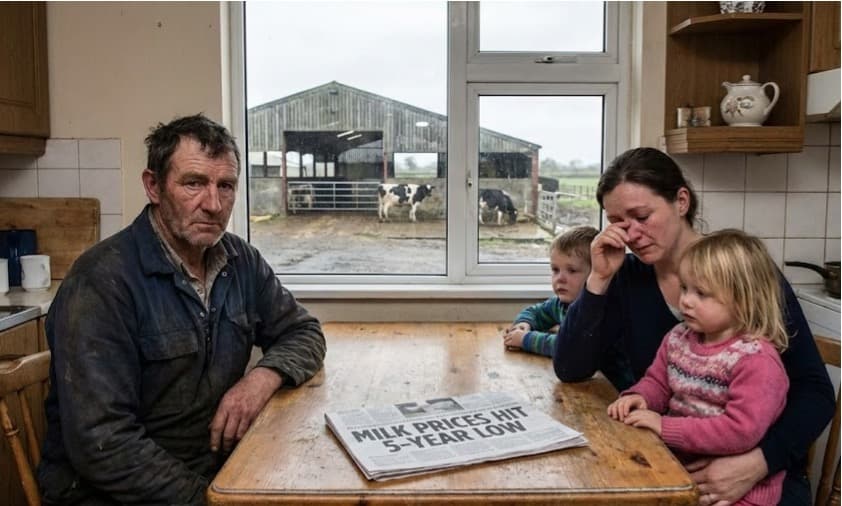
Raw-milk prices in Europe hit 5-yr low; ripple effect looms
Dec 07, 2025

Raw-milk prices in Europe hit 5-yr low; ripple effect looms

European raw-milk prices have plunged to their lowest in five years, as oversupply and weak demand weigh on dairy markets across the region. According to recent data from DCA Market Intelligence B.V.,...Read More

Global food prices ease; FAO dairy index slips — impact looms
Dec 06, 2025

Global food prices ease; FAO dairy index slips — impact looms

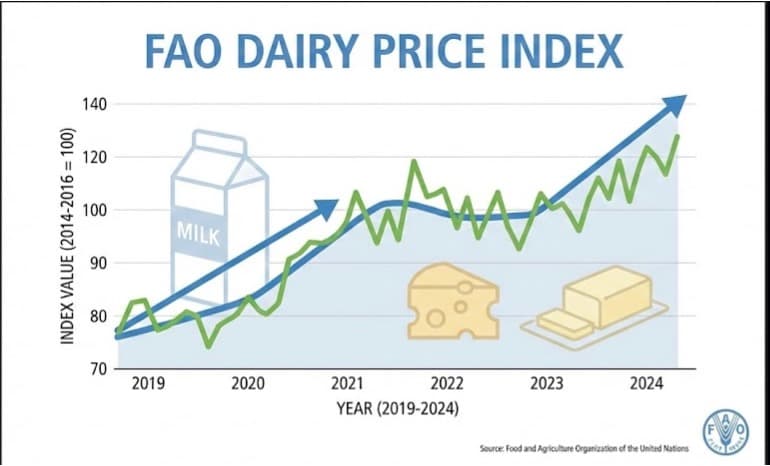
The FAO Dairy Price Index averaged 137.5 points in November, down 4.4 points (3.1 percent) from October and 2.4 points (1.7 percent) from its value a year ago. International dairy prices fell for the...Read More

Dairy News 7x7

Your trusted source for all the latest dairy industry news, market insights, and trending topics.

FOLLOW US
CATEGORIES
  • Global News
  • Indian News
  • Blogs
  • Publications
  • Podcasts
SUBSCRIBE TO OUR NEWSLETTER

Stay informed with the latest updates and trending news in the dairy industry.

No spam, unsubscribe at any time

GET IN TOUCH
C-49, C Block, Sector 65,
Noida, UP 201307
+91 7827405029dairynews7x7@gmail.com

© 2025 Dairy News 7x7. All Rights Reserved.

Terms of ServicePrivacy Policy

Three issues arise in animal-free dairy

By DairyNews7x7•Published on October 29, 2023

Precision fermentation plays a vital role in the animal-free dairy category. Speakers at SupplySide West in Las Vegas talked about the technology’s sustainability benefits, potential food safety issues and cost-reduction options.

Replacing one truckload of conventional whey protein isolate with Perfect Day’s animal-free whey protein isolate could save 1,276 tonnes of carbon dioxide emissions and 92.3 million liters of water used, said Ty Wagoner, PhD, scientist for the Berkeley, Calif.-based company, in an Oct. 25 session.

The day before, John Fagan, PhD, chairman and chief scientist for the Health Research Institute (HRI), said 92 unknown compounds in what he called “synbio milk” needed to be studied for food safety reasons, including by the US Food and Drug Administration.

Exploring alternative substrates for use in precision fermentation in general, and not just in the dairy category, could bring down the costs, said Monica Bhatia, PhD, co-founder and co-chief executive officer of Equii, San Francisco, in the Oct. 25 session.

Reaching commercial scale

Perfect Day in April 2020 received a “no questions” letter from the FDA about the Generally Recognized As Safe (GRAS) status of its beta-lactoglobulin, a proprietary protein for its products. The company uses precision fermentation to create proteins found in nature but made without animals, which decreases land use, water use and carbon dioxide emissions, Dr.Wagoner said
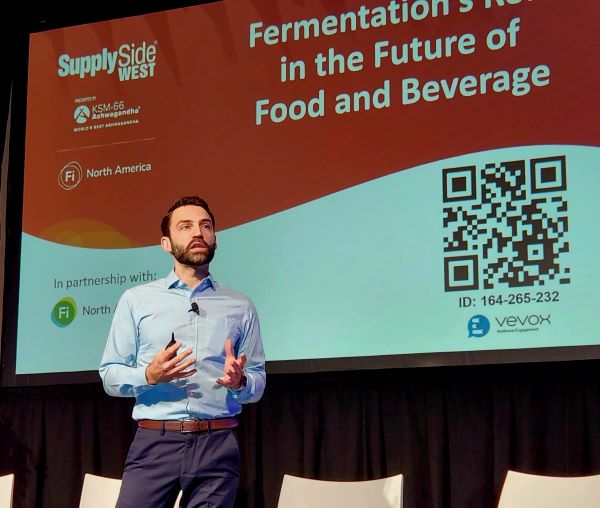
Ty Wagoner, PhD, scientist for Perfect Day. Photo: Sosland Publishing Co.

Precision fermentation involves providing a microorganism with a genetic code to produce a protein of interest.

“Obviously, genetic engineering is a key part of that process,” he said.

Genetically modified organisms are the organisms that produce the protein.

“The end product is not a GMO,” Dr. Wagoner said.

Perfect Day is producing its ingredients at commercial scale. Products containing the ingredients are in over 5,000 stores, he said.

Precision fermentation makes it more efficient to produce lactoferrin, a whey protein that makes up 0.3% of the total protein in cow’s milk, Dr. Wagoner said.

“We just make that protein (lactoferrin),” he said. “You don’t worry about removing everything else from the milk. You just make lactoferrin.”

Perfect Day’s animal-free dairy protein is a dairy protein. Consumers allergic to conventional dairy protein still will be allergic to Perfect Day’s dairy protein, Dr. Wagoner said.

92 unknown compounds

Dr. Fagan said “synbio milk” involves genetically engineered whey genes and yeast/fungal compounds. Precision fermentation creates the milk. HRI, Fairfield, Iowa, found 92 unknown compounds in such milk through HRI’s full spectrum molecular analysis, which detects and quantifies every molecular species in samples.

“We say we make the invisible visible,” Dr. Fagan said.

None of the 92 novel yeast/fungal compounds are GRAS or have undergone any FDA testing, he said.

“Basically there are 92 compounds identified in synbio milk that are not named by scientists,” he said. “Nobody has looked at them for safety, nutrition, quality.”

He said the synbio milk products should have a risk warning on packaging or be taken off the market.

Consider protein yields

Sweeteners, because of costs, often are used as substrates in the precision fermentation process, Dr. Bhatia said. Corn syrups costs about 50¢ per kg, and sucrose costs 50¢ to 80¢ per kg, she said.

A substrate’s protein yield, which means protein recovered per kg of fermentation, will affect costs. A yield of 2% for a substrate could lead to $25 to $40 per kg added to a product’s total costs, Dr. Bhatia said. A yield of 5% could drop the added cost to $10 to $16 per kg, and a yield of 10% could drop the added cost to $5 to $8 per kg.

Potential substrate sources that possibly could offer higher yields include wheat, rice, millet, sorghum, peas, chickpeas, corn, cassava and bananas, Dr. Bhatia said. Upcycled substrates might be dried distillers’ grains, fruit pulp and whey.

Equii, a food technology startup, has a proprietary approach to discover microbial proteins that are used to ferment grains and produce high-protein grain flours.

Source : Food Business News Oct 27th 2023

Swipe to continue reading

Previous Article

Next Article