
Logo
IndianGlobalBlogsPublicationsPodcastsMarketAboutContact
Logo
IndianGlobalBlogsPublicationsPodcasts
7News
TN Minister Urges Farmers to Adopt Tech for Value Addition in DairyListen to the Farm, Not the Farmer—The New Productivity LensWhat’s Driving Change In Beverages, FMCG And Dairy in 2025ED begins money laundering probe in dairy investment fraud caseIndo-Brazil pact aims to boost cattle genetics and dairy yield

Indian Dairy News

TN Minister Urges Farmers to Adopt Tech for Value Addition in Dairy
Dec 12, 2025

TN Minister Urges Farmers to Adopt Tech for Value Addition in Dairy

In Coimbatore this week, Tamil Nadu’s Minister for Milk and Dairy Development, Mano Thangaraj, called on dairy farmers to embrace modern technologies to boost productivity and value addition across th...Read More

Listen to the Farm, Not the Farmer—The New Productivity Lens
Dec 12, 2025

Listen to the Farm, Not the Farmer—The New Productivity Lens

India’s dairy sector, valued at nearly $30 billion, has reached a point where incremental changes will not deliver the next breakthrough. For decades, improvement programs have focused on what farmers...Read More

What’s Driving Change In Beverages, FMCG And Dairy in 2025
Dec 12, 2025

What’s Driving Change In Beverages, FMCG And Dairy in 2025

India’s retail landscape in 2025 was marked by a decisive shift in how consumers choose, consume and connect with brands. From beverages to daily nutrition and even the most essential dairy products,...Read More

Latest Blogs

See More
More Milk, Less Money: India’s Dairy Crisis
Dec 01, 2025

More Milk, Less Money: India’s Dairy Crisis

With the release of the BAHS 2025 summary report, I felt compelled to deep dive into its findings and reflect on the real progress and challenges facing India’s dairy sector. Over the last six years,...Read More

India Milk Prices: Cost Shock and Procurement Pressure
Nov 28, 2025

India Milk Prices: Cost Shock and Procurement Pressure

Milk prices in India face upward pressure as rising feed costs and procurement hikes reshape farm economics. Insight on dairy procurement, feed costs, and market outlook. Official government and coope...Read More

Stop Blaming, Start Claiming: Livestock’s Carbon Credit Future
Nov 16, 2025

Stop Blaming, Start Claiming: Livestock’s Carbon Credit Future

This week, I had the opportunity to attend an Agri Carbon Masterclass conducted by CII FACE. The deliberations, case studies, and discussions presented during the session were both insightful and thou...Read More

India Powers the Gulf’s Dairy Revolution -Gulf Food 2025
Oct 31, 2025

India Powers the Gulf’s Dairy Revolution -Gulf Food 2025

As Gulf Food Manufacturing prepares to open its doors from November 4–6 in Dubai, Indian dairy product and equipment manufacturers have a unique opportunity to explore one of the most promising region...Read More

Global Dairy News

Why the global milk business needs a structural shake-up
Dec 08, 2025

Why the global milk business needs a structural shake-up

The New Zealand dairy stalwart Fonterra has sold its consumer dairy-brands (milk, butter, cheese) — including “Anchor” and “Mainland Cheese” — to French agribusiness giant Lactalis in late October 202...Read More

Raw-milk prices in Europe hit 5-yr low; ripple effect looms
Dec 07, 2025

Raw-milk prices in Europe hit 5-yr low; ripple effect looms

European raw-milk prices have plunged to their lowest in five years, as oversupply and weak demand weigh on dairy markets across the region. According to recent data from DCA Market Intelligence B.V.,...Read More

Global food prices ease; FAO dairy index slips — impact looms
Dec 06, 2025

Global food prices ease; FAO dairy index slips — impact looms

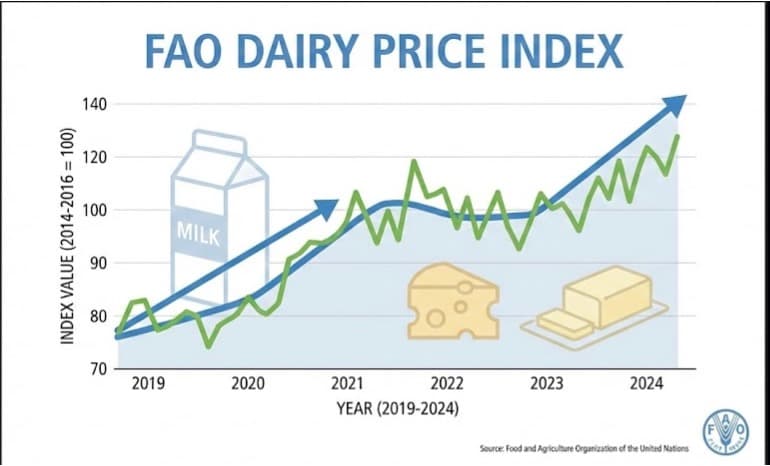
The FAO Dairy Price Index averaged 137.5 points in November, down 4.4 points (3.1 percent) from October and 2.4 points (1.7 percent) from its value a year ago. International dairy prices fell for the...Read More

Dairy News 7x7

Your trusted source for all the latest dairy industry news, market insights, and trending topics.

FOLLOW US
CATEGORIES
  • Global News
  • Indian News
  • Blogs
  • Publications
  • Podcasts
SUBSCRIBE TO OUR NEWSLETTER

Stay informed with the latest updates and trending news in the dairy industry.

No spam, unsubscribe at any time

GET IN TOUCH
C-49, C Block, Sector 65,
Noida, UP 201307
+91 7827405029dairynews7x7@gmail.com

© 2025 Dairy News 7x7. All Rights Reserved.

Terms of ServicePrivacy Policy

Smart labelling shouldn’t mislead consumers: Marketing of dairy foods

By DairyNews7x7•Published on September 28, 2022

A lot of what we consume, food or otherwise, is influenced by our perception of it, rather than by facts. According to Food Marketing and Technology magazine, an average food and drink company in the B2B space spends around 24 per cent of its revenue on marketing. For scale, the food and beverage industry accounts for 3 per cent of India’s GDP. Marketing is a double-edged sword. It introduces us to new products and steers us towards better consumption. But a well-targeted but misleading advertising campaign can negatively influence our decisions.

Ghee is an example. There is an even premium version of ghee called A2 milk ghee. The price of the A2 milk ghee can go up to almost ₹5,000 per litre. Although an outlier, even other prices are markedly higher than non-A2 ghee. What the marketers refer to as A2 ghee, is the ghee made from the milk of indigenous cows, sometimes also made by the traditional Bilona method of ghee-making rather than the industrial method.

Indigenous breeds give less milk and the Bilona process requires more milk to make the ghee. It has a higher cost of processing. The by-product buttermilk is sold for less than the skimmed milk by-product from industrial ghee processing. It is also tastier and better in terms of nutrition due to it containing more milk fat than industrially processed milk.

But all of these are characteristics of the Bilona process and not of A2 protein. The A2 tag in milk only refers to a specific protein made only by indigenous cows. Funnily enough, that protein isn’t even present in the final ghee product. Ghee is mostly made up of fats and micronutrients.

Tagging trends

Why that tag? Why not say this ghee is made from Gir Cow’s milk and by the Bilona method? The marketers know that premium products made for the elite sell better when they are backed by a scientific-sounding reason. In the case of A2 ghee, the claims come close to lying. The ghee might be made of A2 milk, but actual A2 protein is not present in the ghee. But A2 is a catchy and scientific-sounding tag, so slap that on with traditional words like Vedic, Bilona and Gir! Cover all consumer segments.

The next product is the hot new trend in young urban markets — plant-based milk alternatives. They’re higher priced, and they market themselves as a healthier and cruelty-free alternative to animal milk. The marketer’s claim is debatable on both counts.

Minimum content

FSSAI requires milk to be a mammary secretion. Many countries worldwide have certain ‘minimum content requirements’ for key nutrients like protein and milk solids for milk. Most of the alternatives are artificially fortified with micronutrients already present in animal milk and have added sugars.

Therefore, the regulations require them to label their products as milk alternatives and not as plant milk. These alternatives are good only in one case — they offer a viable alternative for lactose intolerant or other allergic people.

From a sustainability perspective, the plants, like almonds, also consume a lot of water. Almond Milk is the most popular alternative to animal milk. About 80 per cent of the world’s almonds are grown in California, a drought-prone state. There have also been cases of using child labour and bonded labour to process the ‘cruelty-free’ plant milk alternatives to keep the costs low. A better case for sustainability can always be made for locally produced buffalo milk.

You, as a consumer, still may prefer the A2 ghee or the soy latte. You like the taste of it or the texture it gives your food. It may be a healthier alternative for your system. It is not the consumption that is under scrutiny here. It is the marketing. A smart consumer’s choice, no matter what it is, is based on objective facts. Not gimmicky advertisement tactics that colour perceptions.

Swipe to continue reading

Previous Article

Next Article