

Sanjaya Baru | Amul and dairy co-ops: Milch cows get political
The controversy generated by the aggressive push into Karnataka of the Gujarat-based Amul, owned by the Gujarat government’s multi-billion dollar entity, the Gujarat Cooperative Milk Marketing Federation (GCMMF), was just waiting to happen.
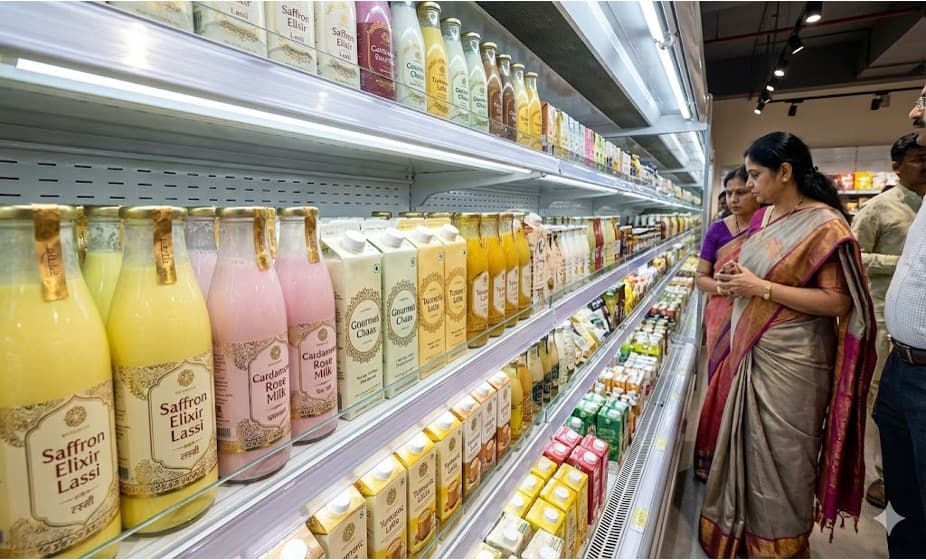
Worried about the impact of the controversy on the outcome of the state Assembly elections in Karnataka, the Amul management has beaten a hasty retreat, clarifying that there was no question of Amul taking over the Karnataka milk cooperatives’ “Nandini” brand. Not only would Amul do only online sales of a couple of products but that it’s packaged yogurt will not be called dahi (a Hindi word), as per an earlier directive of a Union government authority, but would be sold as curd. Amul’s retreat from Karnataka for the time being is political expediency rather than a measure of its reduced political clout or market power. As the dominant dairy brand, Amul has always enjoyed political patronage from the days of its founder V. Kurien.
However, as in the case of the sugar cooperatives, which politicians across the country have extracted juice from, dairy cooperatives too have now turned into political milch cows. Nothing symbolised the political importance of rural-based producers’ cooperatives, in general, and the sugar and dairy cooperatives, in particular, than the 2021 decision of Union home minister Amit Shah to double up as a minister of the newly inaugurated department of cooperatives. Eyebrows were raised by those bewildered by this decision.
Merely because the second most important member of the first Union council of ministers was Sardar Vallabhbhai Patel, many political analysts and commentators even today assume that the home ministry is second in importance to the Prime Minister’s job. Sardar Patel’s importance did not derive from the ministry he held but his political standing and historic relevance. The home minister of 1947-50 was an important member of the Union ministry because he was busy integrating a new republic into one nation.
Since the days of Sardar Patel, all and sundry have been Union home ministers and every incumbent knew the limitations of that job, especially after the Prime Minister of the day took away the Intelligence Bureau from under the home minister’s purview. Fed up with how inconsequential his job was, Lal Krishna Advani asked to be at least called “deputy PM”. A nomenclatural upgrade. This is the main reason why Pranab Mukherjee never wanted to be home minister and opted for finance when given a choice in 2009. As soon as Mukherjee went to Rashtrapati Bhavan in 2012, P. Chidambaram made sure he was back in the saddle at the western end of North Block.
Finance beats home in a modern economy.
Long story short. After two years in home ministry, and after giving up the party president’s post to J.P. Nadda, Amit Shah chose to add heft to his portfolio by becoming the first Union minister for cooperatives. Many political commentators attributed two reasons for Mr Shah’s appointment. The first hypothesis put forward was that the Bharatiya Janata Party wanted to elbow its way into what had for long been Sharad Pawar’s political turf.
A second, more proximate, factor was the near revolt of the dairy cooperatives of Gujarat that rejected the Union commerce ministry’s decision to sign up to a Asia-wide plurilateral trade agreement, Regional Comprehensive Economic Partnership (RCEP). Prime Minister Narendra Modi had already flown into Thailand in November 2019 with a brief that had said India should be one of the founding members of the RCEP. His friend, Prime Minister Shinzo Abe of Japan, was very keen that India be on board so that it could be a counter-weight to China. Mr Modi liked the idea.
However, hours before the PM could sign on to that agreement, he was advised not to do so. An embarrassed Mr Modi returned home and his spin doctors swung into action. India opted out, they declared, because China was adamant on certain issues and the Asean countries were not helpful. Supplicants in New Delhi’s so-called think tank community joined in the chorus and praised the PM for “standing up” to China. This narrative was sold to all and sundry till the usual leaks came out.
Of course, India has issues with China and Asean, but nothing was new on the day that Mr Modi landed in Bangkok. The new factor, however, was an urgent message from Mr Shah that if India agreed to cheaper dairy imports from Australia and New Zealand, then the Gujarat dairy cooperatives would en masse vote for the Opposition. The fear of losing Gujarat’s dairy vote kept India out of RCEP.
Surely, foreign trade policies should not ignore domestic politics. So why fight shy of stating the real reason. Even developed economies subsidise their dairy business, and so there is nothing wrong in India also doing so, but why blame the lactose-intolerant Chinese or the beef-eating Australians for the non-competitiveness of our dairy sector?
Once assured of such protection, the big guys started eyeing the small guys.
Protection from imports allowed the country’s wealthiest and biggest dairy cooperative started eyeing competition. It hoped to gobble up the Karnataka federation before the state Assembly elections there. The Opposition political parties woke up in time and Amul and the BJP have backed off.
There is a larger issue at stake in the dairy market wars. Inspired no doubt by Amul and the Gujarat famers, most states have their own dairy cooperatives. Like in sugar, the milk cooperatives are also a source of political funding and mobilisation.
The BJP’s attempt to centralise this kitty and get all-India control has come up against varying tastes and consumer loyalties and federal interests and pressures.
Why should perugu or thayyaru or mosaru be called dahi?
Through its politicised version of a pluralistic religion and culture and through the systematic imposition of Hindi and so on, the BJP constantly tries not to “unite” a diverse country, but to in fact to “centralise” it. The cow is holy to all Hindus, but there are limits to how much political mileage can be milked from it. Moreover, as every Telugu, Kannadiga and Tamilian knows, no meal is ever complete without curd rice and pickle. Our Gujarati friends don’t know what they are missing.