What does it take to be seen to be working toward a healthier world?
Agriculture is becoming the target of fringe activist groups. No, let me re-state that. Agriculture is already the target of these groups. The reasons are many and varied but they’re almost always linked to the same basic problem — knee-jerk responses to complex issues — like the feeling that Canada’s high-tech, high-science agriculture has got to be worse for the environment than the low-tech agricultures of less advanced countries.
But even within the world’s agriculture, it’s probable that no sector has been a target more often, or more stridently, than its dairy farms.
In Britain, a group called Animal Rebellion has been pouring milk onto the floors of supermarkets — as well as other unlawful acts — in publicized protests, with the stated aim of completely disrupting that country’s dairy supply.
Among that group’s demands are government support for a movement completely away from animal farming and commercial fishing to a totally plant-based system. (That said, there is some flexibility in their demands. One supporter told a local newspaper report he’d also allow a complete return to “wild nature.” )
How converting all existing pasture and forage lands to intensive cropping to allow for a completely plant-based diet would suddenly make agriculture more “natural” is testament to the absurdity of the movement. Nevertheless, the dairy sector has been identified as one of the biggest GHG (greenhouse gas) emitters in agriculture, and that has still other activist groups riled up and targeting farms and value chain businesses as well.
Here in Canada, the Dairy Farmers of Canada (DFC) has launched a public relations campaign in an apparent effort to avoid the kind of problems U.K. farmers and dairy processors are coping with. According to a study completed for the DFC, Canadian dairy operations contribute only half of the global average GHGs emitted by dairy farms around the world, and the group has committed to reaching net-zero emissions by the year 2050.
The UN Food and Agriculture Organization (FAO) confirms this low GHG emissions ranking and estimates the average carbon footprint for a litre of milk produced in Canada ranges from 0.93 kilogram of CO2 equivalents in the west to 1.12 kilograms in the east. Differing climates and the use of irrigation in some regions is the cause for the difference.
Just how significant is that one kilogram of CO2 equivalents? For reference, it’s roughly the equivalent carbon footprint of a two-minute hot shower.
Ag machinery brands have been keenly aware of how farming is perceived by the public, and many of them have been working to help train farmers in “sustainable” production methods. Hopefully, they can help stem the tide of activism against the industry. As brands push precision ag technology to western producers as an aid in that effort, AGCO has also had a relatively impressive record in providing small-holding farmers in developing nations with the skills to not only reduce their impact on the environment, but also to improve their standard of living at the same time.
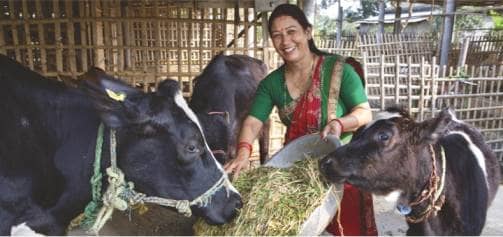
According to the FAO, among those global regions with the highest carbon footprint in dairy production are Africa and Asia. GHG emissions in some of those regions can hit seven kilograms per litre. In October, AGCO’s Agriculture Foundation (AAF) made a $250,000 donation to Heifer Netherlands (a Dutch non-profit organization) “to improve the sustainability, productivity and resilience of smallholder dairy farming families through the development of a climate-smart and productive dairy model in Nepal.”
The AAF’s stated goal is to “fight hunger and promote sustainable climate solutions for farmers through sustainable, impact-driven agriculture projects.” Heifer Netherland’s grant application was chosen from hundreds of others, according to AGCO. As a result, the two have entered a two-year partnership to help Nepalese dairy producers improve their operations.
“Funded by the AAF, this project will help minimize existing GHG emissions from Nepalese smallholder dairy farming practices while improving productivity,” reads AGCO’s statement. “It will also help smallholder dairy producers, particularly women, focus on climate-smart solutions. The project approach will combine several sustainable farming methods. Producers will learn to develop climate-smart feed management and animal husbandry systems that reduce enteric fermentation, improve the productivity of animals and sequester carbon emissions through fodder trees and proper manure management with clean energy production using biogas and organic fertilizer.”
Roger Batkin, board chair at the AGCO Agriculture Foundation, added to that, saying, “Nepal remains one of the world’s least-developed nations. The majority of people live in rural areas. We want to prioritize actions for the direct benefit of these farmers’ livelihoods while supporting sustainable agricultural practices that maintain soil fertility, raise healthy livestock and improve the environment. Across food chains, from livestock to crop production, climate change continues to have a significant impact on food security and livelihoods of farmers and their communities.”
“This project will also contribute to the work of a large long-term program called ‘Milky Way Nepal’ that aims to transform the smallholder dairy sector into a fair, profitable and climate-smart value chain by 2030,” said Goossen Hoenders, executive director of Stichting Heifer Nederland. “The granted award is one of the first steps into realizing this ambitious program.”
Over the 24 months of the program, the effort is expected to have an impact on about 100 small dairy operations, affecting the lives of about 500 people in total. It is also expected to engage with a number of those in the dairy value chain, Nepalese academics and non-governmental organizations to drive sustainable development initiatives from the producer level right through to the final consumer.
Of course climate change-related production processes aren’t the only aspect of animal husbandry that fringe protest groups have targeted. Animal welfare activists, such as PETA, have taken action against beef and dairy operations in the past. And AGCO’s AAF has pushed for improvements in animal welfare, too.
Back in January of 2019, then AGCO CEO Martin Richenhagen spoke at the “Feeding the World — The Future of Protein” summit in Berlin, which his firm had organized.
“Whilst discussing protein production, a special emphasis should be placed on the future of the animal welfare. Meat and poultry producers, especially in emerging markets with a growing middle class, are in need of comprehensive solutions to improve agricultural supply chains,” Richenhagen told the audience back then. “Today, we have brought together industry specialists, politicians, scientists and animal welfare experts to discuss a number of pressing matters, including challenges to feed a rapidly growing world population, as well as solutions that not only boost overall performance and productivity of farms, but also offer innovative and sustainable ways to improve animal handling and the fair treatment of animals in our agricultural supply chains.”
As part of the ongoing efforts of that initiative, in 2020 the AAF launched an event in Zambia to teach small poultry growers better, more sustainable production methods.
“Our agricultural training facility will play a key role to facilitate knowledge and skills transfer for farmers on best livestock management practices required to boost productivity and income. We will work with our grain and protein business unit to support selected farmers on improved animal welfare and livestock management operations,” said Kalongo Chitengi, senior manager at the AGCO Future Farm.
That Future Farm in Zambia was another AGCO initiative created even earlier, in 2015. It was a pet project of Richenhagen and was created to help train African farmers in modern production methods and to give them access to farm equipment. And unlike previous efforts to introduce modern farming on the continent, including a well-known effort by the Canadian International Development Agency back a few decades ago, this one has been working well.
The success of that demonstration farm and other initiatives to improve the lives of farmers around the world could eventually benefit the brand in giving it an early start in future machinery markets where currently none exists. But right now, those efforts are truly providing a worthy humanitarian service.
The world could use a lot more of such corporate responsibility. It’s an effort that will require every stakeholder in agriculture to pitch in, including the machinery sector.
As Charlie McConalogue, Irish minister of Agriculture, Food and the Marine in Donegal, Ireland is reported to have told a rural youth organization during a speech, “We can’t just say we’re sustainable.” The agriculture sector will eventually have to prove it.