Logo
IndianGlobalBlogsPublicationsPodcastsMarketAboutContact
Logo
IndianGlobalBlogsPublicationsPodcasts
7News
High-Oleic Soybeans Could Transform Dairy Feed & Milk QualityAmul Dairy Records ₹14,099 Cr Turnover, 9.2% GrowthHi-Tech dairy plant to be commissioned in Namakkal in FebruaryKerala Milk Output Up by 10 Lakh Litres, Minister SaysJallikattu Bull-Taming Fest Draws Large Crowds Near Tirupati

Indian Dairy News

Amul Dairy Records ₹14,099 Cr Turnover, 9.2% Growth
Jan 19, 2026

Amul Dairy Records ₹14,099 Cr Turnover, 9.2% Growth

The Kaira District Cooperative Milk Producers’ Union Ltd (Amul Dairy) reported a turnover of ₹14,099 crore in FY25, marking a 9.2 % year-on-year growth, according to figures announced at its 79th Annu...Read More

Hi-Tech dairy plant to be commissioned in Namakkal in February
Jan 19, 2026

Hi-Tech dairy plant to be commissioned in Namakkal in February

A hi-tech dairy plant, that is upcoming in Namakkal at a cost of ₹89.28 crore, will be commissioned next month (February) and the trial run of the plant has begun. The Namakkal Aavin that was bifur...Read More

Kerala Milk Output Up by 10 Lakh Litres, Minister Says
Jan 19, 2026

Kerala Milk Output Up by 10 Lakh Litres, Minister Says

Kerala’s **total milk production has climbed by approximately 10 lakh litres per day, the state’s Animal Husbandry Minister announced during the ongoing State Ksheera Sangamam dairy expo, highlighting...Read More

DairyNews7x7
Advertisement

Latest Blogs

See More
5 Year Budget Plan to Make Indian Dairy Global Leader in 2047
Jan 15, 2026

5 Year Budget Plan to Make Indian Dairy Global Leader in 2047

I recently moderated a key session on India Dairy Vision 2047 at the TPCI's International Dairy Processing Conference 2026, gaining valuable insights from panellists. This led to me developing policy...Read More

From Forecast to Fact: 2025 Lessons, 2026 Dairy Outlook
Jan 01, 2026

From Forecast to Fact: 2025 Lessons, 2026 Dairy Outlook

As we step into 2026, it is worth pausing to reflect on how the Indian dairy sector navigated the challenges of 2025 and how closely reality tracked the forecasts I outlined in the first blog of last...Read More

India–NZ Dairy FTA: Safeguards or Silent Slippages?
Dec 26, 2025

India–NZ Dairy FTA: Safeguards or Silent Slippages?

The recently concluded India–New Zealand Free Trade Agreement (FTA) marks an important milestone in bilateral trade, while carefully ring-fencing India’s sensitive dairy sector. Under the agreement, c...Read More

Vision 2047: India’s Dairy Development Roadmap
Dec 21, 2025

Vision 2047: India’s Dairy Development Roadmap

As India moves steadily toward Vision 2047, the dairy sector stands at a strategic inflection point. From being a food security instrument in the decades following Independence, dairy has evolved into...Read More

Global Dairy News

High-Oleic Soybeans Could Transform Dairy Feed & Milk Quality
Jan 19, 2026

High-Oleic Soybeans Could Transform Dairy Feed & Milk Quality

New research shows that feeding high-oleic soybeans to dairy cows can both improve milk composition and cut feed costs, offering a promising feed strategy for producers amid rising input prices. This...Read More

Dairy Protein Value Index Slips as South America Exports Shift
Jan 18, 2026

Dairy Protein Value Index Slips as South America Exports Shift

The Dairy Protein Value Index posted a modest decline in mid-December, highlighting subtle but meaningful shifts in South American dairy exports that continue to shape global protein markets — includi...Read More

Real California Milk Excelerator Boosts Dairy Brand Innovation
Jan 17, 2026

Real California Milk Excelerator Boosts Dairy Brand Innovation

The Real California Milk Excelerator, run by the California Milk Advisory Board (CMAB) in partnership with innovation firm VentureFuel, has once again put the spotlight on dairy innovation by supporti...Read More

DairyNews7x7
Advertisement
Dairy News 7x7

Your trusted source for all the latest dairy industry news, market insights, and trending topics.

FOLLOW US
CATEGORIES
  • Global News
  • Indian News
  • Blogs
  • Publications
  • Podcasts
SUBSCRIBE TO OUR NEWSLETTER

Stay informed with the latest updates and trending news in the dairy industry.

No spam, unsubscribe at any time

GET IN TOUCH
C-49, C Block, Sector 65,
Noida, UP 201307
+91 7827405029dairynews7x7@gmail.com

© 2026 Dairy News 7x7. All Rights Reserved.

Terms of ServicePrivacy Policy

Uncontrolled use of critically important antibiotics in dairy cattle is making milk unsafe: CSE findings
By DairyNews7x7•Published on July 31, 2020

CSE’s new assessment of antibiotic misuse in the dairy sector says milk is not safe. Centre for Science and Environment organised an online consultation with stakeholders on indiscriminate use of Antibiotics on milch animals . It also shared concern over inadequate attention to testing antibiotic residues in milk .

A wide spectrum of experts and participants from the FSSAI; the National Dairy Development Board (NDDB); the World Health Organization (WHO); the Department of Animal Husbandry and Dairying; the Central Drugs Standard Control Organisation;and representatives from specialised educational and research institutions, civil society bodies, and concerned departments from different states attended this event.

Milk adulteration survey 2018 by FSSAI

FSSAI conducted a national level milk adulteration survey in 2018. A total of 6,432 samples of milk were collected from 1,103 towns/cities . These towns were having population above 50,000. Samples were collected from the organised as well as from the un-organised sectors.

The survey further showed that that 1.2 % of the samples had antibiotic residue above the permissible limits. Madhya Pradesh (23 out of 335 samples), Maharashtra (9 out of 678 samples) and UP (8 out of 729 samples) were amongst the top three States with highest levels of Antibiotic residues were

Most farmers CSE spoke to did not know about withdrawal period . This is the time after the last day an antibiotic is administered and before the milk is sold. Farmers must not sell milk cattle during this period as it can increase chances of antibiotic residues in milk.

Department of Animal Husbandry (DAHD) Farmer Manual recommends use of only penicillin, gentamicin, streptomycin and enro-floxacin on animals. Farmers, however, uses ceftiofur, amoxicillin, cloxacillin and ceftriaxone-sulbactam, ceftizoxime or ceftriaxone-tazobactum.

CSE has recently published its assessment of antibiotic use in the country’s dairy industry . It could is available on the website downtoearth.org.in , and its findings are disturbing. “We have found that antibiotics are extensively misused in the dairy sector”; antibiotic residues remain largely untested in milk, an integral part of Indian diets, particularly of children. We are concerned about this , said CSE ‘s DG Sunita Narayan.

There is no protocol on sale and use of antibiotics

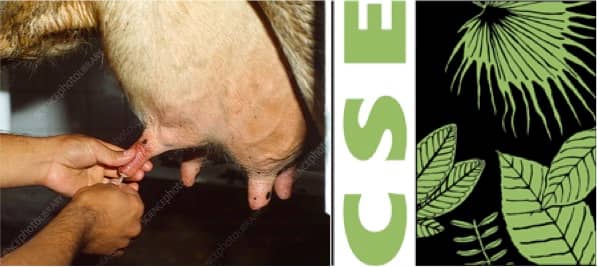
CSE’s assessment shows that dairy farmers indiscriminately use antibiotics for diseases such as mastitis (infection/inflammation of the udder). It is a common ailment in dairy animals. Often, these include critically important antibiotics (CIAs) meant for humans. The WHO has warned that these antibiotics should be preserved in view of the growing crisis of antibiotic resistance.

These antibiotics ,despite a law against it ,are easily available without the prescription of a registered veterinarian and stocked at farms. Farmers often inject animals based on their own judgement of signs and symptoms of a disease without any veterinary supervision.

CSE researchers also point towards inadequate focus on testing for antibiotic residues in the milk by some state milk federations. These federations later process it and sell packaged milk and dairy products under popular brands.

The way forward

CSE has suggested a series of measures such as limiting misuse of antibiotics, particularly CIAs, and no-use of HPCIAs; modifying existing standards for antibiotic residues in milk accordingly; ensuring antibiotics are not available without prescription; and undertaking routine surveillance of antibiotic residues in milk.

Summing up, Narainsaid: “What is really remarkable and significant is that India is now talking about antibiotic resistance in the one-health perspective. We must ramp up surveillance and testing, put a complete stop to the use of critically important antibiotics and penalise their use and work with farmers and the agriculture-dairy sectors to innovate on solutions.”

Swipe to continue reading

Previous Article

Next Article