
Logo
IndianGlobalBlogsPublicationsPodcastsMarketAboutContact
Logo
IndianGlobalBlogsPublicationsPodcasts
7News
TN Minister Urges Farmers to Adopt Tech for Value Addition in DairyListen to the Farm, Not the Farmer—The New Productivity LensWhat’s Driving Change In Beverages, FMCG And Dairy in 2025ED begins money laundering probe in dairy investment fraud caseIndo-Brazil pact aims to boost cattle genetics and dairy yield

Indian Dairy News

TN Minister Urges Farmers to Adopt Tech for Value Addition in Dairy
Dec 12, 2025

TN Minister Urges Farmers to Adopt Tech for Value Addition in Dairy

In Coimbatore this week, Tamil Nadu’s Minister for Milk and Dairy Development, Mano Thangaraj, called on dairy farmers to embrace modern technologies to boost productivity and value addition across th...Read More

Listen to the Farm, Not the Farmer—The New Productivity Lens
Dec 12, 2025

Listen to the Farm, Not the Farmer—The New Productivity Lens

India’s dairy sector, valued at nearly $30 billion, has reached a point where incremental changes will not deliver the next breakthrough. For decades, improvement programs have focused on what farmers...Read More

What’s Driving Change In Beverages, FMCG And Dairy in 2025
Dec 12, 2025

What’s Driving Change In Beverages, FMCG And Dairy in 2025

India’s retail landscape in 2025 was marked by a decisive shift in how consumers choose, consume and connect with brands. From beverages to daily nutrition and even the most essential dairy products,...Read More

Latest Blogs

See More
More Milk, Less Money: India’s Dairy Crisis
Dec 01, 2025

More Milk, Less Money: India’s Dairy Crisis

With the release of the BAHS 2025 summary report, I felt compelled to deep dive into its findings and reflect on the real progress and challenges facing India’s dairy sector. Over the last six years,...Read More

India Milk Prices: Cost Shock and Procurement Pressure
Nov 28, 2025

India Milk Prices: Cost Shock and Procurement Pressure

Milk prices in India face upward pressure as rising feed costs and procurement hikes reshape farm economics. Insight on dairy procurement, feed costs, and market outlook. Official government and coope...Read More

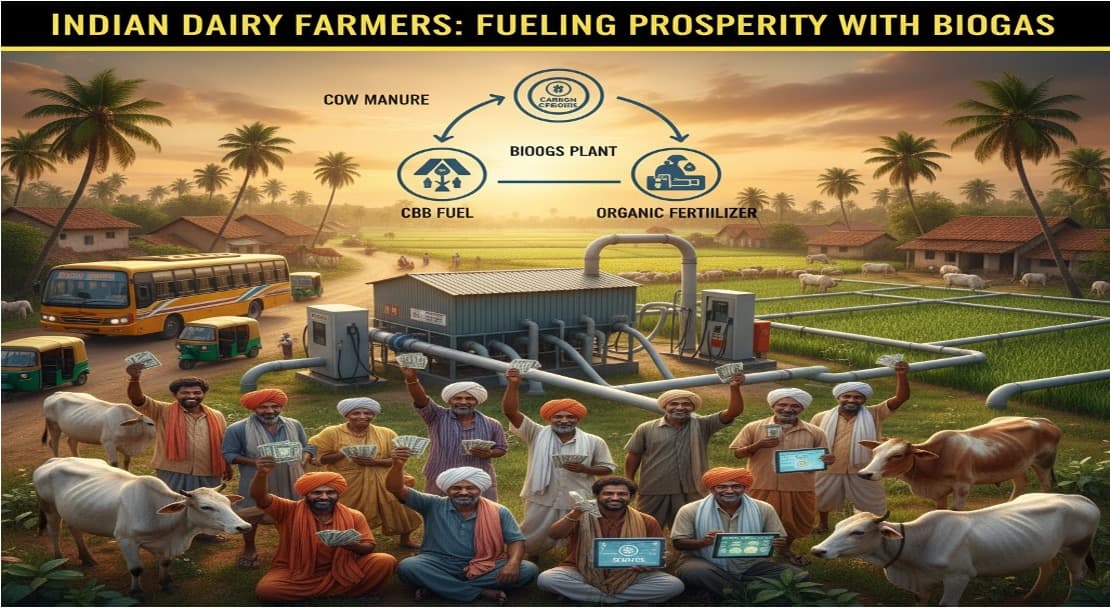
Stop Blaming, Start Claiming: Livestock’s Carbon Credit Future
Nov 16, 2025

Stop Blaming, Start Claiming: Livestock’s Carbon Credit Future

This week, I had the opportunity to attend an Agri Carbon Masterclass conducted by CII FACE. The deliberations, case studies, and discussions presented during the session were both insightful and thou...Read More

India Powers the Gulf’s Dairy Revolution -Gulf Food 2025
Oct 31, 2025

India Powers the Gulf’s Dairy Revolution -Gulf Food 2025

As Gulf Food Manufacturing prepares to open its doors from November 4–6 in Dubai, Indian dairy product and equipment manufacturers have a unique opportunity to explore one of the most promising region...Read More

Global Dairy News

Why the global milk business needs a structural shake-up
Dec 08, 2025

Why the global milk business needs a structural shake-up

The New Zealand dairy stalwart Fonterra has sold its consumer dairy-brands (milk, butter, cheese) — including “Anchor” and “Mainland Cheese” — to French agribusiness giant Lactalis in late October 202...Read More

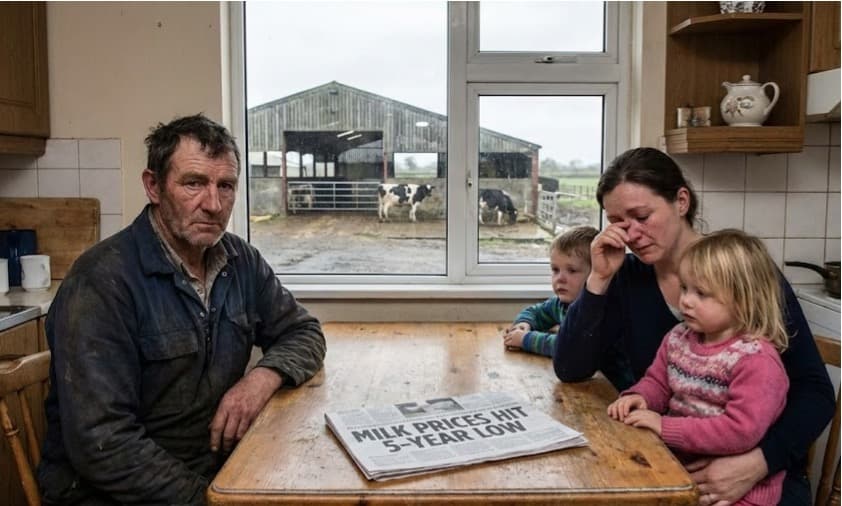
Raw-milk prices in Europe hit 5-yr low; ripple effect looms
Dec 07, 2025

Raw-milk prices in Europe hit 5-yr low; ripple effect looms

European raw-milk prices have plunged to their lowest in five years, as oversupply and weak demand weigh on dairy markets across the region. According to recent data from DCA Market Intelligence B.V.,...Read More

Global food prices ease; FAO dairy index slips — impact looms
Dec 06, 2025

Global food prices ease; FAO dairy index slips — impact looms

The FAO Dairy Price Index averaged 137.5 points in November, down 4.4 points (3.1 percent) from October and 2.4 points (1.7 percent) from its value a year ago. International dairy prices fell for the...Read More

Dairy News 7x7

Your trusted source for all the latest dairy industry news, market insights, and trending topics.

FOLLOW US
CATEGORIES
  • Global News
  • Indian News
  • Blogs
  • Publications
  • Podcasts
SUBSCRIBE TO OUR NEWSLETTER

Stay informed with the latest updates and trending news in the dairy industry.

No spam, unsubscribe at any time

GET IN TOUCH
C-49, C Block, Sector 65,
Noida, UP 201307
+91 7827405029dairynews7x7@gmail.com

© 2025 Dairy News 7x7. All Rights Reserved.

Terms of ServicePrivacy Policy

Milk prices are projected to increase by 28% this year.What’s driving costs?

By DairyNews7x7•Published on October 25, 2022

At the end of 2021, the cost of a litre of home-brand milk in an Australian supermarket was about $1.30. It’s now about $1.60.

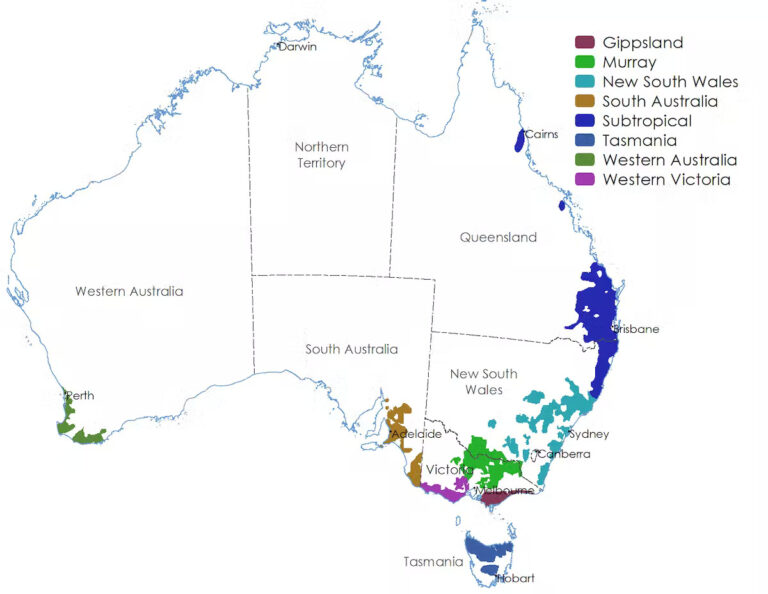
What will it cost at the end of 2022? That depends on the continued effect of flooding on prime dairy-production regions in New South Wales, Victoria and Tasmania, as well as on global economic conditions.

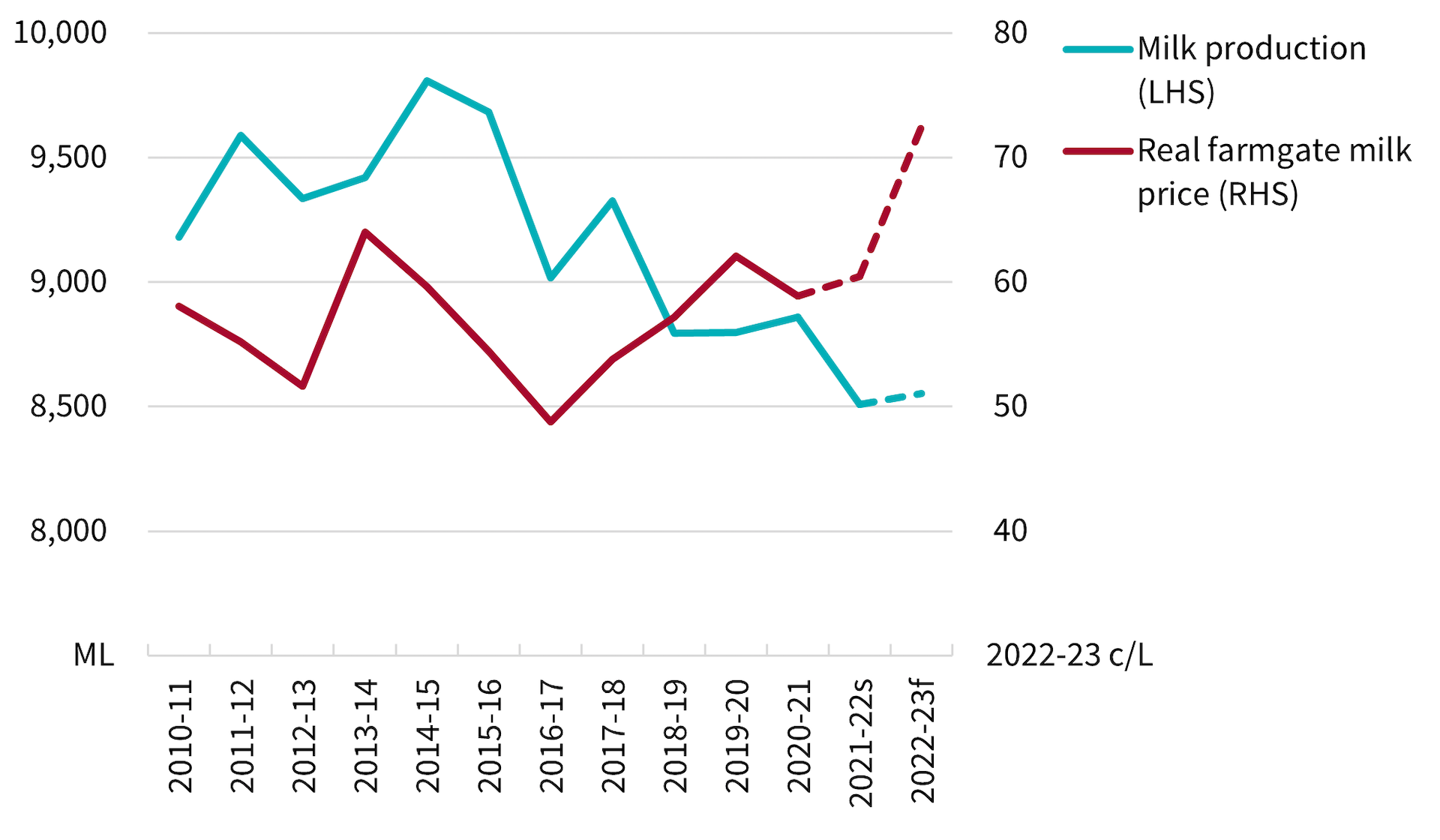
The Australian Bureau of Agricultural and Resource Economics and Science has projected a 28% increase in the farm-gate milk price in 2022-23 — to 72.5 cents per litre, a record high. With less milk being produced, it could be even more.

It’s a case of higher demand and lower supply. Production has been declining since 2014. In the first half of 2022, ABARES says milk production was about 7% lower than the same period in 2021:

This was driven by extreme weather events: a drier than average start of the year in southern Victoria and northwest Tasmania, flooding in regions of Queensland and northern New South Wales. Also, with export prices for Australian dairy products increasing substantially at the start of 2022, less milk was available to the domestic market.

Obviously, things aren’t all rosy. Some dairy farmers face the devastation of natural disasters. All face the same post-COVID challenges as other primary producers. Russia’s war on Ukraine has help drive up costs of inputs, from fertilisers to feed. Labour is hard to find.
 

ABARES, CC BY-NC-ND
But for all that, the record-high farm-gate price is good news for an industry where the number of farmers has declined by a quarter in the past decade (from about 7500 in 2011 to about 5,700 now).

Deregulation stirs the pot

Until 2000, farm-gate milk prices were regulated. State and territory governments set minimum farm-gate prices that maintained farmer income.

This was abandoned in July 2000. With deregulation, farmers, processors and supermarkets were set free to negotiate prices.

In economic theory, free trade works fine when you have a large number of buyers and sellers, all with the same amount of information about what is happening in the market.

But in the milk industry, thousands of producers sell to a handful of milk processors, who then sell to even fewer retailers. The major supermarkets control almost 60% of total milk sales.

This is not always such a problem. It is not often you hear fresh producers screaming at supermarkets, in what is a very similar arrangement. But with the dairy industry, as noted in a 2021 report from the Department of Agriculture, Waters and the Environment, there is a “perceived market failure”.

Why? It has to do with how supermarkets have used their power.

Waging the milk price war

To give time for the market to find an equilibrium, the Howard government introduced a “Dairy Adjustment Levy” of 11 cents per litre to support farmers through deregulation. This levy remained in place until 2008, when it was abolished by the Rudd government.

Then, in 2011, the “milk war” broke out. Coles had the idea of luring shoppers from Woolworths by selling milk at $1 a litre. Woolworths responded. Aldi joined the move. And the war kept prices artificially low for almost a decade.

Supermarkets put the squeeze on processors, who had little option but to accept what was offered for crucial supermarket contracts. Processors then put the squeeze on farmers.
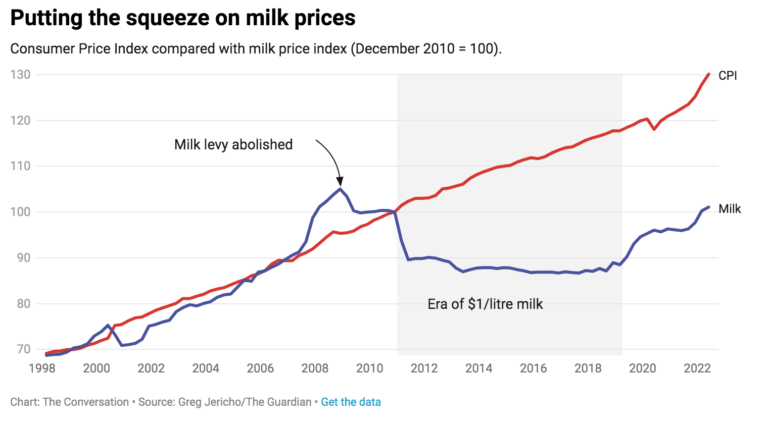
Chart: The Conversation  Source: Greg Jericho/The Guardian 
Many decided the effort was not worth it, and quit farming. Milk production peaked in 2014 then declined.

Supermarkets finally abandoned $1/litre milk in 2019, under considerable public and political pressure to acknowledge that, after eight years with no increase, some rebalancing was needed.

During this time, overseas demand for dairy products has also been increasing, especially in Asia. Now about 32% of Australian dairy production is exported – not as fresh milk, but as cheese, butter and other dairy products. (It takes about 10 litres of milk to make 1 kilogram of cheese, and 20 litres to make 1kg of butter.)

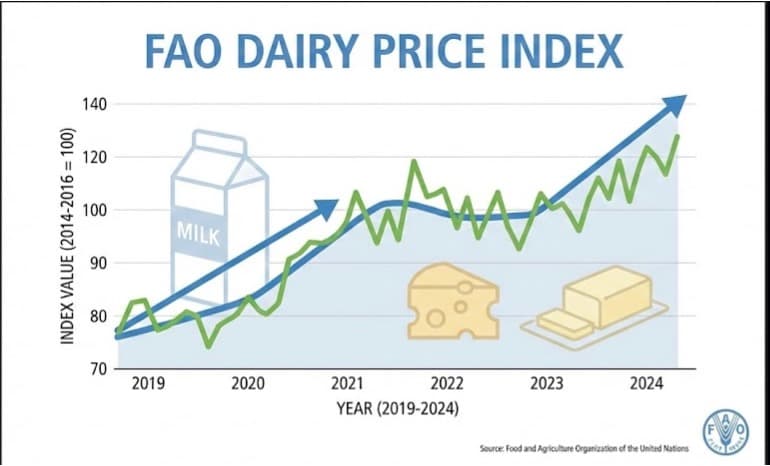
On top of that, lately US and European dairy farmers have had a hard time with drought, increasing international prices. The United Nations’ Food and Agriculture Organization’s Dairy Price Index increased by more than 17% from 2020 to 2021 and is expected to rise another 15% by the end of this year.
ABARES; Dairy Australia
The projected 28% rise in farm-gate milk prices in 2022-23 will bring the value of Australian dairy production to a record $6.2 billion.

Which is good news for the long-term sustainability of dairy farming in Australia. You might not appreciate it, but to keep dairy farmers in business, a fair price must be paid for your fresh milk.

Flavio Macau is an associate dean in the School of Business and Law at Edith Cowan University, and Amy Cosby is a research fellow — agricultural education and extension at CQUniversity Australia. 

This article is republished from The Conversation under a Creative Commons license. Read the original article.

Swipe to continue reading

Previous Article

Next Article