
Logo
IndianGlobalBlogsPublicationsPodcastsMarketAboutContact
Logo
IndianGlobalBlogsPublicationsPodcasts
7News
TN Minister Urges Farmers to Adopt Tech for Value Addition in DairyListen to the Farm, Not the Farmer—The New Productivity LensWhat’s Driving Change In Beverages, FMCG And Dairy in 2025ED begins money laundering probe in dairy investment fraud caseIndo-Brazil pact aims to boost cattle genetics and dairy yield

Indian Dairy News

TN Minister Urges Farmers to Adopt Tech for Value Addition in Dairy
Dec 12, 2025

TN Minister Urges Farmers to Adopt Tech for Value Addition in Dairy

In Coimbatore this week, Tamil Nadu’s Minister for Milk and Dairy Development, Mano Thangaraj, called on dairy farmers to embrace modern technologies to boost productivity and value addition across th...Read More

Listen to the Farm, Not the Farmer—The New Productivity Lens
Dec 12, 2025

Listen to the Farm, Not the Farmer—The New Productivity Lens

India’s dairy sector, valued at nearly $30 billion, has reached a point where incremental changes will not deliver the next breakthrough. For decades, improvement programs have focused on what farmers...Read More

What’s Driving Change In Beverages, FMCG And Dairy in 2025
Dec 12, 2025

What’s Driving Change In Beverages, FMCG And Dairy in 2025

India’s retail landscape in 2025 was marked by a decisive shift in how consumers choose, consume and connect with brands. From beverages to daily nutrition and even the most essential dairy products,...Read More

Latest Blogs

See More
More Milk, Less Money: India’s Dairy Crisis
Dec 01, 2025

More Milk, Less Money: India’s Dairy Crisis

With the release of the BAHS 2025 summary report, I felt compelled to deep dive into its findings and reflect on the real progress and challenges facing India’s dairy sector. Over the last six years,...Read More

India Milk Prices: Cost Shock and Procurement Pressure
Nov 28, 2025

India Milk Prices: Cost Shock and Procurement Pressure

Milk prices in India face upward pressure as rising feed costs and procurement hikes reshape farm economics. Insight on dairy procurement, feed costs, and market outlook. Official government and coope...Read More

Stop Blaming, Start Claiming: Livestock’s Carbon Credit Future
Nov 16, 2025

Stop Blaming, Start Claiming: Livestock’s Carbon Credit Future

This week, I had the opportunity to attend an Agri Carbon Masterclass conducted by CII FACE. The deliberations, case studies, and discussions presented during the session were both insightful and thou...Read More

India Powers the Gulf’s Dairy Revolution -Gulf Food 2025
Oct 31, 2025

India Powers the Gulf’s Dairy Revolution -Gulf Food 2025

As Gulf Food Manufacturing prepares to open its doors from November 4–6 in Dubai, Indian dairy product and equipment manufacturers have a unique opportunity to explore one of the most promising region...Read More

Global Dairy News

Why the global milk business needs a structural shake-up
Dec 08, 2025

Why the global milk business needs a structural shake-up

The New Zealand dairy stalwart Fonterra has sold its consumer dairy-brands (milk, butter, cheese) — including “Anchor” and “Mainland Cheese” — to French agribusiness giant Lactalis in late October 202...Read More

Raw-milk prices in Europe hit 5-yr low; ripple effect looms
Dec 07, 2025

Raw-milk prices in Europe hit 5-yr low; ripple effect looms

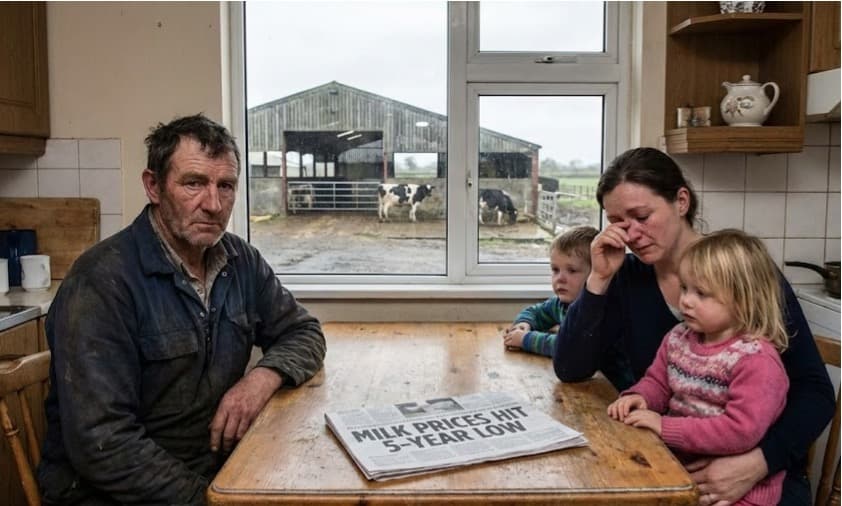
European raw-milk prices have plunged to their lowest in five years, as oversupply and weak demand weigh on dairy markets across the region. According to recent data from DCA Market Intelligence B.V.,...Read More

Global food prices ease; FAO dairy index slips — impact looms
Dec 06, 2025

Global food prices ease; FAO dairy index slips — impact looms

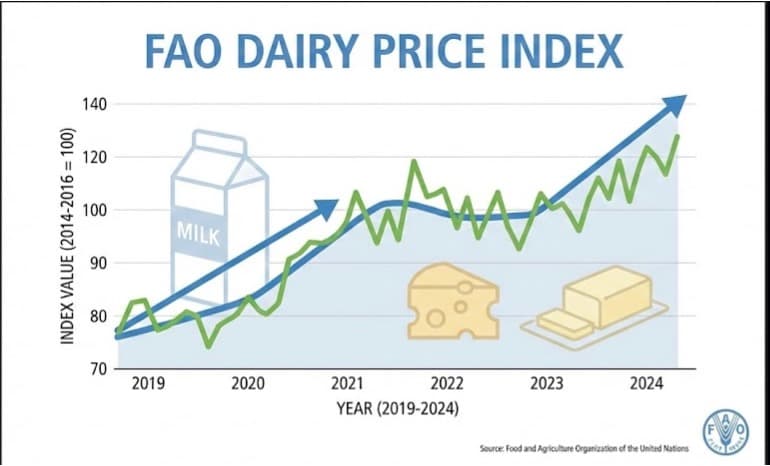
The FAO Dairy Price Index averaged 137.5 points in November, down 4.4 points (3.1 percent) from October and 2.4 points (1.7 percent) from its value a year ago. International dairy prices fell for the...Read More

Dairy News 7x7

Your trusted source for all the latest dairy industry news, market insights, and trending topics.

FOLLOW US
CATEGORIES
  • Global News
  • Indian News
  • Blogs
  • Publications
  • Podcasts
SUBSCRIBE TO OUR NEWSLETTER

Stay informed with the latest updates and trending news in the dairy industry.

No spam, unsubscribe at any time

GET IN TOUCH
C-49, C Block, Sector 65,
Noida, UP 201307
+91 7827405029dairynews7x7@gmail.com

© 2025 Dairy News 7x7. All Rights Reserved.

Terms of ServicePrivacy Policy

Microbes, not fossil fuels, produced most new methane

By DairyNews7x7•Published on May 02, 2024

A modelling study has found methane emissions from fossil fuels declined between 1990 and the 2000s and have been stable since, whereas microbes have been producing more methane of late. One reason could be an increase in cattle-rearing in Latin America and more emissions from waste in South and Southeast Asia

For the last three years, Naveen Chandra has been spending most of his days running simulations at the Research Institute for Global Change in Japan. He is trying to recreate the last 50 years of the earth’s atmosphere on a supercomputer roughly the size of an auditorium.

Mr. Chandra has been trying to answer a question that came out of his team’s research. During 2019-2020, these researchers examined the concentration of methane in the atmosphere and how it changed with time. Until the 1990s, the concentration increased, then stabilised for a bit, and then started to increase again around 2007. According to recent estimates, the atmospheric concentration of methane today is three-times what it was 300 years ago.

Where is this methane coming from? That’s what they wanted to know.

Evolving understanding

Methane is the second most abundant anthropogenic greenhouse gas after carbon dioxide (CO2) but it warms the planet more. Over a century, methane has a global warming potential 28-times greater than CO2, and even higher over shorter periods like two decades.

It wasn’t until recently that policymakers began to focus on methane vis-a-vis addressing global warming. At the U.N. climate talks in 2021, member countries launched the ‘Global Methane Pledge’ to cut the gas’s emissions and slow the planet’s warming. Yet our understanding of methane also continues to evolve.

For instance,Mr. Chandra and his team recently reported that microbes have been the biggest sources of methane in the atmosphere, not the burning of fossil fuels.

The sources of methane

Scientists are increasingly recognising various sources of methane, most of which fit in two categories: biogenic and thermogenic. When fossil fuels such as natural gas or oil are extracted from deep within the earth’s crust, thermogenic methane is released. Biogenic methane comes from microbial action.

The microbes that produce methane are archaea — single-celled microorganisms distinct from bacteria and eukaryotes — and are called methanogens. They thrive in oxygen-deficient environments, such as the digestive tracts of animals, wetlands, rice paddies, landfills, and the sediments of lakes and oceans.

Methanogens play a crucial role in the global carbon cycle by converting organic matter into methane. While methane is a potent greenhouse gas, its production by methanogens is an essential part of natural ecosystems. But human activities like agriculture, dairy farming, and fossil fuel production have further increased methane emissions.

Both biogenic and thermogenic activities produce different isotopes of methane. Tracking the isotopes is a way to track which sources are the most active.

Modelling with a supercomputer

According to Prabir Patra, principal scientist at the Japan Agency for Marine-Earth Science and Technology (JAMSTEC) and one of the lead authors of the study, carbon-13 is key. (Atoms of this carbon isotope have 13 nucleons: 6 protons + 7 neutrons.)

If there are fewer carbon-13 atoms than a certain level in a group of 1,000 methane molecules, the methane is from a biological source. If the methane is from thermogenic sources, such as trapped fossil fuels or geological activities, there will be more carbon-13 atoms in 1,000 molecules.

Mr. Chandra and Mr. Patra worked with scientists from Austria, Japan, the Netherlands, and the U.S. to collect data from the 12 monitoring sites worldwide tracking atmospheric parameters since the 1990s. Then they sorted the methane isotope data by year and ran it through a program they had developed to recreate the atmosphere from 1980 to 2020 on a supercomputer.

“One year of data analysis takes about four to five hours,” Mr. Chandra said.

Data mismatch

Finally, the team compared their own results with two emissions inventories, called EDGAR and GAINS, and found some discrepancies. EDGAR had reported that methane emissions from oil and natural gas exploration had increased between 1990 and 2020. GAINS had recorded a large “unconventional” rise in emissions since 2006. Their findings disagreed with both inventories.

Mr. Patra said combining the numbers for all biogenic and thermogenic isotopes should match the total emissions in a year. They also took insights from other available data like, number of rice fields, wetlands, dairy farms, biomass burning and likewise sources of methane emissions, and estimated the emissions from those sources. But when they ran their atmosphere models with this data, the year-wise total methane emissions overshot the total production.

In fact, the models said methane emissions from fossil fuels declined between 1990 and the 2000s and that they’ve been stable since. They also found microbes were producing more methane than fossil fuels.

Need for local data

One possible reason could be an increase in cattle-rearing in Latin America and more emissions from waste in South and Southeast Asia, Latin America, and Africa, the study’s authors wrote in their paper. They added that the number of wetlands worldwide had increased as well.


Swipe to continue reading

Previous Article

Next Article