









Materials morph into cool green warriors-Innovative milk cooling systems
The last time you or a family member sprained an ankle, your family doctor likely asked you to apply an ‘ice’ pack to help bring the inflammation down. After use, the pack would go back into the refrigerator to turn the melted water into ice again.
The water-ice combination is a classic example of a phase-changing material (PCM). When a material changes phase, it stores or releases energy and this freeze-thaw cycle is useful in applications that not only require maintaining a desired temperature but also a practical and cost-effective alternative to electricity and fossil fuels.
Air vs water
In a 2014 article in the CIGR journal Agricultural Engineering International, authors Amandeep Sharma and Kulwinder Kaur explain why milk stored with ice packs is cooled faster than when carried in an air-cooled truck from farm to processing factory. They point out that air absorbs heat slowly.For example, if a can of warm milk is placed in a room where the air temperature is at freezing point, it will take 12 hours to cool the milk to 10 degrees C. In contrast, water cools the milk more than 20 times faster than air. “When ice is present in the cooling tank, the heat from milk to the coolant is used up largely in melting of ice and, thus, enhances the efficiency of the cooling system.”
Prof Satya Seshadri at the Department of Applied Mechanics in IIT-Madras explains the concept: “When water turns to ice, it essentially gives up energy. When ice is placed along with, or inside of materials that require cooling, the ice regains the energy to turn into water but that energy is now extracted out of the materials that need to be cooled.” And, the cooling stays as long as all of the ice turns to water.
He has mentored Tan90 Thermal Solutions, a start-up that provides energy-efficient cold storage solutions to farmers.
Additionally, the use of nanoparticles has helped improve the energy storage-release property of water-based PCMs.
In a paper approved for publishing in the upcoming edition of the Innovative Food Science & Technologies Journal, Ravi Prakash and Rekha Menon of ICAR-National Dairy Research Institute show that using titanium dioxide in water-based PCMs helps in quicker cooling of milk at the point of production. Their study used nanoparticles-enhanced PCMs (NePCM) inside the jackets of a cylindrical milk chilling module. They numerically simulated transient energy storage and its discharge during passive milk chilling, and then validated their conclusions with experiments.
The use of nanoparticles reduced “the charging time, supercooling degree, phase-transition time and the energy discharging time during milk chilling by 25.49 per cent, 47.05 per cent, 30.18 per cent and 42.90 per cent, respectively”.
The fresh raw milk was chilled from 37 degrees C to below 10 degrees C within one hour, and maintained below this safe limit using the NePCM inside the module.
They say there is scope for a rechargeable, portable and passive chilling-cum-storage unit for maintaining the cold-chain starting right from the milk production points in rural areas.
Localised solutions
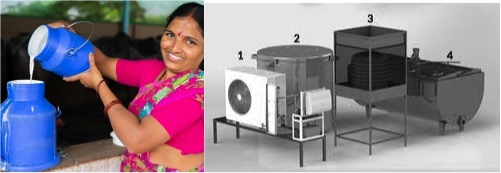
Why could such research be important for a country like India? The authors point out in the paper that the pooled contribution by small-time farmers in total milk production is as high as 70–80 per cent. These farmers are located in rural areas, have small herds of five animals or less, and handle about 0.5 to tens of litres per head per milking. Given the low per capita volumes and distances between milking centres and processing units, bulk milk chillers are not useful for such producers. The fresh milk is usually handled in day temperatures going up to 40 degrees C for about 3-5 hours before they reach processing units. But fresh raw milk must be chilled soon after production to below the critical temperature limit of 10 degrees C to help preserve quality and safety for consumption. Without sufficient cooling mechanisms, the authors say, milk rejection rates are high, leading to revenue losses for small-time dairy farmers.For temperatures far beyond the 0-degree point, such as –10 degrees C or +40 degrees C, different phase changing materials will be needed.
Pluss Advanced Technologies, now a subsidiary of Carborundum Universal of Murugappa Group, has been in the PCM arena for more than a decade. It offers cooling solutions for applications ranging from trucks carrying perishables to buildings that need cooling during the daytime, and hospitals for infant care.
In some countries in western Europe, summer night temperatures are 13-18 degrees Celsius. But daytime temperatures have been rising because of climate change, going up to 30 degrees C, which is seen as hot in those geographies. The company has executed cooling solutions for buildings in that region.
Says Samit Jain, the company’s managing director, “We have installed a 22-degree [Celsius] PCM in these buildings. In the daytime, when the room temperature gets to 23 or even 24 [degrees Celsius], nothing happens, but when it gets to 25 there is enough delta ‘t’ [or significant difference in temperature] between 22 and 26 and the PCM begins to melt.”
In other words, the PCM takes the heat from the room. So, the room temperature begins to stabilise around 25 degrees Celsius and will stay there till all the PCM is melted. Beyond this, air conditioners may be needed to maintain 25 degrees C.
“But by that time, the office is probably closed or, in the least, you’ve reduced your air conditioning requirement.” At night, with the aid of the cold air, the PCM again freezes. So, he says, “I’m getting what is called absolute free cooling — I have used the night-time cold to cool my building in the daytime.”
He says ice and water won’t work as PCM for these applications because they don’t change phases at 18-25 degrees C. Inorganic salts mixed with water in a certain proportion are preferred instead. While the identity of the material is a company secret, ‘calcium chloride’ is an example of such salts. Organic materials like paraffins or even bio-based oils could work but are avoided because they are flammable.
And if you were wondering where exactly the PCM is located in such applications, he says: “The PCM panels are laid between the ceiling and the false ceiling.”
Cleaner, cheaper
On energy savings, Jain says it is about 30 per cent for an area of 30,000 sq ft and 12 hours of operation.Using PCM, the company has also helped implement space heating solutions at high altitudes for the Indian Army. The technology development was sponsored by the government’s Department of Science and Technology.
Similarly, for trucks that transport perishables, Pluss helps line containers with a PCM suited for the required temperature. Before the trip begins, the PCM is frozen or charged using electricity. The PCM melts during transit and lasts for the duration of the journey. Explains Jain, “Without PCM, the cooling system was active throughout the journey, using diesel to power the system. Diesel is twice as costly, and dirty, as electricity off the grid.”
Pluss offers a PCM-based solution for hospitals to prevent asphyxia in newborn children. “The standard care for a birth-asphyxiated baby is to maintain the baby at about 33 degrees C, instead of the 37 that humans need — helping lower their need for oxygen.
“Rural hospitals typically don’t have budgets to import cooling devices. And the problem of birth asphyxia is seen more in low-income groups.” The company developed the technology and equipment in collaboration with Christian Medical College, Vellore.
Two layers of PCM material go into an insulated cradle. One layer lowers the temperature to the 33-degree C range and can then be removed. The second layer helps sustain the temperature for the required 72 hours with minimum human intervention. A conduction mattress makes up the top layer on which the infant is placed.