

Livestock sector Catching Up in Recent Years
The allied sectors of Indian agriculture – livestock, forestry & logging and fishing & aquaculture are gradually becoming sectors of buoyant growth and a potential source of better farm incomes. The livestock sector grew at a CAGR of 7.9 per cent during 2014-15 to 2020- 21 (at constant prices), and its contribution to total agriculture GVA (at constant prices) has increased from 24.3 per cent in 2014-15 to 30.1 per cent in 2020-21. Similarly, the annual average growth rate of the fisheries sector has been about 7 per cent since 2016-17 and has a share of about 6.7 per cent in total agriculture GVA. Higher growth in allied sectors compared to the crop sector has obvious implications in terms of the increasing importance of the former in total agricultural GVA. Recognising the growing importance of allied sectors, the Committee on Doubling Farmers’ Income (DFI, 2018) considers dairying, livestock, poultry, fisheries and horticulture as high-growth engines and has recommended a focussed policy with a concomitant support system for the allied sector.
Though the Crop sector is still the major contributor to agriculture GVA, the livestock sector is catching up (per cent)
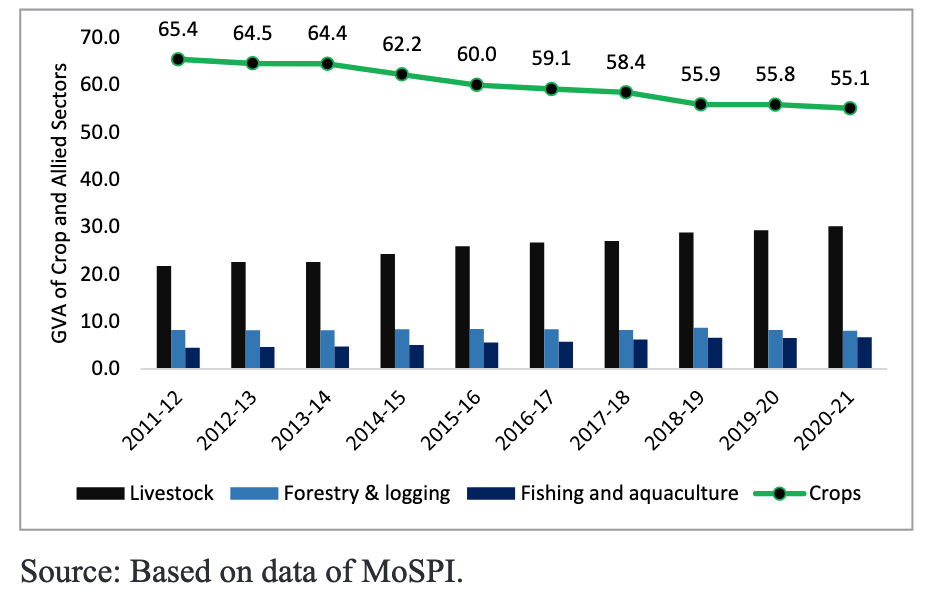
The dairy sector is the most critical component of the livestock sector, employing more than eight crore farmers directly, and is the most prominent agrarian product. Other livestock products, such as eggs and meat, are also growing in importance. While India ranks first in milk production in the world, it ranks third in egg production and eighth in meat production in the world.
Cognisant of the importance of allied sectors, the Government has made several critical interventions to enhance infrastructure and improve livestock productivity and disease control. As a part of the Aatmanirbhar Bharat (ANB) stimulus package, the Animal Husbandry Infrastructure Development Fund (AHIDF) worth ₹15,000 crore was launched in 2020. Under this scheme, the Central Government provides a 3 per cent interest subvention to the borrower and credit guarantees up to 25 per cent of total borrowing. As of 14 October 2022, 116 projects have been approved under the scheme involving project costs of ₹3,731.4 crore. National Livestock Mission (NLM) scheme has been restructured for 2021-22 to 2025-26. The scheme focuses on entrepreneurship development and breeds improvement in poultry, sheep, goat and piggery, including feed and fodder development. Also, the Livestock Health and Disease Control (LH&DC) Scheme is being implemented to supplement the State/UT governments’ efforts towards preventing, controlling and containing animal diseases of economic and zoonotic importance by vaccination. National Animal Disease Control Programme (NADCP) is being implemented to control Foot & Mouth Disease and Brucellosis by completely vaccinating cattle, buffalo, sheep, goat and pig populations against Foot & Mouth Disease and bovine female calves of 4-8 months of age against brucellosis.
Source : Economic Survey 2022-23 Jan 31st 2023