

Logo
IndianGlobalBlogsPublicationsPodcastsMarketAboutContact
Logo
IndianGlobalBlogsPublicationsPodcasts
7News
TN Minister Urges Farmers to Adopt Tech for Value Addition in DairyListen to the Farm, Not the Farmer—The New Productivity LensWhat’s Driving Change In Beverages, FMCG And Dairy in 2025ED begins money laundering probe in dairy investment fraud caseIndo-Brazil pact aims to boost cattle genetics and dairy yield

Indian Dairy News

TN Minister Urges Farmers to Adopt Tech for Value Addition in Dairy
Dec 12, 2025

TN Minister Urges Farmers to Adopt Tech for Value Addition in Dairy

In Coimbatore this week, Tamil Nadu’s Minister for Milk and Dairy Development, Mano Thangaraj, called on dairy farmers to embrace modern technologies to boost productivity and value addition across th...Read More

Listen to the Farm, Not the Farmer—The New Productivity Lens
Dec 12, 2025

Listen to the Farm, Not the Farmer—The New Productivity Lens

India’s dairy sector, valued at nearly $30 billion, has reached a point where incremental changes will not deliver the next breakthrough. For decades, improvement programs have focused on what farmers...Read More

What’s Driving Change In Beverages, FMCG And Dairy in 2025
Dec 12, 2025

What’s Driving Change In Beverages, FMCG And Dairy in 2025

India’s retail landscape in 2025 was marked by a decisive shift in how consumers choose, consume and connect with brands. From beverages to daily nutrition and even the most essential dairy products,...Read More

Latest Blogs

See More
More Milk, Less Money: India’s Dairy Crisis
Dec 01, 2025

More Milk, Less Money: India’s Dairy Crisis

With the release of the BAHS 2025 summary report, I felt compelled to deep dive into its findings and reflect on the real progress and challenges facing India’s dairy sector. Over the last six years,...Read More

India Milk Prices: Cost Shock and Procurement Pressure
Nov 28, 2025

India Milk Prices: Cost Shock and Procurement Pressure

Milk prices in India face upward pressure as rising feed costs and procurement hikes reshape farm economics. Insight on dairy procurement, feed costs, and market outlook. Official government and coope...Read More

Stop Blaming, Start Claiming: Livestock’s Carbon Credit Future
Nov 16, 2025

Stop Blaming, Start Claiming: Livestock’s Carbon Credit Future

This week, I had the opportunity to attend an Agri Carbon Masterclass conducted by CII FACE. The deliberations, case studies, and discussions presented during the session were both insightful and thou...Read More

India Powers the Gulf’s Dairy Revolution -Gulf Food 2025
Oct 31, 2025

India Powers the Gulf’s Dairy Revolution -Gulf Food 2025

As Gulf Food Manufacturing prepares to open its doors from November 4–6 in Dubai, Indian dairy product and equipment manufacturers have a unique opportunity to explore one of the most promising region...Read More

Global Dairy News

Why the global milk business needs a structural shake-up
Dec 08, 2025

Why the global milk business needs a structural shake-up

The New Zealand dairy stalwart Fonterra has sold its consumer dairy-brands (milk, butter, cheese) — including “Anchor” and “Mainland Cheese” — to French agribusiness giant Lactalis in late October 202...Read More

Raw-milk prices in Europe hit 5-yr low; ripple effect looms
Dec 07, 2025

Raw-milk prices in Europe hit 5-yr low; ripple effect looms

European raw-milk prices have plunged to their lowest in five years, as oversupply and weak demand weigh on dairy markets across the region. According to recent data from DCA Market Intelligence B.V.,...Read More

Global food prices ease; FAO dairy index slips — impact looms
Dec 06, 2025

Global food prices ease; FAO dairy index slips — impact looms

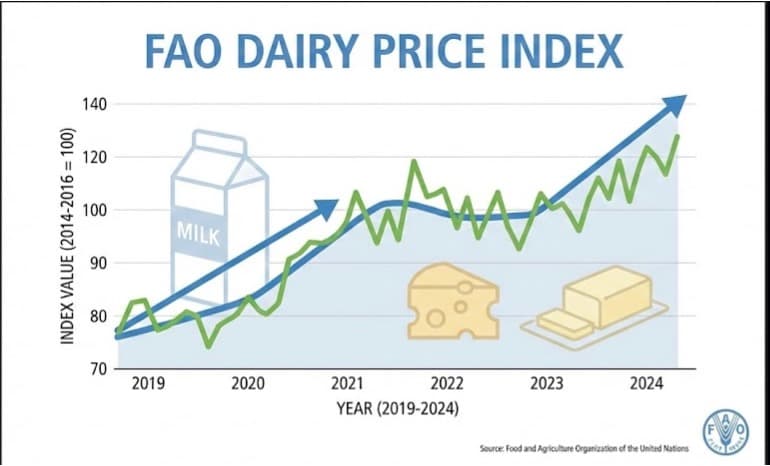
The FAO Dairy Price Index averaged 137.5 points in November, down 4.4 points (3.1 percent) from October and 2.4 points (1.7 percent) from its value a year ago. International dairy prices fell for the...Read More

Dairy News 7x7

Your trusted source for all the latest dairy industry news, market insights, and trending topics.

FOLLOW US
CATEGORIES
  • Global News
  • Indian News
  • Blogs
  • Publications
  • Podcasts
SUBSCRIBE TO OUR NEWSLETTER

Stay informed with the latest updates and trending news in the dairy industry.

No spam, unsubscribe at any time

GET IN TOUCH
C-49, C Block, Sector 65,
Noida, UP 201307
+91 7827405029dairynews7x7@gmail.com

© 2025 Dairy News 7x7. All Rights Reserved.

Terms of ServicePrivacy Policy

Limiting antibiotics for cows may create a new dairy market

By DairyNews7x7•Published on November 05, 2022

Consumers would be willing to buy milk from cows only treated with antibiotics when medically necessary – as long as the price isn’t much higher than conventional milk, according to researchers at the College of Veterinary Medicine.

The findings suggest conventional farmers could tap a potentially large market for this type of milk if they can find the right price point – and that dairy consumers can help slow the rise of antimicrobial resistance.

“Most of the antibiotics produced throughout the world are used for animal agriculture. Therefore, reducing antibiotic use in animals, including dairy cattle, is necessary to tackle antibiotic resistance at a global scale,” said Dr. Renata Ivanek, professor in the Department of Population Medicine and Diagnostic Sciences. She is senior author on the study, which published Nov. 4 in the Journal of Dairy Science.

In the paper, the researchers propose a new label for milk that indicates responsible antibiotic use (RAU), which would leverage consumer preferences to reduce the use of antibiotics on commercial dairy farms. The study showed that, although a consumer’s willingness to pay for the RAU-labeled milk was comparable to how much they would pay for the unlabeled milk, they strongly preferred the RAU-labeled milk over the unlabeled milk option. Therefore, the researchers hypothesize this new RAU label would entice farmers to minimize antibiotics more than they do for conventional, unlabeled milk.

Too much antibiotic treatment in cows leads to the rise of resistant strains of bacteria, which can make antibiotics for both animals and humans less effective, the researchers note. “Consumers should know that their choices are important, and that their understanding of antibiotic use could move the dairy industry toward more sustainable milk production practices,” said Dr. Ece Bulut, research associate in the Department of Population Medicine and Diagnostic Sciences and co-author of the study.

The researchers conducted a nationally representative survey of U.S. adults, finding that half were willing to buy RAU-labeled milk. They also held a randomized, experimental auction with real money and milk, which showed that buyers were also willing to pay for RAU-labeled milk but only slightly more than they are willing to pay for the unlabeled cartons.

“What this means is that there could potentially be a large market for RAU milk as long as the price isn’t much higher than conventional milk, so it’s a possible new option for conventional farmers,” said Robert Schell, M.S. ’19, first author of the study.

A similar label for certified responsible antibiotic use (CRAU) is already used in the poultry industry, Bulut said. CRAU limits the use of medically important antibiotics – antibiotics used in human medicine – in poultry production. The researchers envision that the RAU label would similarly be determined by veterinarians and U.S. Department of Agriculture (USDA) standards, so that any carton of milk with an RAU label would come from a cow treated with antibiotics only when medically necessary.

“The existing literature suggests that larger bodies regulating these sorts of claims, like the USDA and CRAU certification, makes consumers more willing to trust and, as a result, buy products with desirable labels,” said Schell, a doctoral student at the School of Public Health in University of California, Berkeley, who started working on the study as a master’s degree student at the Charles H. Dyson School of Applied Economics and Management.

This study is an important initial step in exploring consumer attitudes toward an RAU label and its potential market for conventional farmers, the researchers said.

The work is the result of collaboration between the College of Veterinary Medicine, the Charles H. Dyson School of Applied Economics and Management, and the Department of Communication in the College of Agriculture and Life Sciences. The researchers also worked with Cornell’s Lab for Experimental Economics and Decision Research as well as Cornell’s Survey Research Institute.

Funding for this study was provided by the National Institute of Food and Agriculture, the USDA and the National Institutes of Health.

Swipe to continue reading

Previous Article

Next Article