
Logo
IndianGlobalBlogsPublicationsPodcastsMarketAboutContact
Logo
IndianGlobalBlogsPublicationsPodcasts
7News
TN Minister Urges Farmers to Adopt Tech for Value Addition in DairyListen to the Farm, Not the Farmer—The New Productivity LensWhat’s Driving Change In Beverages, FMCG And Dairy in 2025ED begins money laundering probe in dairy investment fraud caseIndo-Brazil pact aims to boost cattle genetics and dairy yield

Indian Dairy News

TN Minister Urges Farmers to Adopt Tech for Value Addition in Dairy
Dec 12, 2025

TN Minister Urges Farmers to Adopt Tech for Value Addition in Dairy

In Coimbatore this week, Tamil Nadu’s Minister for Milk and Dairy Development, Mano Thangaraj, called on dairy farmers to embrace modern technologies to boost productivity and value addition across th...Read More

Listen to the Farm, Not the Farmer—The New Productivity Lens
Dec 12, 2025

Listen to the Farm, Not the Farmer—The New Productivity Lens

India’s dairy sector, valued at nearly $30 billion, has reached a point where incremental changes will not deliver the next breakthrough. For decades, improvement programs have focused on what farmers...Read More

What’s Driving Change In Beverages, FMCG And Dairy in 2025
Dec 12, 2025

What’s Driving Change In Beverages, FMCG And Dairy in 2025

India’s retail landscape in 2025 was marked by a decisive shift in how consumers choose, consume and connect with brands. From beverages to daily nutrition and even the most essential dairy products,...Read More

Latest Blogs

See More
More Milk, Less Money: India’s Dairy Crisis
Dec 01, 2025

More Milk, Less Money: India’s Dairy Crisis

With the release of the BAHS 2025 summary report, I felt compelled to deep dive into its findings and reflect on the real progress and challenges facing India’s dairy sector. Over the last six years,...Read More

India Milk Prices: Cost Shock and Procurement Pressure
Nov 28, 2025

India Milk Prices: Cost Shock and Procurement Pressure

Milk prices in India face upward pressure as rising feed costs and procurement hikes reshape farm economics. Insight on dairy procurement, feed costs, and market outlook. Official government and coope...Read More

Stop Blaming, Start Claiming: Livestock’s Carbon Credit Future
Nov 16, 2025

Stop Blaming, Start Claiming: Livestock’s Carbon Credit Future

This week, I had the opportunity to attend an Agri Carbon Masterclass conducted by CII FACE. The deliberations, case studies, and discussions presented during the session were both insightful and thou...Read More

India Powers the Gulf’s Dairy Revolution -Gulf Food 2025
Oct 31, 2025

India Powers the Gulf’s Dairy Revolution -Gulf Food 2025

As Gulf Food Manufacturing prepares to open its doors from November 4–6 in Dubai, Indian dairy product and equipment manufacturers have a unique opportunity to explore one of the most promising region...Read More

Global Dairy News

Why the global milk business needs a structural shake-up
Dec 08, 2025

Why the global milk business needs a structural shake-up

The New Zealand dairy stalwart Fonterra has sold its consumer dairy-brands (milk, butter, cheese) — including “Anchor” and “Mainland Cheese” — to French agribusiness giant Lactalis in late October 202...Read More

Raw-milk prices in Europe hit 5-yr low; ripple effect looms
Dec 07, 2025

Raw-milk prices in Europe hit 5-yr low; ripple effect looms

European raw-milk prices have plunged to their lowest in five years, as oversupply and weak demand weigh on dairy markets across the region. According to recent data from DCA Market Intelligence B.V.,...Read More

Global food prices ease; FAO dairy index slips — impact looms
Dec 06, 2025

Global food prices ease; FAO dairy index slips — impact looms

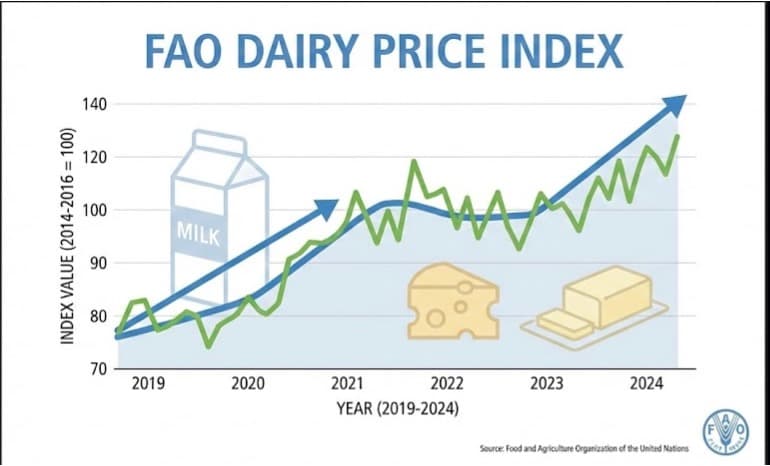
The FAO Dairy Price Index averaged 137.5 points in November, down 4.4 points (3.1 percent) from October and 2.4 points (1.7 percent) from its value a year ago. International dairy prices fell for the...Read More

Dairy News 7x7

Your trusted source for all the latest dairy industry news, market insights, and trending topics.

FOLLOW US
CATEGORIES
  • Global News
  • Indian News
  • Blogs
  • Publications
  • Podcasts
SUBSCRIBE TO OUR NEWSLETTER

Stay informed with the latest updates and trending news in the dairy industry.

No spam, unsubscribe at any time

GET IN TOUCH
C-49, C Block, Sector 65,
Noida, UP 201307
+91 7827405029dairynews7x7@gmail.com

© 2025 Dairy News 7x7. All Rights Reserved.

Terms of ServicePrivacy Policy

Is it Time to Rethink Dairy Cow Lifespan?

By DairyNews7x7•Published on October 01, 2023

A cow has a natural life expectancy of up to 20 years. Today, the average productive lifespan of a U.S. dairy cow is about 3 years.

“Productive” lifespan is defined as the length of time cows live after they have their first calf and start producing milk. Because most cows calve in for the first time at about 2 years of age, that means, on average, cows are living a total of about 5 years.

A few years ago, University of Florida Professor of Dairy Science Dr. Albert DeVries published an article in the Journal of Dairy Science examining the issue of productive lifespan. DeVries noted that dairy cow productive lifespan is a complicated and evolving issue, and one that can vary significantly based on conditions and priorities of individual herds.

Cows used to live longer in U.S. herds. In the 1930s, a productive life of 5 to 10 years after calving (7-12 years total) was common. That age has been going down since at least the 1960s, with assessments showing an average length in the herd after calving of 38 months around 2000, and 35.3 months – or fewer than 3 lactations – in 2018.

Have we hit the “nadir” of average productive lifespan for dairy cows? Possibly, considering a number of new factors DeVries discussed that are influencing mating, management, and culling decisions. They include:

  1. Reproductive efficiency changes – “Failure to conceive” has historically been a top criteria for culling lactating cows. After several decades of flat-to-declining reproductive efficiency, the last 2 decades have seen healthy improvements in breeding success. DeVries credited changes in management and genetic selection for improved fertility for the positive change. The upward trend could theoretically keep cows in milking herds longer.
  1. Sexed semen – Commercially available now for more than 20 years, female sexed semen has led to the ability to produce an abundance of heifer calves. For herds of a fixed size, that has meant more aggressive culling of older cows to make room for the more genetically advanced replacement heifers.
  1. Beef crossbreeding – Breeding to create higher-value surplus calves with beef semen – usually accompanied by genomic and/or dam-parity selection – has emerged in about the same timeframe as sexed semen. In some herds, this strategy may offset the production of excess heifers and thus reduce culling pressure.
  1. Genetic progress – DeVries cited predictions by Dr. Jack Britt, longtime dairy researcher and agricultural futurist. Britt speculated that the total genetic merit of dairy cattle, as a sum of all desirable traits, will continue to increase for at least the next 40 years, resulting in a doubling of milk production per cow. Britt predicted those cows also will have improved health and greater capacity for a longer productive life.
  1. Longer lactations – With fewer replacements potentially needed, does it really make sense to dry off cows milking 100+ pounds per day? Researchers are exploring the potential for using longer voluntary waiting periods before rebreeding to lengthen lactations. One advantage of this approach is reducing the frequency of risk surrounding the transition period.
  1. Social and environmental issues – Public concerns have been voiced about the perceived short lifespans of dairy cows, citing early culling as a symptom of poor animal welfare. High prevalence of lameness and failure to conceive have been noted as specific welfare issues. The environmental footprint of dairy products is also an issue of public concern.  Researchers have found that increasing productive lifespan has been shown to reduce the environmental impact of dairy production, as herds with younger animals emit more greenhouse gases. DeVries said it is conceivable that the public will demand longer productive lifespans in the future.
A challenge in determining the ideal productive lifespan is that these and other factors – especially prices of milk, feed, and beef — are relatively fluid and ever-changing. “Consequently, optimal replacement decisions and optimal annual cow replacement rates are dynamic and change over time,” said DeVries.

He pointed out that longer productive lifespans for healthy dairy cows are not necessarily profitable. Using a simple economic model, he arrived at an “ideal” productive lifespan of about 5 years.

The issue will be discussed in great depth at the 45th Discover Conference presented by the American Dairy Science Association (ADSA). “Dairy Cattle Lifespans: New Perspectives” will explore current data, future trends, and potentially out-of-the-box scenarios related to the way we approach productive lifespans in dairy cows – in both individual herds, and industry-wide.

Source : Dairy herd management Sep 29 2023 by Maureen Hanson

Swipe to continue reading

Previous Article

Next Article