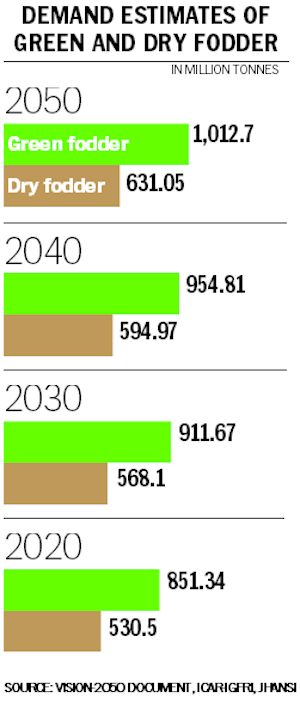


Green and Dry fodder Demand may reach 1,012 and 631 mil tonnes by 2050
INDIA’s achievement of transforming itself from a milk-deficient country to the world’s largest milk producer has been exemplary. With a stock of over 136 million female bovines producing about 230 million tonnes of milk in 2022-23, the Indian dairy sector exhibits strong growth potential. However, poor productivity of Indian milch cattle is a major cause for concern that may threaten India’s numero uno position in milk production in the long run.
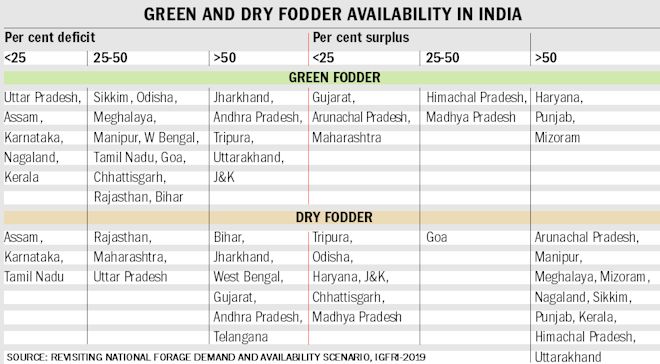
With the increasing livestock population and the government’s focus on genetic upgrade of cattle through cross-breeding programmes, the demand for green and dry fodder is expected to increase to 1,012 and 631 million tonnes, respectively, by 2050. Bridging the gap between the demand and supply of fodder is a huge challenge. Reportedly, devoting 14-17 per cent of the land for fodder cultivation will be ideal for meeting the current fodder shortage in the country, but fodder is being cultivated on an area of 8.4 million hectares (nearly 4 per cent) over the past few decades. Therefore, there is an urgent need to have practical and meaningful strategies for enhancing fodder resources for sustaining the Indian livestock sector. The Union Government is looking to bolster forage resources, a crucial component for the sustenance of the country’s thriving dairy industry. It is commendable that the government recently unveiled plans to support entrepreneurs for fodder seed processing infrastructure under the National Livestock Mission. It has also proposed the establishment of at least one fodder bank each in all four corners of the country. This initiative signifies a proactive step towards ensuring a sustainable and nutritious feed base for livestock. Various state research institutions, along with the IGFRI, have developed a number of improved fodder crop varieties and technologies that can ensure year-round availability of quality feed and fodder for increasing animal productivity. Every year, 30-35 new forage varieties are being released by IGFRI and the All-India Coordinated Research Project (forage crops). Around 90 improved varieties are already in the seed chain. However, their adoption has remained limited. Though constraints in adopting improved fodder technologies by farmers vary locally, a lack of assured market for fodder is a common challenge hindering the maintenance of the fodder balance for the country as a whole. Therefore, investment is required to ensure parallel development of supporting market environment for surplus fodder, encompassing backward and forward market linkages. The provision of a dedicated market space with legal credentials will facilitate transparency and remunerative prices for fodder traders. As there exists regional and seasonal disparity in fodder production, channelling funds for establishing community-based fodder banks would be crucial for safeguarding the interests of small dairy farmers. Sparing more area for fodder is vital in the wake of the intense competition for additional land from commercially important crops. Therefore, the policy focus on bringing more area under perennial grasses with high biomass would be imperative for meeting livestock green fodder needs. Among the cultivated perennial grasses, Bajra-Napier hybrid grass, popularly known as the BN hybrid, has been acclaimed as the highest forage yielder in a unit time and space. The grass is endowed with several unique characteristics in terms of biomass, nutrition quality and palatability. The green fodder yield potential of the grass has been reported to be 200-450 tonnes/hectare, depending upon varieties, management practices and agro-ecological regions.With the increasing livestock population and the govt’s focus on genetic upgrade of cattle through cross-breeding programmes, the demand for green and dry fodder is expected to increase to 1,012 and 631 million tonnes, respectively, by 2050. Bridging the gap between the demand and supply of fodder is a huge challenge. There is an urgent need to have practical and meaningful strategies for enhancing fodder resources for sustaining the livestock sector.
The major causes of low milk productivity are both intrinsic (low genetic potential) and extrinsic (poor nutrition/feed management). Empirical studies have shown that enhancing the quality and quantity of feed and fodder has a greater impact than breed improvement on increasing milk productivity. The lack of timely availability of nutritionally rich feed and fodder is a major hitch that affects the productivity of farm animals. With the increase in agricultural production, the animal forage availability has improved, but its supply always falls short of the aggregate demand. As per the vision document of the Indian Grassland and Fodder Research Institute (IGFRI), Jhansi, the deficit of dry and green fodder in India for 2020 was around 12 per cent and 30 per cent, respectively.