



Global Dairy Quarterly Q3 2023: Progressing Past the Pain
Rabobank lowers its 2023 milk production forecast. Milk production from the Big 7 export regions is anticipated to grow by 0.3% YOY in 2023. The downgrade from last quarter’s estimate of 0.5% is driven by reductions in most key global regions, including the US, EU, and New Zealand. Into 2024, output is expected to climb by 0.4%, far less than the 1.6% annual average gain from 2010-2020.
Milk production is quickly increasing towards the seasonal peak in Oceania, with a keen focus on milksolids output in New Zealand. Farmers in the region are stressed following significant milk price forecast reductions from Fonterra and other processors, pressuring margins as production costs remain elevated. Total season output is expected to be lower, driven by the weak milk price, with the October peak watched closely in the market.
In the Northern Hemisphere, fewer cows and lower yield mean US output will struggle to achieve gains throughout the second half. Flat-to-lower EU volume is expected in upcoming months against strong prior-year comparables.
China’s dairy demand recovery has not, to date, offset strong domestic milk production growth. Milk production growth will slow into 2H 2023 and 2024, but a complete market rebalance is not expected in the near term.
New Zealand’s search for markets outside of China, has a domino impact. EU WMP has not been price competitive in global markets for some time. More recently, EU SMP (and FFMP) exports have faced more competition in markets that traditionally lean more towards European suppliers, especially during New Zealand’s low season. This could result in more milk being allocated to cheese, away from SMP and butter.
The domino impact continues to South America. Lower Oceania dairy product prices have made Argentina- and Uruguay-sourced product less competitive in North Africa and other regions. Shipments to Brazil, where they have a competitive advantage as part of Mercosur, have increased. However, lower milk prices in Brazil are adding political pressure for Brasilia to consider import restrictions from its southern neighbors.
With a full rebalance of the Chinese dairy market not expected in the near term, dairy farmers in New Zealand and around the globe will need to manage through more financial pain in the months ahead, according to Rabobank’s latest Global Dairy Quarterly report.
But the storm won’t last forever, the report says, and, with lower global prices stemming supply growth in key dairy production regions, there is an increasing possibility a demand resurgence could emerge well before milk output can recover, creating a whiplash effect in global markets and a bullish run in to 2024.
In the Q3 report, titled Progressing Past the Pain, Rabobank says a myriad of factors has converged to drive the longed-for dairy demand recovery in China – the world’s largest dairy importer – even further into the future.
“The severity of the economic headwinds and the duration of the lull in economic growth in China are shrouded in uncertainty, and this reduces the likelihood of a strong demand recovery that would provide a solid footing for global dairy markets,” report co-author Rabobank senior agricultural analyst, Emma Higgins said.
“On the supply side, we are now starting to see Chinese milk production begin to slow, and we do expect this trend to continue in the remainder of 2023 and into 2024, but a complete market rebalance in China is still a way off.”
The report says lower demand for dairy imports in China has reduced global dairy prices, and, in turn, flowed through to reduced global dairy production.
“Milk production from the Big 7 export regions – New Zealand, Australia, the EU, the US, Uruguay, Brazil and Argentina – is now anticipated to grow by 0.3 per cent year-on-year in 2023, downgraded from last quarter’s estimate of 0.7 per cent, with this driven by reductions in most key global regions, including the US, EU, and New Zealand,” Ms Higgins said.
“Into 2024, output is expected to climb by 0.4 per cent, far less than the 1.6 per cent annual average gain from 2010-2020.”
The report says slowing global milk production will eventually match the tepid demand growth noted in most regions, preventing further significant price declines.
While the immediate outlook for dairy prices remains challenging, Ms Higgins said, there is a ray of optimism for the months ahead.
“The US Class III milk price and the GDT-weighted average price both fell to Covid-level lows in recent weeks, allowing buyers to replenish stocks at bargain prices,” she said.
Demand from Mexico, the second-largest dairy importer, has also been robust, supported by a stronger peso. And, even though the Global Dairy Trade (GDT) index has weakened, demand has not entirely evaporated from China, which has accounted for roughly 30 per cent to 40 per cent of the sales on the GDT since Q2.”
The reports say these factors make a demand-led resurgence in global dairy markets in the months ahead a growing possibility.
“If buyers become increasingly confident that prices have hit a low for this cycle and flock back to procure products en masse, the world may be short on milk,” she said.
“And this could create a whiplash-like effect for global dairy prices, with the possibility that the weak global supply situation is faced with stronger demand.
“This does provide some reason for optimism over the coming months, but dairy farmers will need to manage through the current financial pain first.”
Rabobank milk price forecast
Due largely to lower Chinese import demand, the report says Fonterra’s opening farmgate milk price was reduced twice in August, dropping by $1.25/kgMS to a mid-point of $6.75/kgMS for the current 2023/24 season.
“Weaker Chinese import demand has also prompted a downwards revision of Rabobank’s milk price forecast from our initial forecast published in June,” Ms Higgins said.
“And Rabobank is now anticipating NZD6.75/kgMS for this season, in line with Fonterra’s latest forecast.”
Upside and downside price risks
The Q3 Global Dairy Quarterly report outlines several watch factors for the coming months which hold both ‘upside’ and ‘downside’ risks for global milk prices.
“Markets are bristling with risk right now and there are several factors that we are watching that would move the milk price needle here at home either way,” Ms Higgins said.
“Chinese import demand remains the most influential of these, given the changes in volumes we’ve seen over the last year,” Ms Higgins said. “On a year-to-date basis (January-July), China’s whole milk powder (WMP) imports are down 40 per cent versus the prior year. During the same period, skim milk powder, whey, and cheese imports have increased by 21 per cent, 25 per cent and 18 per cent, respectively, but these do account for much lower volume than WMP.
“So any signals of increased Chinese buying will be monitored closely, especially due to weaker forecasted milk production growth in dairy export regions.”
Ms Higgins said New Zealand milk output into the peak of the season will also be watched closely as global buyers estimate product availability into 2024.
“Any signs of significant weakness could send buyers back to the market, pushing prices higher,” she said.
“Our own expectation for the full 23/24 season is that New Zealand production will fall by -0.7 per cent year-on-year, driven by the lower milk price forecast.”
The report identifies El Nino, and dairy production in India as further watch factors.
“El Nino’s wrath, or lack thereof, could upend milk production in key parts of the world, with a meaningful departure from normal weather patterns holding the potential to shift production expectations,” Ms Higgins said.
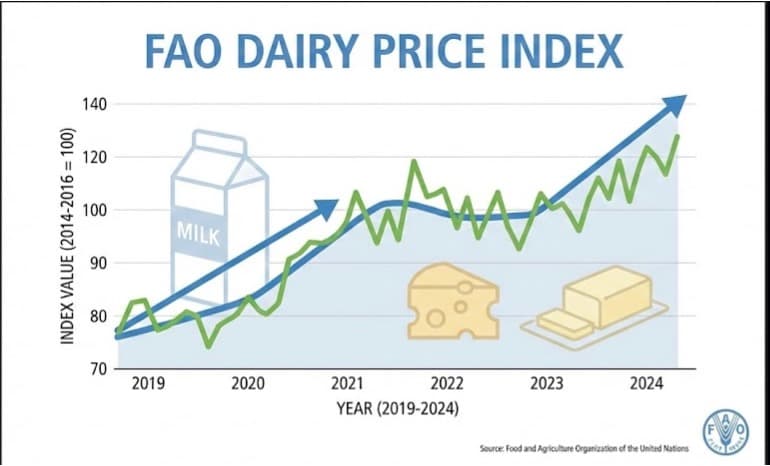
“Production in India – the world’s largest dairy production and consuming country – will also be of interest. India is currently experiencing dryness and has limited exports of certain products like wheat, rice, and sugar, while disease has shrunk cow numbers, and milk prices are climbing quickly. And any reduction in production from India, could provide an unexpected demand boost for other dairy exporting nations.”
Your access to our unique and original content is free, and always has been. But ad revenues are under pressure so we need your support.
Source : Rabo Research and interest New Zealand Oct 7 2023