

Logo
IndianGlobalBlogsPublicationsPodcastsMarketAboutContact
Logo
IndianGlobalBlogsPublicationsPodcasts
7News
TN Minister Urges Farmers to Adopt Tech for Value Addition in DairyListen to the Farm, Not the Farmer—The New Productivity LensWhat’s Driving Change In Beverages, FMCG And Dairy in 2025ED begins money laundering probe in dairy investment fraud caseIndo-Brazil pact aims to boost cattle genetics and dairy yield

Indian Dairy News

TN Minister Urges Farmers to Adopt Tech for Value Addition in Dairy
Dec 12, 2025

TN Minister Urges Farmers to Adopt Tech for Value Addition in Dairy

In Coimbatore this week, Tamil Nadu’s Minister for Milk and Dairy Development, Mano Thangaraj, called on dairy farmers to embrace modern technologies to boost productivity and value addition across th...Read More

Listen to the Farm, Not the Farmer—The New Productivity Lens
Dec 12, 2025

Listen to the Farm, Not the Farmer—The New Productivity Lens

India’s dairy sector, valued at nearly $30 billion, has reached a point where incremental changes will not deliver the next breakthrough. For decades, improvement programs have focused on what farmers...Read More

What’s Driving Change In Beverages, FMCG And Dairy in 2025
Dec 12, 2025

What’s Driving Change In Beverages, FMCG And Dairy in 2025

India’s retail landscape in 2025 was marked by a decisive shift in how consumers choose, consume and connect with brands. From beverages to daily nutrition and even the most essential dairy products,...Read More

Latest Blogs

See More
More Milk, Less Money: India’s Dairy Crisis
Dec 01, 2025

More Milk, Less Money: India’s Dairy Crisis

With the release of the BAHS 2025 summary report, I felt compelled to deep dive into its findings and reflect on the real progress and challenges facing India’s dairy sector. Over the last six years,...Read More

India Milk Prices: Cost Shock and Procurement Pressure
Nov 28, 2025

India Milk Prices: Cost Shock and Procurement Pressure

Milk prices in India face upward pressure as rising feed costs and procurement hikes reshape farm economics. Insight on dairy procurement, feed costs, and market outlook. Official government and coope...Read More

Stop Blaming, Start Claiming: Livestock’s Carbon Credit Future
Nov 16, 2025

Stop Blaming, Start Claiming: Livestock’s Carbon Credit Future

This week, I had the opportunity to attend an Agri Carbon Masterclass conducted by CII FACE. The deliberations, case studies, and discussions presented during the session were both insightful and thou...Read More

India Powers the Gulf’s Dairy Revolution -Gulf Food 2025
Oct 31, 2025

India Powers the Gulf’s Dairy Revolution -Gulf Food 2025

As Gulf Food Manufacturing prepares to open its doors from November 4–6 in Dubai, Indian dairy product and equipment manufacturers have a unique opportunity to explore one of the most promising region...Read More

Global Dairy News

Why the global milk business needs a structural shake-up
Dec 08, 2025

Why the global milk business needs a structural shake-up

The New Zealand dairy stalwart Fonterra has sold its consumer dairy-brands (milk, butter, cheese) — including “Anchor” and “Mainland Cheese” — to French agribusiness giant Lactalis in late October 202...Read More

Raw-milk prices in Europe hit 5-yr low; ripple effect looms
Dec 07, 2025

Raw-milk prices in Europe hit 5-yr low; ripple effect looms

European raw-milk prices have plunged to their lowest in five years, as oversupply and weak demand weigh on dairy markets across the region. According to recent data from DCA Market Intelligence B.V.,...Read More

Global food prices ease; FAO dairy index slips — impact looms
Dec 06, 2025

Global food prices ease; FAO dairy index slips — impact looms

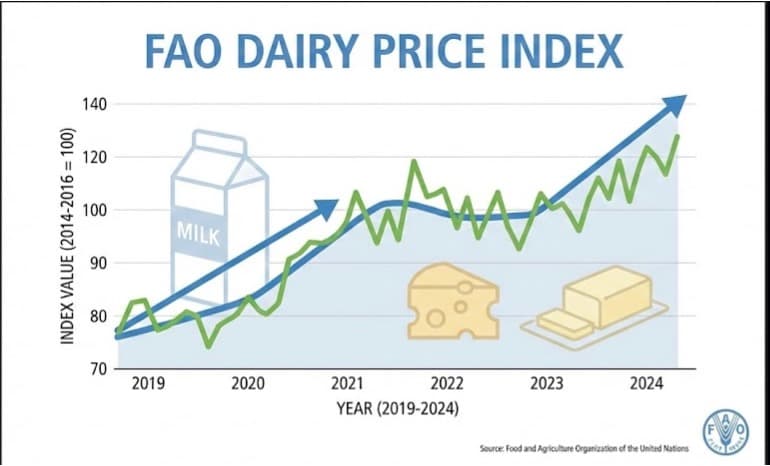
The FAO Dairy Price Index averaged 137.5 points in November, down 4.4 points (3.1 percent) from October and 2.4 points (1.7 percent) from its value a year ago. International dairy prices fell for the...Read More

Dairy News 7x7

Your trusted source for all the latest dairy industry news, market insights, and trending topics.

FOLLOW US
CATEGORIES
  • Global News
  • Indian News
  • Blogs
  • Publications
  • Podcasts
SUBSCRIBE TO OUR NEWSLETTER

Stay informed with the latest updates and trending news in the dairy industry.

No spam, unsubscribe at any time

GET IN TOUCH
C-49, C Block, Sector 65,
Noida, UP 201307
+91 7827405029dairynews7x7@gmail.com

© 2025 Dairy News 7x7. All Rights Reserved.

Terms of ServicePrivacy Policy

ELISA method to test adulterated cow milk in camel milk

By DairyNews7x7•Published on April 06, 2024

Camel milk might be adulterated with cheaper cow's milk because of its high price. The establishment of a rapid and reliable method for detecting cow milk in camel milk is a matter of great concern. In the study, the chromatogram of camel milk with different adulteration ratios was analyzed by High Performance Liquid Chromatography (HPLC). The peak area of liquid chromatography was analyzed by Principal Component Analysis (PCA). β-lactoglobulin (β-Lg) was screened as a characteristic protein. Enzyme-Linked Immunosorbent Assay (ELISA) was established selected β-Lg as the antigenic indicator. This study was aimed at developing an ELISA method that enabled rapid and highly sensitive detection of the proportion of adulterated milk in camel milk. The minimum detection limit was 1% of cow milk in camel milk, and the results were highly reproducible with no significant difference between true and measured values (P > 0.05).

Camel milk has an important role in human nutrition in the arid and semi-arid regions of the world because it contains all the essential nutrients found in other milks (Devendra, 2016; Swelum et al., 2021). Camels are rich in nutrients such as bioactive peptides, lactoferrin, zinc, vitamins (Kaskous, 2016; Konuspayeva, Faye & Loiseau, 2009). The nutritional value of camel milk is better than cow milk, and its protein composition is quite close to breast milk. Therefore, camel milk is often used as a substitute for breastfeeding (Zou et al., 2022).

As is known to all, olive oil adulteration is the biggest adulteration problem in the world (Calvano, Ceglie, D Accolti, & Zambonin, 2012). The adulteration of dairy products has had a tendency to increase in recent years. Adulteration of camel milk not only occurs in the Chinese market, but also in the European Union and other countries were very common (Mabood et al., 2017).

Camel milk costs 2-10 times more than cow milk. Moreover, it is reported that camel milk was also used for other potential therapeutic purposes (DeshwalTiwari & Kadyan, 2021), such as anti-carcinogenic (Habib, Ibrahim, Schneider-Stock, & Hassan, 2013), anti-diabetic (Agrawal et al., 2007), anti-aging activities (HoZou & Bansal, 2022; Izadi, Khedmat & Mojtahedi, 2019), and anti-hypertensive (Quan, Tsuda & Miyamoto, 2008), Camel milk will not cause allergic issues for cow milk allergic children (Devendra, 2016). In this case, many merchants adulterate cow milk with camel milk to seek windfall profits (Merin et al., 2001). The effects of milk adulteration are not only economic but may even have serious health implications. (El-Sayed & El-Agamy, 2022). For this reason, it is very necessary to quickly detect whether there is cow milk in camel milk to ensure the quality and the legitimate rights and interests of consumers.

To date, a number of methods have been developed to detect adulteration in dairy products (El-Hatmi, 2015). A quantitative method was developed to detect the different kinds of milk by infrared spectroscopy (Nicolaou, Xu & Goodacre, 2010). Polypropylene gel electrophoresis was used to distinguish different source milk(Sharma et al., 2021). The adulteration of dairy products and camel milk was measured by the low-field NMR method and liquid chromatography (Ribeiro et al., 2014). Although these methods have become quite sophisticated, there is still disadvantage, such as the expensive and heavy experimental equipment and high testing costs. ELISA was chosen in this study, which is a sensitive, rapid, and highly specific method widely used in the food industry. For low concentrations of biomarkers, ELISA typically has higher sensitivity than HPLC because it takes advantage of the amplification effect of the enzyme. ELISA is generally more economical and higher throughput than HPLC. It’s necessary to screen for a signature protein to distinguish before developing an ELISA to detect camel milk adulterated with cow milk.

Swipe to continue reading

Previous Article

Next Article