
Logo
IndianGlobalBlogsPublicationsPodcastsMarketAboutContact
Logo
IndianGlobalBlogsPublicationsPodcasts
7News
TN Minister Urges Farmers to Adopt Tech for Value Addition in DairyListen to the Farm, Not the Farmer—The New Productivity LensWhat’s Driving Change In Beverages, FMCG And Dairy in 2025ED begins money laundering probe in dairy investment fraud caseIndo-Brazil pact aims to boost cattle genetics and dairy yield

Indian Dairy News

TN Minister Urges Farmers to Adopt Tech for Value Addition in Dairy
Dec 12, 2025

TN Minister Urges Farmers to Adopt Tech for Value Addition in Dairy

In Coimbatore this week, Tamil Nadu’s Minister for Milk and Dairy Development, Mano Thangaraj, called on dairy farmers to embrace modern technologies to boost productivity and value addition across th...Read More

Listen to the Farm, Not the Farmer—The New Productivity Lens
Dec 12, 2025

Listen to the Farm, Not the Farmer—The New Productivity Lens

India’s dairy sector, valued at nearly $30 billion, has reached a point where incremental changes will not deliver the next breakthrough. For decades, improvement programs have focused on what farmers...Read More

What’s Driving Change In Beverages, FMCG And Dairy in 2025
Dec 12, 2025

What’s Driving Change In Beverages, FMCG And Dairy in 2025

India’s retail landscape in 2025 was marked by a decisive shift in how consumers choose, consume and connect with brands. From beverages to daily nutrition and even the most essential dairy products,...Read More

Latest Blogs

See More
More Milk, Less Money: India’s Dairy Crisis
Dec 01, 2025

More Milk, Less Money: India’s Dairy Crisis

With the release of the BAHS 2025 summary report, I felt compelled to deep dive into its findings and reflect on the real progress and challenges facing India’s dairy sector. Over the last six years,...Read More

India Milk Prices: Cost Shock and Procurement Pressure
Nov 28, 2025

India Milk Prices: Cost Shock and Procurement Pressure

Milk prices in India face upward pressure as rising feed costs and procurement hikes reshape farm economics. Insight on dairy procurement, feed costs, and market outlook. Official government and coope...Read More

Stop Blaming, Start Claiming: Livestock’s Carbon Credit Future
Nov 16, 2025

Stop Blaming, Start Claiming: Livestock’s Carbon Credit Future

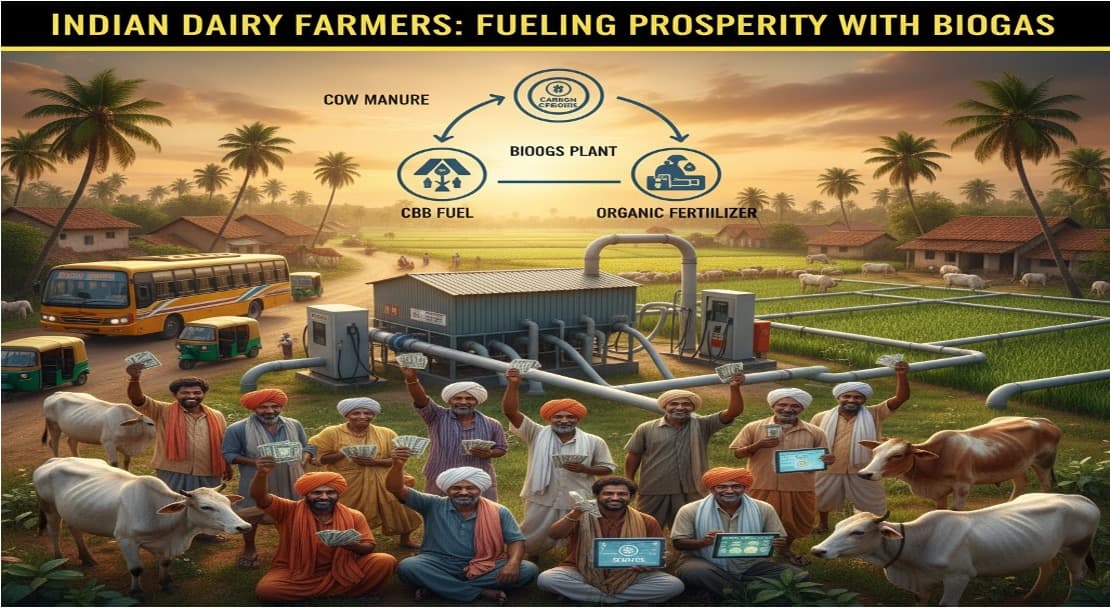
This week, I had the opportunity to attend an Agri Carbon Masterclass conducted by CII FACE. The deliberations, case studies, and discussions presented during the session were both insightful and thou...Read More

India Powers the Gulf’s Dairy Revolution -Gulf Food 2025
Oct 31, 2025

India Powers the Gulf’s Dairy Revolution -Gulf Food 2025

As Gulf Food Manufacturing prepares to open its doors from November 4–6 in Dubai, Indian dairy product and equipment manufacturers have a unique opportunity to explore one of the most promising region...Read More

Global Dairy News

Why the global milk business needs a structural shake-up
Dec 08, 2025

Why the global milk business needs a structural shake-up

The New Zealand dairy stalwart Fonterra has sold its consumer dairy-brands (milk, butter, cheese) — including “Anchor” and “Mainland Cheese” — to French agribusiness giant Lactalis in late October 202...Read More

Raw-milk prices in Europe hit 5-yr low; ripple effect looms
Dec 07, 2025

Raw-milk prices in Europe hit 5-yr low; ripple effect looms

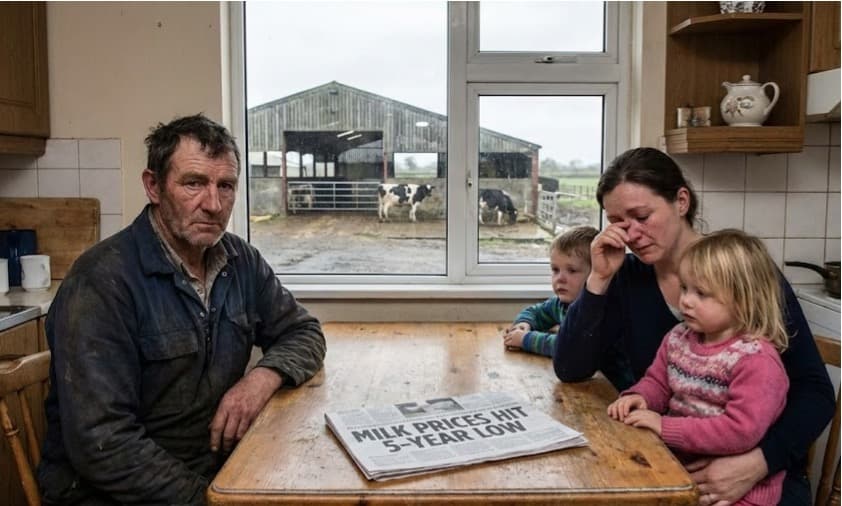
European raw-milk prices have plunged to their lowest in five years, as oversupply and weak demand weigh on dairy markets across the region. According to recent data from DCA Market Intelligence B.V.,...Read More

Global food prices ease; FAO dairy index slips — impact looms
Dec 06, 2025

Global food prices ease; FAO dairy index slips — impact looms

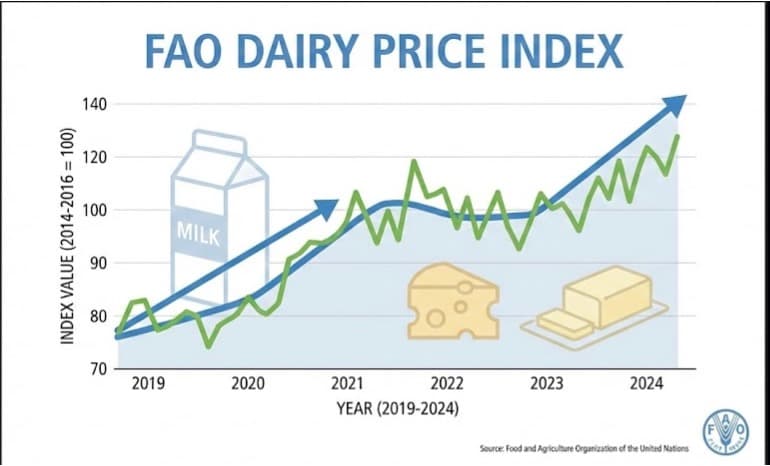
The FAO Dairy Price Index averaged 137.5 points in November, down 4.4 points (3.1 percent) from October and 2.4 points (1.7 percent) from its value a year ago. International dairy prices fell for the...Read More

Dairy News 7x7

Your trusted source for all the latest dairy industry news, market insights, and trending topics.

FOLLOW US
CATEGORIES
  • Global News
  • Indian News
  • Blogs
  • Publications
  • Podcasts
SUBSCRIBE TO OUR NEWSLETTER

Stay informed with the latest updates and trending news in the dairy industry.

No spam, unsubscribe at any time

GET IN TOUCH
C-49, C Block, Sector 65,
Noida, UP 201307
+91 7827405029dairynews7x7@gmail.com

© 2025 Dairy News 7x7. All Rights Reserved.

Terms of ServicePrivacy Policy

Dairy excluded in India-UAE FTA to protect the domestic industry

By DairyNews7x7•Published on February 21, 2022

The trade deal between India and the United Arab Emirates (UAE) has mandated stringent rules of origin conditions, with 40 per cent value addition required on exporting items to avoid routing of products manufactured in third countries to India via UAE.

In any Free Trade Agreement (FTA), the rules of origin determine the criteria for which goods are eligible for free imports.

Under this trade deal, there will be a need for substantial processing of up to 40 per cent value addition and a certificate of origin issued by the Ministry of Economy, UAE, said government officials.

Generally, in trade deals, the value addition is to the tune of 30-35 per cent. In the case of India-UAE Comprehensive Economic Partnership Agreement (CEPA), some high-valued items are excluded from such stringent value-addition requirements.

Moreover, a permanent bilateral safeguard mechanism has been agreed upon to deal with any sudden surge in imports of any product. Such a clause has been included to protect the domestic industry.

According to government officials, previous FTAs did not have enough safeguards to protect the domestic industry in case of surge in imports. This, according to them, led to a trade deficit with the Association of Southeast Asian Nations after signing the FTA.

This is the first time India is entering into a contract enforcing the country of origin, which will disable the circumventing of products from other countries through the FTA  route.

India has kept items such as dairy, fruit, cereals, vegetables, tea, coffee, tobacco, dyes, soaps, footwear, petroleum, tyres, toys, aluminium scrap, copper, processed marble, among others, out of the trade pact with the UAE.  here is also a separate exclusion list for some products, including dairy, tea, coffee, spices, sugar, and tobacco, to protect the domestic industry.

Areas where manufacturing has been robust and sectors wherein the government has rolled out production-linked incentive schemes have been put on the negative list, Commerce Secretary B V R Subrahmanyam had told reporters on Saturday.
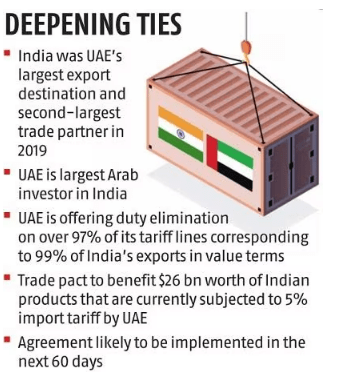
India and the UAE on Friday signed a CEPA that is set to benefit nearly 90 per cent of India’s exports, in terms of value. The pact is expected to kick in over the next 60 days, after the UAE completes its constitutional and legal processes.

The UAE is offering overall duty elimination on over 97 per cent of its tariff lines, corresponding to 99 per cent of India’s exports, in terms of value. Indian exporters will get immediate zero-duty market access in labour-intensive sectors, such as leather, footwear, gems and jewellery, furniture, among others.

The trade pact is likely to benefit around $26 billion worth of Indian products that are subject to 5 per cent import duty by the UAE.

This is the first time the pact has included chapters on intellectual property rights, government procurement, and digital trade. “These (chapters) may be very small, but they will set the tone and convey India’s desire to be a large global player,” Subrahmanyam had said.

While digital trade will cover areas including paperless trading, personal data protection, and cross-border flow of information, the dispute settlement provisions will not apply to this.

The Federation of Indian Export Organisations President A Sakthivel said the trade deal will result in exponential growth in India’s exports to the UAE and will open the market to other Gulf Cooperation Council (GCC) countries.

“GCC countries also follow the same technical standards as applicable to the UAE, paving the way for greater market access to Indian goods in the GCC market. This may be used as a template for similar agreements with GCC countries,” said Sakthivel.

Swipe to continue reading

Previous Article

Next Article