

Chhattisgarh’s Godhan Nyay Yojana gets lukewarm response on ground
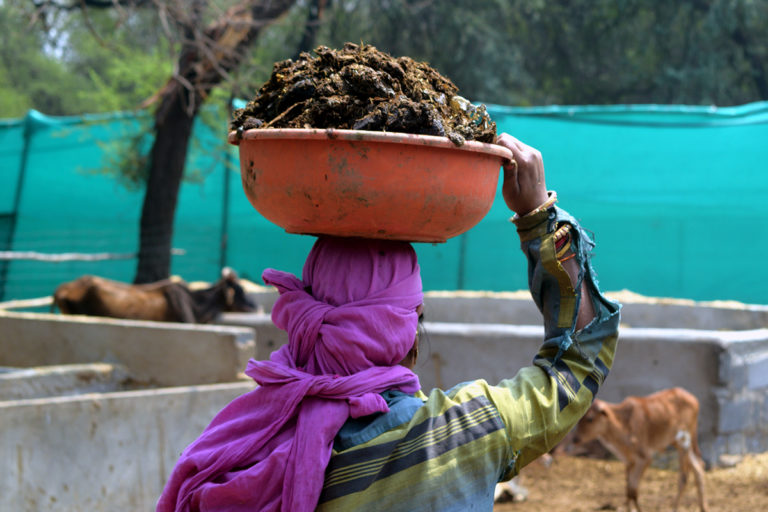
- A recent parliament committee report praised Chhattisgarh’s Godhan Nyay Yojna under which the state government purchases cattle-dung from farmers, converts it into vermicompost and sells it to farmers with the aim of promoting organic farming in the state.
- Despite the state government’s claims and appreciation from the centre’s standing committee, the on ground data shows that there is a lukewarm response to purchasing vermicompost and using it as fertiliser.
- Chhattisgarh government’s officials emphasise the need for marketing vermicompost but experts say that using vermicompost at the existing price is what deters most farmers.
Also read : 5 member ministerial committee to decide cow dung rates in Chhattisgarh
“It has come to the notice that government of Chhattisgarh is procuring cow dung under Godhan Nyay Yojna since 2020 at Rs. two per kilogram from farmers for vermicomposting …procuring of cattle dung directly from the farmers will not only augment their income and provide employment opportunities but also address the problem of stray cattle and promote organic farming in the country as the country has a vast cattle population,” noted the committee in its report.
Chhattisgarh’s Chief Minister Bhupesh Baghel has similar views. On July 20, 2020, in his address at the launch of the scheme, he said “(The) GNY scheme is multipurpose and beneficial for everyone. Cow dung procurement will encourage conservation and nourishment of livestock. The scheme would promote vermi-compost production and use, improving fertility of soil. This will also end the practice of open grazing and encourage use of organic manure instead of chemical fertilisers, and thereby reducing the input cost of farming.”
However, the BJP opposition in the state claims that the purchase of cow dung in Chhattisgarh has opened new doors for corruption. Former chief minister and BJP leader Raman Singh has alleged that the state government is claiming success using fake purchase figures.
What exactly is the Godhan Nyay Yojana?
Even before the Congress-led government came to power in Chhattisgarh in December 2018, the party had given a slogan indicating its aim to strengthen the rural economy – Chhattisgarh Ke Chaar Chinhari, Narwa, Garua, Ghurwa, Baadi, Ela Bachana He Sangwari. Loosely translated, it says that the perennial streams of villages, livestock, organic waste coming out of the houses and cow dung manure along with fruits and vegetables in the backyard, are the identity of Chhattisgarh and must be protected. Soon after coming to power, it launched several schemes based on the commitment made in this slogan.According to the GNY plan launched in July 2020, self-help groups (SHGs) were to be roped in to prepare vermicompost and other products from the cow dung purchased under the scheme. It was claimed that procurement of dung and converting it into vermicompost will boost organic farming in the state and the cattle rearers will get its benefit.
Initially, the cost of vermicompost per kg was fixed at Rs 8 per kg but it was later increased to Rs. 10 and then Rs. 12 per kg, confirmed a senior official of the Chhattisgarh government.
Till February 15, 2021, a total of 40.359 lakh (4.03 million) quintal dung was procured across the state under the scheme. For this, the state government paid Rs. 7,752.13 lakh (Rs. 775.2 million) to farmers who sold cow dung, according to data by the Chhattisgarh government’s agriculture department, that Mongabay-India has reviewed. The data varies in every district of the state. For instance, the Raipur district witnessed maximum procurement of cow dung with a purchase of 541,225.19 quintal dung for which it paid Rs. 1033.59 lakh (Rs. 103.3 million) in return. While another district, Narayanpur, was lowest in terms of cow dung purchased, with the government buying 6,546.16 thousand quintals of cow dung for Rs. 11.74 lakh (Rs.1.17 million).
Contrary to the expectation, out of 40.359 lakh quintal dung purchased across the state, only a small amount of dung was used for vermicomposting. Had the whole dung been used, around 20 lakh quintal vermicompost would have been prepared across the state, but according to the state’s Agriculture Minister Ravindra Choubey, only 95,680 quintal vermicompost has been prepared across the state so far. Out of the total vermicompost prepared, less than half (44,368 quintal) was sold to farmers.
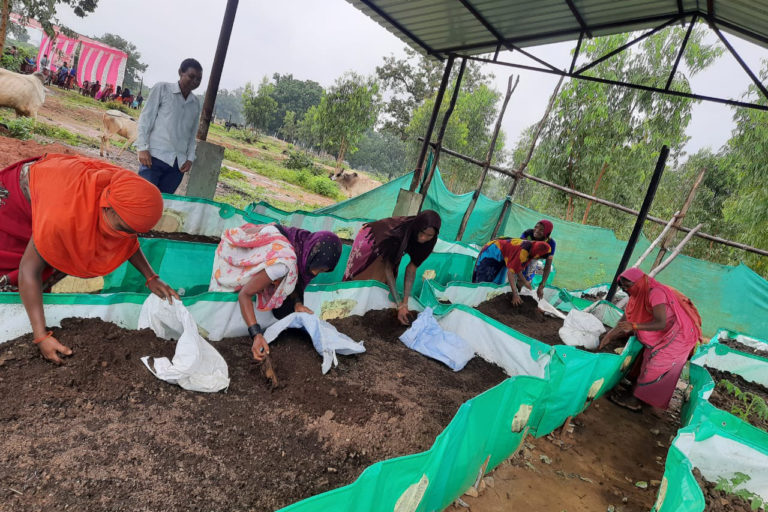
In addition to organic manure, 29,236 litres of pesticides and 45,265 litres of biogas were produced in Bemetara, Surajpur and Surguja districts by February 2020. Few other items like dung-cake, idols, toys etc. are being prepared as well but the income from these is not comparable to the expenditure on the purchase of cow dung.
There are reports highlighting that a lot of cow dung is getting swept away in unseasonal rains. However, in many areas of the state, the dung purchase has been stopped for the last few months citing reasons like increased quantity of cow dung and more. Villagers have also organised protests at many places, against the stopping of the purchase.
While examining the claims, Mongabay-India was informed by the people impacted, that several purchasing centres have been closed. For instance, 12 centres of cow dung purchasing were opened in Rajnandgaon but of them eight centres are now closed. Similar is the story in many other districts in the state.
Jayalal Ka, a resident of Asra in Dongargaon (Rajnandgaon), said, “The government promised to buy cow dung but stopped doing the same within a few months. If this was their plan, they should not have initiated at all.”
What happened to the idea of promoting organic farming?
The state government’s claim of making vermicompost from the purchased cow dung and taking the state towards organic farming with the help of it also seems to be losing ground. Despite all the publicity, the farmers are not very enthusiastic about using vermicompost in their field.Statistics from the Department of Agriculture in the state show that six out of the 28 districts where 26,992 people sold dung worth Rs. 913.15 lakh (Rs. 91.3 million), did not get a single farmer to sell vermicompost to. These districts include Gariyaband, Koriya, Bastar, Sukma, Bijapur and Narayanpur. In these six districts, even those farmers, who had sold cow dung to the state government, didn’t show interest in buying vermicompost.
Similarly, in 11 districts including Baloda Bazar, Balod, Gaurella-Pendra-Marwahi, Mungeli, Korba, Sarguja, Surajpur, Balrampur, Jashpur, Kondagaon and Kanker, a total of 57,351 farmers sold dung worth Rs. 1867.13 lakh (Rs. 186.7 million). But by combining all these 11 districts, the farmers bought just 577.88 quintals of vermicompost. It translates into just about 0.01 quintal or one kilogram of vermicompost to each farmer.
Former state agriculture minister and BJP’s legislator Brijmohan Agrawal has doubts about the entire scheme. He alleged that farmers in the state did not show much interest in the scheme and cited low numbers of farmers selling cow dung under the GNY-only 167,450.
The state’s agriculture minister said that nearly 100,000 women from the self-help groups have joined Gothan (cow shelters) and Chhattisgarh is moving towards organic farming. Today, 12 lakh (1.2 million) quintal of vermicompost is ready and the government is working on its marketing plan.
Pradip Sharma, the agricultural advisor to the chief minister of Chhattisgarh who played a significant role in conceptualising these projects, said that people have been using chemical fertilisers for the past several decades, forgetting the old tradition. In such a situation, it is not easy to turn them towards vermicompost.
Sharma, who holds the rank of cabinet minister, told Mongabay-India that the GNY is a brilliant scheme launched by the Chhattisgarh government. Under it, the usage of organic manure, which was in practice earlier but disappeared gradually, is being promoted. Now, farmers are getting good price of cattle-dung in their village and also getting vermicompost there itself. There is an increase in awareness regarding vermicompost which will only increase further. It will definitely improve the quality of soil and crop as well, he said.
Agricultural scientist Sanket Thakur disagrees with it. He said that the farmers of Chhattisgarh basically cultivate paddy and they use chemical fertilisers which cost them Rs 4,000 per acre. He said: “For the kind of nutrition that paddy needs, about 3,000 kg of vermicompost will be required for one acre of land. It will cost Rs 36,000 to farmers. So, using vermicompost makes farming quite expensive for an ordinary farmer.”
Thakur told Mongabay-India that a large number of people who sell cow dung are those who run the dairy industry. Small farmers are not interested in selling cow dung. Similarly, the government departments are buying the vermicompost. In addition, few amateur people engaged in farming are also investing in vermicompost.
He said, “If the farmers make vermicompost by themselves or the price is kept Rs 4-5 per kg, it might motivate farmers to use vermicompost in their field.”