



Logo
IndianGlobalBlogsPublicationsPodcastsMarketAboutContact
Logo
IndianGlobalBlogsPublicationsPodcasts
7News
TN Minister Urges Farmers to Adopt Tech for Value Addition in DairyListen to the Farm, Not the Farmer—The New Productivity LensWhat’s Driving Change In Beverages, FMCG And Dairy in 2025ED begins money laundering probe in dairy investment fraud caseIndo-Brazil pact aims to boost cattle genetics and dairy yield

Indian Dairy News

TN Minister Urges Farmers to Adopt Tech for Value Addition in Dairy
Dec 12, 2025

TN Minister Urges Farmers to Adopt Tech for Value Addition in Dairy

In Coimbatore this week, Tamil Nadu’s Minister for Milk and Dairy Development, Mano Thangaraj, called on dairy farmers to embrace modern technologies to boost productivity and value addition across th...Read More

Listen to the Farm, Not the Farmer—The New Productivity Lens
Dec 12, 2025

Listen to the Farm, Not the Farmer—The New Productivity Lens

India’s dairy sector, valued at nearly $30 billion, has reached a point where incremental changes will not deliver the next breakthrough. For decades, improvement programs have focused on what farmers...Read More

What’s Driving Change In Beverages, FMCG And Dairy in 2025
Dec 12, 2025

What’s Driving Change In Beverages, FMCG And Dairy in 2025

India’s retail landscape in 2025 was marked by a decisive shift in how consumers choose, consume and connect with brands. From beverages to daily nutrition and even the most essential dairy products,...Read More

Latest Blogs

See More
More Milk, Less Money: India’s Dairy Crisis
Dec 01, 2025

More Milk, Less Money: India’s Dairy Crisis

With the release of the BAHS 2025 summary report, I felt compelled to deep dive into its findings and reflect on the real progress and challenges facing India’s dairy sector. Over the last six years,...Read More

India Milk Prices: Cost Shock and Procurement Pressure
Nov 28, 2025

India Milk Prices: Cost Shock and Procurement Pressure

Milk prices in India face upward pressure as rising feed costs and procurement hikes reshape farm economics. Insight on dairy procurement, feed costs, and market outlook. Official government and coope...Read More

Stop Blaming, Start Claiming: Livestock’s Carbon Credit Future
Nov 16, 2025

Stop Blaming, Start Claiming: Livestock’s Carbon Credit Future

This week, I had the opportunity to attend an Agri Carbon Masterclass conducted by CII FACE. The deliberations, case studies, and discussions presented during the session were both insightful and thou...Read More

India Powers the Gulf’s Dairy Revolution -Gulf Food 2025
Oct 31, 2025

India Powers the Gulf’s Dairy Revolution -Gulf Food 2025

As Gulf Food Manufacturing prepares to open its doors from November 4–6 in Dubai, Indian dairy product and equipment manufacturers have a unique opportunity to explore one of the most promising region...Read More

Global Dairy News

Why the global milk business needs a structural shake-up
Dec 08, 2025

Why the global milk business needs a structural shake-up

The New Zealand dairy stalwart Fonterra has sold its consumer dairy-brands (milk, butter, cheese) — including “Anchor” and “Mainland Cheese” — to French agribusiness giant Lactalis in late October 202...Read More

Raw-milk prices in Europe hit 5-yr low; ripple effect looms
Dec 07, 2025

Raw-milk prices in Europe hit 5-yr low; ripple effect looms

European raw-milk prices have plunged to their lowest in five years, as oversupply and weak demand weigh on dairy markets across the region. According to recent data from DCA Market Intelligence B.V.,...Read More

Global food prices ease; FAO dairy index slips — impact looms
Dec 06, 2025

Global food prices ease; FAO dairy index slips — impact looms

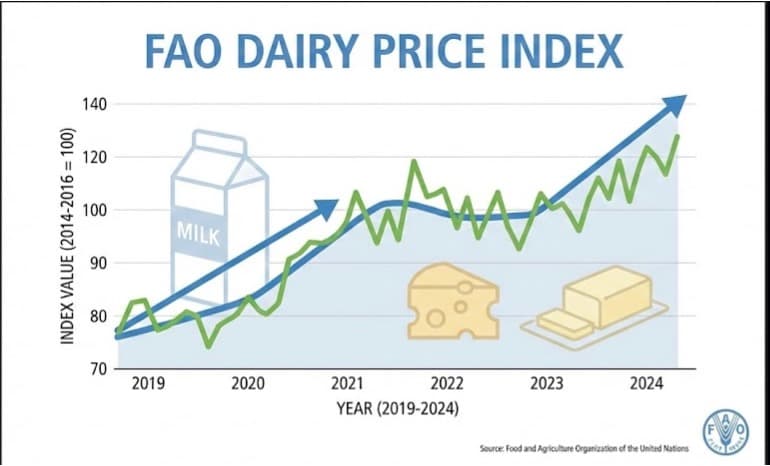
The FAO Dairy Price Index averaged 137.5 points in November, down 4.4 points (3.1 percent) from October and 2.4 points (1.7 percent) from its value a year ago. International dairy prices fell for the...Read More

Dairy News 7x7

Your trusted source for all the latest dairy industry news, market insights, and trending topics.

FOLLOW US
CATEGORIES
  • Global News
  • Indian News
  • Blogs
  • Publications
  • Podcasts
SUBSCRIBE TO OUR NEWSLETTER

Stay informed with the latest updates and trending news in the dairy industry.

No spam, unsubscribe at any time

GET IN TOUCH
C-49, C Block, Sector 65,
Noida, UP 201307
+91 7827405029dairynews7x7@gmail.com

© 2025 Dairy News 7x7. All Rights Reserved.

Terms of ServicePrivacy Policy

Ancient Europeans were lactose intolerant. They drank milk anyway.

By DairyNews7x7•Published on August 06, 2022

A group of scientists has concluded that ancient Europeans drank milk for millennia despite the digestive problems it may have caused, casting doubt on theories on how humans evolved to tolerate it.

Scientists have long speculated that an enzyme needed to avoid any gastrointestinal discomfort developed rapidly in populations where domesticating dairy animals was prevalent.

People who could tolerate milk, that theory goes, gained a new source of calories and protein and passed on their genes to more healthy offspring than those without the genetic trait — known as lactase persistence — that allows themto digest the sugar in milk into adulthood.

But a new study has offered a radically different theory, arguing that side effects such as gas, bloating and intestinal cramps weren’t enough on their own to move the evolutionary needle on the genetic mutation.

“Prehistoric people in Europe may have started consuming milk from domesticated animals thousands of years before they evolved the gene to digest it,” the study’s authors said.

The study, published in the journal Nature, was produced in collaboration with more than 100 scientists across a range of fields including genetics, archaeology and epidemiology. The scientists mapped out estimated milk consumption in Europe from approximately 9,000 years ago to 500 years ago.

By analyzing animal fat residues in pottery from hundreds of archaeological sites, alongside DNA samples harvested from ancient skeletons, the researchers concluded that lactase persistence was not common until around 1,000 B.C., nearly 4,000 years after it was first detected.

And, rather than in times of abundance, they argue that it was during famine and epidemics that having the mutation became critical to survival: when undigested lactose could lead to serious intestinal illnesses and death.

Using archaeological records to identify periods where populations shrank, they concluded that people were more likely to drink milk when all other food sources had been exhausted, and that during those periods, diarrhea was more likely to escalate from a mild to a deadly condition.

George Davey Smith, an epidemiologist at the University of Bristol, who teamed up with the researchers on an analysis of contemporary data on milk and lactase persistence in current populations, said the study raises “fascinating questions” about whether some people who believe they are lactose intolerant “might actually be fine if they drank milk.”

About a quarter of Americans are lactose intolerant. In a lawsuit filed last year, a group of American doctors asked why the U.S. Department of Agriculture’s dietary guidelines recommend so much dairy — suggesting that the federal agency is looking out for the interests of the meat and dairy industries rather than the health of Americans.

USDA dietary guidelines are driven by milk marketing concerns — not nutrition — lawsuit alleges

Previous studies have suggested that populations had to rely heavily on dairy before individuals adapted to tolerate it in abundance. A smaller study in 2014 found the variation that allows humans to digest lactose didn’t appear in Hungarian DNA samples until 3,000 years ago, whereas it may have cropped up as far back as 7,000 years in places such as Ireland where cheesemaking became abundant.

Amber Milan, an expert in dairy intolerance at the University of Auckland, said the idea that the lactase mutation became important to survival only when Europeans began enduring epidemics and famines is a “sound theory” and “supported by previous research of drivers of genetic selection.”

She added, however, that she is not sure the new study “entirely rules out that widespread milk consumption was the evolutionary force behind lactose tolerance” — partly because the genetic data was collected from Biobank, a British biomedical database of genetic and health information from some 500,000 people.

The authors have also focused on the major European genetic variant for lactase persistence — which, while appropriate for this study, “does potentially miss other genetic variants that result in lactase persistence,” Milan said.

Swipe to continue reading

Previous Article

Next Article