


Amul’s Honest ingredients inside campaign for Indian sweets launched
The Indian traditional sweets market is dominated by local halwais .And Amul is investing its milk muscle to get a piece of the ‘Mithai’ business.
Top dairy brand Amul is upping its presence in the mithai (traditional sweets) market in India. Amul’s Mithai portfolio currently has close to 30 products, around eight of which were introduced in the last six months. The portfolio includes items like Khoa, Ras Malai, Gulab Jamun, Kaju Katli, Rosogolla, Peda, etc. The latest additions include products like ‘sugar and lactose-free Peda’, among others.
As per Federation of Sweets and Namkeen Manufacturers , the traditional sweets and namkeen market in India is worth Rs 1lakh crore. It has an year-on-year growth of 15-18 per cent. Around a third of it is snacks and namkeen.
Existing brands makes a killing during diwali
However, the market is largely dominated by local manufacturers, aka, halwais. For years, food brands like Haldiram’s, Balaji, Bikano and Bikaji have been trying to organise the segment, launching products like tinned Gulab Jamun, Soan Papdi, etc. These brands make a killing during festivals, like Diwali, with branded traditional sweets packed as gift boxes.Also read : Amul sets record by launching 1 product every 4th day in last trimester
Most traditional sweets contain milk (as an ingredient), making them highly perishable and unviable for large-scale distribution. The interest of a large player, like Amul, comes as a welcome move for the category. Also, prices of traditional sweets vary from region to region based on various factors like prices of raw materials, labour cost, etc. A branded product carries a more uniform pricing across markets.
Industry experts suggest that the COVID pandemic has spiked consumer interest in packaged products from trusted brands especially in the case of food items.
Jayen Mehta shares consumer insights
Jayen Mehta, senior general manager, planning and marketing, Gujarat Cooperative Milk Marketing Federation or GCMMF (Amul’s owner company), tells afaqs! that that trend applies to traditional sweets too. “Due to the pandemic, we witnessed consumers buying branded products against trusting the neighbourhood halwai. The Mithai portfolio has got a big boost that way.”Backed by Mithai’s tagline ‘Honest Ingredients Inside’, Mehta says that the portfolio has performed well and is growing multifold. “Along with Amul’s assurance of quality, we are offering a great price. This year, during Raksha Bandhan, we had planned to sell 2.5 times of what we sold last year, but everything was sold out a day before Rakhi, even in the middle of the lockdown. Diwali is going to be very big.”
While the demand seems to be growing, Mehta and his teams at GCMMF are busy solving the problem of supply and distribution. While the quality is being celebrated on social media by happy consumers, there are many complaints about availability.
Also Read : Amul steering sweet revolution after white revolution by launching natural honey
Mehta mentions that most of the Mithai products can’t be distributed at a national level because of the short shelf life of 30 days. Only products like Kaju Katli (which has a shelf life of 75 days) reach the farthest from the place of manufacturing.
Distribution is still a challenge for Amul
This limitation in distribution also bars Amul from communicating the portfolio to a national audience. Much of the interest is driven by local advertising backed by positive word-of-mouth and availability.“From that point of view, if we want to advertise a Motichoor Laddoo, we’ll do so in the Anand or Ahmedabad editions, and won’t go for a national print campaign. The brand building won’t be too visible, and there won’t be an ad on national TV. There will be ads for milk and other products.”
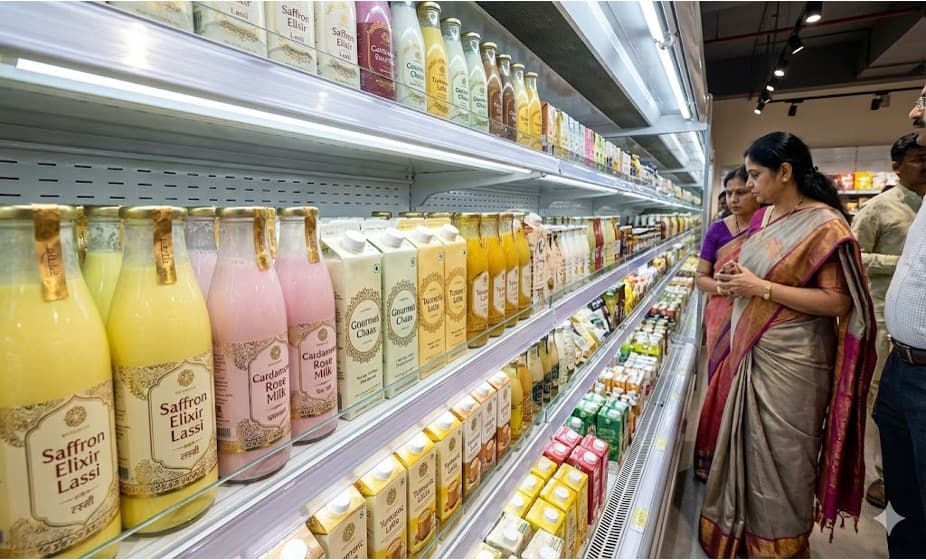
Mehta reveals that the goal is to build a national brand with local manufacturing. Also, Amul does have a strong and fast expanding cold-chain built for its ice-cream business. “In a year or so, we will be a national brand backed by strong local manufacturing. We do see a spike in festive demand in our markets and are able to take care of that. We have around 87 plants dedicated to fresh products, starting with Paneer, Dahi, Chaas, Lassi, while also bolstering the supply of fresh sweets.”
But can Amul eat off the halwai’s plate this Diwali?
As far as Mithai’s uptake during (a post-COVID) Diwali is concerned, Amit Kekre, national strategy head, DDB Mudra Group, feels that the consumers would want to buy their mithai from their regular halwai.Also read : Amul Launches Ginger and Tulsi milk in Corona times
“One would hope that cautiousness about health would send people reeling towards packaged sweets. But if you go by how people have been thronging the street food stalls all over the country, without a bother for the dangers of COVID, I suspect things will be different. I reckon that people are just fed up with too much caution and regulation, and come Diwali, they would give into carefree indulgence. Not wise or rational behaviour, but then, that’s what humans are – they do everything emotionally,” Kekre adds.
Let the admen speak
Veteran adman-turned-consultant Vikas Mehta says that mithai, traditionally, is an offering meant for friends and family,. And is often bought from the halwai one has always gone to.“Markets, especially in the small towns, are dominated by few renowned shops. Another major problem for Amul is the availability. We don’t see many shops packing the whole (Mithai) range. I might have a hard time finding Amul’s Rosogolla. Also, one knows that the shelf life of the sweets at the halwai is pretty low and has to be sold fresh. It’s one of the pros of buying from a halwai.”
“… Distribution is a problem Amul is already suffering from. The range of chocolates also suffers from a similar problem. In terms of a packaged sweets, especially for gifting purposes, they would be fighting (with) a tougher competition, like chocolates, etc. Also, Amul’s promise of ‘Honest Ingredients’ will work for products that have milk as the key ingredient, what about the others?” Mehta signs off.