Latest Blogs
See More
Indian Dairy News


DairyNews7x7
Global Dairy News


DairyNews7x7
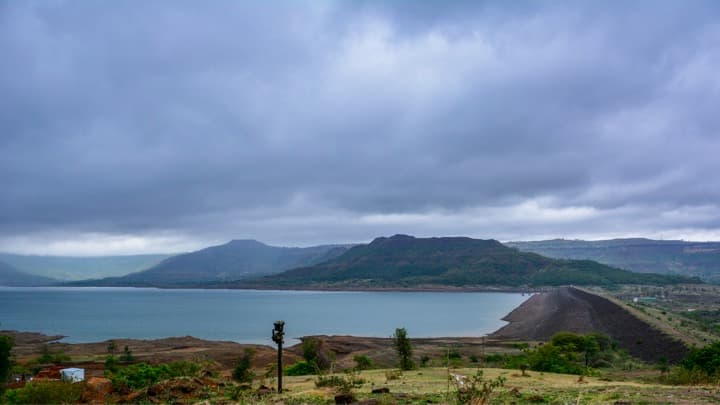
The October 2019 Maharashtra state elections were held under the shadow of a prolonged drought from July 2018 to July 2019.
In the worst-hit Marathwada region and neighbouring Ahmednagar and Solapur districts, government-funded fodder camps sheltering over 11 lakh cattle at their peak were operational till late-September. The animals were even fed whole sugarcane that fetched higher price as fodder than the rates paid by mills.
It wasn’t that different in the April-May 2024 Lok Sabha elections. Maharashtra had a poor southwest (June-September) and also northeast monsoon (October-December) season in 2023, which was followed by deficient winter rains in January-February 2024 and the mercury crossing 40 degrees Celsius as early as March.
The run-up to the Assembly polls scheduled on November 20 has, in contrast, been marked by all the four meteorological subdivisions of the state – Vidarbha, Marathwada, Madhya Maharashtra and Konkan – receiving surplus (above long period average) monsoon rains. These have helped fill up the state’s major reservoirs – such as Jayakwadi, Bhima, Mula and Pench – and recharge groundwater aquifers, holding out hope for the upcoming rabi (winter-spring) crop season as well.
Less distress
Simply put, the 2024 Maharashtra state elections are being fought amid not as much farm distress as was clearly obvious during the previous two polls.
Agriculture had just 11.2% share of Maharashtra’s GDP (at current prices, net of product taxes and subsidies) in 2023-24, below the corresponding all-India average of 17.7%. But it employed 43.2% of the state’s workforce, marginally lower than the national average of 46.1%, as per the official periodic labour force survey for 2023-24.
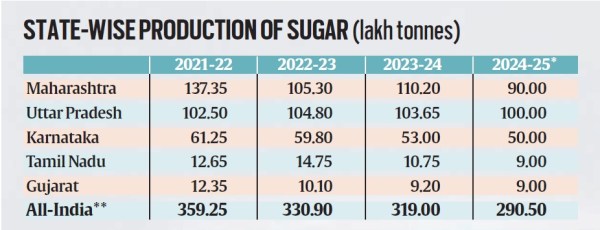 Source: National Federation of Cooperative Sugar Factories.Also, the latest NABARD All India Rural Financial Inclusion Survey report for 2021-22 identified 59% of rural households in Maharashtra as “agricultural”, i.e. deriving a significant share of their income from farm-related activities. Agriculture, hence, matters when it comes to voting in Maharashtra. And whether elections are taking place against the backdrop of drought or relative plenty can influence the political narrative and sentiment.
Sugarcane is a 12-18 months duration crop. The cane that mills will start crushing from next month, till about April, was the dry weather-affected crop planted last year. Maharashtra farmers plant either a 12-month ‘suru’ (in January), a 15-month ‘pre-seasonal’ (July-December) or an 18-month adsali (April-June) cane. The benefits of this time’s good rains would show up only in the cane crushed in the 2025-26 sugar year.
Not sugar alone
Sugarcane is grown largely in western Maharashtra (Ahmednagar, Pune, Satara, Solapur, Sangli and Kolhapur) and the adjoining Marathwada region districts of Osmanabad, Latur and Beed.
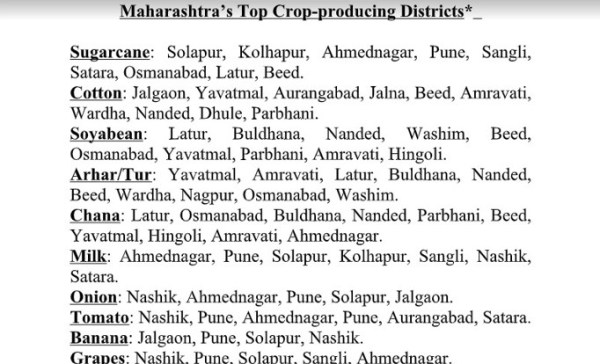
*Ahmednagar, Osmanabad and Aurangabad have been renamed as Ahilyanagar, Dharashiv and Chhatrapati Sambhaji Nagar respectively.But Maharashtra isn’t just a leading sugar producer (along with UP). It also ranks No. 1 in the production of jowar (sorghum), onion, grapes and pomegranate, and No. 2 in cotton (after Gujarat), soyabean (after Madhya Pradesh), chana or chickpea (after MP), arhar/tur or pigeon-pea (after Karnataka) and organised milk procurement (after Gujarat). That makes for a quite diversified cropping profile.
While jowar is cultivated as a staple cereal across Maharashtra – barring the Konkan and Nagpur (eastern Vidarbha) divisions that mostly take rice – the production of other crops is concentrated in particular regions.
The accompanying chart shows that the western Maharashtra sugar belt is also the state’s milk production hub, housing major cooperative (Gokul, Warana and Rajarambapu) as well as private (Sonai, Chitale, Schreiber Dynamix, Parag and Prabhat) sector dairies.
Cotton is primarily grown in Khandesh (Jalgaon-Dhule), Marathwada and western Vidarbha (Amravati division plus Wardha-Nagpur). Marathwada and western Vidarbha are also the main cultivation tracts for soyabean, arhar/tur and chana. Horticultural crops are even more regionally-concentrated: Northern Maharashtra (especially Nashik) for onion, tomato and grapes; Jalgaon for banana; Solapur for pomegranates; and Konkan (Ratnagiri, Sindhudurg and Raigad) for mangoes.
Horticulture farming entails heavy investments, whether in drip irrigation systems, tissue-cultured planting material, specialty water-soluble and liquid fertilisers (as opposed to normal urea or di-ammonium phosphate) or fungicides.
While production cost per acre is only Rs 15,000-20,000 in soyabean, it is Rs 45,000-50,000 for onions, Rs 1-1.25 lakh for grapes and Rs 1.75-2 lakh for pomegranate. But average per-acre yields are lower, at 0.5-0.6 tonnes, for soyabean, compared to 6-7 tonnes in onion and 9-10 tonnes in grapes.The other side of bumper harvests
Farm incomes are a function of not only production, but also prices.
Take soyabean, which is selling at an average of Rs 4,350-4,400 per quintal in the Latur market. That’s below the government’s minimum support price (MSP) of Rs 4,892 and also last year’s market rate of Rs 4,650-4,700/quintal at this time. Kapas (raw un-ginned cotton) is, likewise, fetching Rs 6,500-6,600 per quintal at Yavatmal, as against Rs 6,800-6,900 a year ago and the officially-declared MSP of Rs 7,121.
It isn’t prices alone. Balasaheb Dake, a farmer from Kajla village in Jalna district’s Badnapur tehsil, says that harvesting/picking costs for kapas have increased from Rs 7 to Rs 12 per kg over the last one year. He attributes it to the ruling BJP-Shiv Sena-NCP Mahayuti’s Ladki Bahin Yojana, which provides a cash transfer of Rs 1,500 per month to women from families with an annual income of up to Rs 2.5 lakh. This scheme, Dake claims, has led farm labourers to reduce their days or hours of work. The resultant scarcity has pushed up wages
Maharashtra farmers have sown a record 51.6 lakh hectares (lh) area under soyabean in the current kharif season, even while cutting down cotton acreage to 40.9 lh from last year’s 42.2 lh. The area planted under these crops is much more than the 10.5 lh under sugarcane. Their prices ruling below MSP – and dairies, too, paying only Rs 27-28/litre for cow milk containing 3.5% and 8.5% solids-not-fat (from Rs 37-38 in February-March 2023) – can well be poll issues this time.