Latest Blogs
See More

Indian Dairy News
DairyNews7x7
Global Dairy News
DairyNews7x7
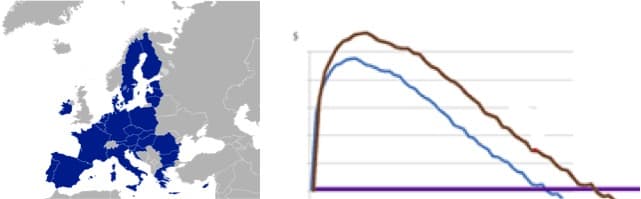
EU milk production peaked in 2020, according to analysis by the US Department of Agriculture.
USDA analysts said milk deliveries from dairy farms declined in 2021, and they predicted it will fall further this year, and in 2023 and later years, when the new Common Agricultural Policy (CAP) and the accompanying Farm to Fork Strategy (F2F) require EU dairy farmers to adjust their production systems.
Significantly higher input costs for feed and fodder production, energy, and labour are also blamed for Europe’s shrinking dairy industry. Brexit and Covid-19 also affected European dairy markets, but their impact is now receding.
In 2020, milk production in the EU increased 1.6%, compared to 2019. But the USDA reckons that was the last hurrah for dairy farms, thanks to supply increases led by Belgium, Ireland, Italy, Poland, and Spain.
But the writing was on the wall for the industry, with the Nitrate Directive dampening further expansion in most of the northern and western EU member states, said USDA experts.
More recently, limits to phosphate emissions increased the pressure on farmers.
And last year, governments in the Netherlands and Belgium introduced legislation to ban nitrogen emission deposits on natural habitats that are part of the EU’s Natura 2000 zones, halting new farm permits.
In October 2020, Wageningen University published a report for FrieslandCampina, on likely policy scenarios for the Netherlands, which suggested a reduction in dairy farms by a third, or even a half, by 2030.
EU-27 dairy cow numbers have stagnated since 2014. Their numbers decreased by more than 1.4 million head since 2016, due to many farmers quitting dairying, as they chose not to make the needed investments to meet new environmental requirements. Cow numbers in the EU-27 fell by 800,000 head since 2019.
Since the peak milk production in 2020, deliveries from dairy farms have decreased, as the least productive farmers and cows left the sector.
This brought increases in milk productivity. However, that was not enough to maintain production levels, and could not offset the impact of higher costs for feed and fodder, energy, and labour, which are limiting further intensification of production.
Smaller farms in the eastern member states, but also in Portugal, have switched to beef cattle, for which there are good live export opportunities, and which require less on-farm investment.
There has also been a trend towards more extensive dairying systems like organic production and hay milk.
In 2021, EU milk production declined by 0.3%, compared to 2020, despite relatively good fodder supplies, and high export demand in the second half of the year.
Farmers were also boosted by significantly increased farm-gate milk prices. But prices reportedly fell short of compensating for increased production costs in several member states. It was in the “North Sea” countries that milk production decreased most in 2021, despite cool and wet weather driving grass growth.
Up to April of this year, EU raw milk deliveries have decreased by 0.6%, compared to the same period last year.
In the year to February 2022, the milk supply increased significantly only in Cyprus (6.4%), Hungary(6.1%), Ireland (5.1%), and Italy (3.2%).
Cow milk production in the EU-27 is forecast at 144.6 million tonnes for 2022, a decrease of 434,000 tonnes compared to 2021, and 836,000 tonnes down from 2020.
According to USDA analysts, “As dairy experts anticipate a new wave of dairy farmers potentially quitting the sector, the major industry players are already adapting their corporate plans and strategies, as they adjust to these new EU policy realities.
“Available milk supplies are redirected towards their most profitable and strategic domestic and export market interests.”
Cheese production is expected to remain the preferred EU-27 processing route, with several new cheese plants built in recent years, mainly to produce mozzarella for the food processing industry.
EU-27 cheese production for 2022 is forecast to increase to 10.6m tonnes, an increase of 50,000 tonnes over 2021, and almost 240,000 tonnes higher than 2020.
Thanks to the EU’s vaccination campaigns keeping Covid-19 infections under control, the pandemic no longer seriously hampers dairy processors.
But environmental restrictions have already brought EU dairying intensification in general to a halt, even before new F2F restrictions kick in with the implementation of the new CAP and F2F initiatives in 2023.
Stronger environmental and climate mitigation policies built into member states’ CAP strategic plans will begin in 2023, intensifying as part of the EU’s Green Deal to reach climate neutrality by 2050.
“This is expected to lead to further consolidation of dairy farms, as small and less efficient farmers may choose not to make the necessary investments to upgrade their barns and production equipment to the new F2F standards,” said USDA experts.
“The remaining dairy farmers can be expected to continue to improve the genetics and feeding techniques of their herds, not only for higher productivity but also lower environmental footprints, especially methane emissions. This may well lead to further geographical concentration of milk production.
“Several member states may face difficulties with a faltering dairy industry that fails to keep up the competition with western European countries.
The Irish dairy industry has signalled its intention to maintain or increase its share of the shrinking EU dairy industry, with a milk price paid to farmers this year which was the third-highest of all member states (up from the sixth highest in 2021).
At €47.50 per 100kg in February, the price paid to Irish farmers was higher only in Malta (€61.90) and Cyprus (€58.40). The February 2022 EU average was €42.60.
At the processing end, increasing cheese production will come at the expense of the production of butter, non-fat dry milk, and whole milk powder. Exports of these commodities will fall, and their price will increase within the EU market.
The USDA says the EU butter market may start to shrink in 2022, as the ageing population is looking for healthier eating patterns. Butter production decreased by 2% in 2021.