Latest Blogs
See More



Indian Dairy News
DairyNews7x7
Global Dairy News



DairyNews7x7
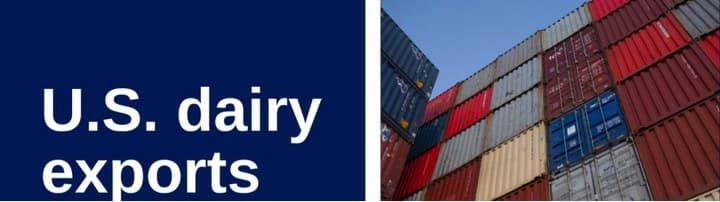
Global economic uncertainty apparently isn’t diminishing foreign demand for U.S. cheese, according to a monthly market update from the U.S. Dairy Export Council (USDEC). Multiple factors, especially adequate cheese supplies at competitive prices, put the U.S. in a position to continue export growth in the near term and increase its presence in the international market.
Based on data summarized in the most recent U.S. Dairy Exporter Blog as follows :
Beyond the major categories, the U.S. expanded its portfolio to include gains in milkfat-heavy products. Butter jumped 63% (+2,272 MT), anhydrous milkfat more than tripled (+225%, +1,695 MT), whole milk powder climbed significantly (+83%, +1,695 MT), and even evaporated/condensed milk saw substantial growth (+77%, +883 MT).
Nonfat dry milk/skim milk powder (NFDM/SMP) was the only major product to see an export decline in June (-14%, -11,288 MT). According to USDEC, the primary obstacle to growing NFDM/SMP exports remains a lack of supply.
First, despite limited milk production growth in the U.S., cheese production has managed to expand.
Second, U.S. cheese has been relatively affordable on the global market, both on a spot basis and in futures markets for the majority of the first half of the year.
Pricing factors have also favored U.S. cheese suppliers in key buying regions like Mexico and Central America, where cheese prices are more competitive with cheaper alternatives using palm oil instead of dairy fats. Demand in Latin America is further aided by a strengthening peso, raising purchasing power for imports while local milk production remains weak.
Finally, the rebound in Chinese pig prices that began in mid-April and peaked in July likely also supported June whey export volume.
After declining for most of the final three-quarters of 2021, the number of loaded outbound 20-foot equivalent shipping units (TEUs) leaving major California ports has been slowly ticking upward this year.
While the West Coast dockworkers contract remains a big shipping unknown, the improvement in container flow bodes well for U.S. dairy export efforts heading into the back half of 2022 – particularly as more attention is paid to correcting additional supply chain choke points.
Economic growth and inflation (from dairy input costs to retail prices) will continue to create export headwinds, but the supply chain arguably is looking up for the first time since before the pandemic, according to USDEC.
Through the first seven months of the year, contracts total 57.2 million pounds of American-type cheese, 459,000 pounds of butter, 28.6 million pounds of whole milk powder and 6.5 million pounds of cream cheese, for a total milk equivalent for the year of 797 million pounds (milkfat basis). CWT estimates are based on contracts for delivery, not completed export volumes.
Here’s a look at other export trends followed by Progressive Dairy:
Tony Clayton, Clayton Agri-Marketing Inc., Jefferson City, Missouri, said foreign interest in U.S. dairy replacement heifers is high, but price and availability remain hurdles. He said the Vietnam-Laos sales reported for June were actually scheduled for January, providing an indication of logistical and supply challenges facing exporters and leading to shipment delays.
With a strong U.S. beef market, Clayton expects the heavy use of beef semen in dairy cattle will continue for a long time, leading to further heifer supply shortages.
Year-to-date exports of dairy replacement heifers total 6,236 head, the lowest for the first six months of any year dating back to 2016, and follows a March-May 2022 total of just 572 head, the lowest three-month total dating back to the first quarter of 2009.
Another issue facing exporters is the near-equal relationship in the value of the euro to the U.S. dollar, making U.S. cattle prices less competitive. Clayton estimates current U.S. quotes for dairy heifer sales to Eqypt, for example, are about $3,500 per head. That compares to a similar quote from Germany at about $2,285 euros. Most buyers will be importing from Germany, France and other countries until heifer inventories in those countries are gone.
“The only opportunity for the U.S. trade will be open heifers until the international marketplace learns they will have to forward contract for pregnant heifers that can be set up several months in advance of the shipment,” said Clayton, who was headed to Vietnam on a sales trip in early August.
Beyond live animals, exports of dairy embryos were also up in June at 1,660, with China (1,000), Japan (230), Brazil (154) and the United Kingdom (142) being the leading markets. For the January-June period, dairy embryo exports total 6,646 head, the highest six-month total to start the year in the past five years.
Beef female replacement exports totaled 943 in June, about half of the May total but still the second-largest monthly total of the year. Canada and Mexico continue to be the leading markets. Year-to-date beef replacement exports are estimated at 5,201. Beef cattle embryo exports were estimated at 298 in June, the second-lowest monthly total of the year.
At 202,700 MT, June alfalfa hay exports were down 40,000 MT from May and the third-lowest monthly total in the past 18 months. Contributing to the falloff was a 16,000 MT decline in sales to China and a 14,000 MT drop in sales to Japan.
China remained the leading market at 104,395 MT, about 52% of the month’s total, but sales there were the smallest since February 2021. Exports to Japan fell to an 11-month low at 38,000 MT, representing 19% of the month’s total.
Alfalfa hay exports were valued at about $390 per ton, up about $3 from May.
Another explanation for the decline in alfalfa hay sales to Japan could be a huge increase in shipments of sun-dried alfalfa meal as a replacement. June sales to Japan were estimated at 9,598 MT. In comparison, monthly exports of sun-dried alfalfa meal averaged just 640 MT during the first five months of the year. Historically, exports of that product totaled 9,110 MT tons in February 2020, but otherwise topped 2,000 MT only nine times in history.
At 95,497 MT, June exports of other hay also fell from May, with sales down to both major markets. Shipments to Japan totaled 57,659 MT, the lowest since August 2021 but still representing about 60% of other hay exports. Sales to South Korea at 23,136 MT were the lowest since January and represented 24% of the month’s total.
Other hay exports were valued at about $391 per MT, down about $8 from May.
The same factors that impacted June exports are likely to affect July sales volumes (to be announced in early September), according to Christy Mastin, sales representative with Eckenberg Farms, Mattawa, Washington. High prices will also play a deterrent.
“Some suppliers have no carryover, and new-crop harvest conditions were terrible,” Mastin said. “We experienced rain every four days or so, which did not allow for making good hay.”
The late start and wetter growing season could impact inventories going forward. Third-cutting alfalfa was underway, but many growers are considering only four cuttings this year. Reduced volumes will keep prices high, and combined with unfavorable currency exchange rates, will prevent potential buyers from completing purchases.
“The hay is priced too high for the possibility to purchase. They hope the exchange rates will decline so the product will cost less or at the very least become more stable,” Mastin said.
Nonetheless, foreign buyers continue to call in search of lower and more stable prices. Some foreign customers have been looking into securing lower grades of hay to match purchase budgets. However, purchasing the lower grade does not seem to be enough of a price decrease, Mastin said.
Source : Progressive Dairy August 8 2022 written by Dave Natzke Editor