Logo
IndianGlobalBlogsPublicationsPodcastsMarketAboutContact
Logo
IndianGlobalBlogsPublicationsPodcasts
7News
Mandatory Daily Record of Production and Raw Material UtilisationHeritage Foods inaugurates new Ice Cream PlantFSSAI makes registration to all milk vendors in IndiaGujarat Ice Cream Makers Face Cone ShortageSummer Heat to Stress India’s Dairy Cold Chain

Indian Dairy News

FSSAI Licences Get Perpetual Validity
Mar 14, 2026

FSSAI Licences Get Perpetual Validity

India’s food regulator, the Food Safety and Standards Authority of India (FSSAI), has announced a major reform granting perpetual validity to food licences and registration certificates, eliminating t...Read More

Dairy Sector a ‘Safety Net’ for Farmers: NABARD
Mar 14, 2026

Dairy Sector a ‘Safety Net’ for Farmers: NABARD

The Chairman of National Bank for Agriculture and Rural Development, Shaji K V, has highlighted the crucial role of India’s dairy industry in protecting rural livelihoods, describing it as a “safety n...Read More

Bihar Dairy Officer Arrested in ₹30,000 Bribery Case
Mar 14, 2026

Bihar Dairy Officer Arrested in ₹30,000 Bribery Case

A field officer of the district dairy development department in Bihar was arrested by the Vigilance Investigation Bureau (VIB) for allegedly accepting a bribe of ₹30,000 in West Champaran district. Th...Read More

DairyNews7x7
Advertisement

Latest Blogs

See More

Mandatory Daily Record of Production and Raw Material Utilisation
Mar 14, 2026

Mandatory Daily Record of Production and Raw Material Utilisation

I recently reviewed the notification issued by the Food Safety and Standards Authority of India in the context of Schedule IV of the Food Safety and Standards (Licensing and Registration of Food Busin...Read More

FSSAI makes registration to all milk vendors in India
Mar 13, 2026

FSSAI makes registration to all milk vendors in India

The recent advisory issued by Food Safety and Standards Authority of India (FSSAI) mandating registration of milk vendors is a timely and progressive step towards strengthening traceability and accou...Read More

Rajahmundry Milk Incident: Accident or Adulteration?
Mar 10, 2026

Rajahmundry Milk Incident: Accident or Adulteration?

The recent editorial “Bitter Milk” published by The Hindu raises important concerns about food safety in India. The editorial deserves appreciation for attempting to broaden the conversation and under...Read More

Milk Prices Rise in South & West: Is North Next?
Mar 05, 2026

Milk Prices Rise in South & West: Is North Next?

The recent round of retail milk price increases across South India and Maharashtra is no longer an episodic adjustment but a clear signal of structural stress building up in India’s milk economy. Over...Read More

Global Dairy News

Global Dairy Commodity Prices Show Signs of Rally
Mar 14, 2026

Global Dairy Commodity Prices Show Signs of Rally

Global dairy commodity prices have shown a rally in the first quarter of 2026, particularly for products originating from Australia and New Zealand, according to a new Q1 Global Dairy Quarterly report...Read More

How Walmart Keeps Great Value Milk So Affordable
Mar 14, 2026

How Walmart Keeps Great Value Milk So Affordable

Retail giant Walmart has managed to keep the price of its private-label Great Value milk significantly lower than many competing brands through a vertically integrated dairy supply chain and direct co...Read More

Lactose-Free Milk Seen as Growth Driver in Coffee
Mar 13, 2026

Lactose-Free Milk Seen as Growth Driver in Coffee

Lactose-free milk is emerging as a major growth opportunity for the dairy industry, particularly in the rapidly expanding coffee and café segment. A recent US-based study highlighted that lactose-free...Read More

DairyNews7x7
Advertisement
Dairy News 7x7

Your trusted source for all the latest dairy industry news, market insights, and trending topics.

FOLLOW US
CATEGORIES
  • Global News
  • Indian News
  • Blogs
  • Publications
  • Podcasts
SUBSCRIBE TO OUR NEWSLETTER

Stay informed with the latest updates and trending news in the dairy industry.

No spam, unsubscribe at any time

GET IN TOUCH
C-49, C Block, Sector 65,
Noida, UP 201307
+91 7827405029dairynews7x7@gmail.com

© 2026 Dairy News 7x7. All Rights Reserved.

Terms of ServicePrivacy Policy
Prefer Us
Prefer Us

Pasteurization reduces H5N1 in milk, verification needed.

By DairyNews7x7•Published on October 08, 2024

Pasteurization reduces H5N1 in milk, verification needed.
Prefer on

In a recent study published in the journal Emerging Infectious Diseases, researchers evaluated the resilience of the highly pathogenic avian influenza A (H5N1) virus in milk under pasteurization-like temperatures and assessed the effectiveness of thermal inactivation.

Background 

H5N1 influenza is enzootic in many bird populations and can infect mammals, including humans, leading to severe or fatal outcomes in some cases.

The detection of H5N1 virus in United States (U.S.) dairy cows has raised significant public health concerns. Pasteurization, a widely used method to ensure milk safety, involves heating milk to eliminate harmful bacteria. In the U.S., low-temperature long-time (LTLT) and high-temperature short-time (HTST) pasteurization are common processes. However, recent studies have shown conflicting results regarding the efficacy of pasteurization-like conditions, indicating that unpasteurized milk from H5N1-infected cows may contain sufficient virus to infect susceptible animals. These findings highlight the potential risk to human health, and further research is needed to fully understand the virus's resilience and improve safety measures.

About the study

Researchers evaluated the effects of different temperatures on influenza virus viability in milk. It is important to note that the test tube conditions used in the experiment do not precisely replicate actual pasteurization processes in the dairy industry, and this presents a key limitation of the study. Four influenza virus strains were used in the study: one laboratory-adapted strain (PR8) and three H5N1 strains. Commercially available pasteurized whole milk (3.25% fat) was spiked with virus strains at a concentration of 108 50% tissue culture infectious dose/mL of milk or Optimized Minimum Essential Medium (Opti-MEM) control media. The samples were subjected to three distinct heat treatments: 63°C for 30 minutes, 72°C for 20 seconds, and 91°C for 20 seconds.

Different volumes of the spiked samples (200 μL, 20 μL, and 2 μL) were used to assess how volume might influence the effectiveness of heat treatments. Additionally, the PR8 strain was tested in both pasteurized and unpasteurized milk to examine the impact of preheating milk at 37°C for 1 minute before exposure to HTST conditions. After the heat treatments, the samples were adjusted to a final volume of 200 μL and titrated to determine viral viability.

Study results

Human-to-human transmission of H5N1 remains rare, but the virus is regarded as a significant pandemic threat.

The researchers found no significant difference in viral titers between influenza viruses diluted in control media and those diluted in milk. All three viruses tested- PR8, VN/04 ΔH5N1, and ty/IN/22- behaved similarly. However, it is essential to emphasize that these findings are based on controlled laboratory settings, which may not fully capture the complexities of real-world dairy processing. Heat treatment at 63°C for 30 minutes effectively decreased viral viability below the limit of detection. At 72°C for 20 seconds, titer reduction was inversely proportional to the sample volume, with a non-significant decrease in 200 μL samples, but significant reduction in 20 μL and 2 μL samples. A similar trend was observed with treatment at 91°C for 20 seconds, where smaller sample volumes showed greater viral inactivation. Preheating the samples to 37°C for 1 minute before applying HTST conditions accelerated viral inactivation, particularly in smaller volumes.

The study further explored the impact of different types of milk and storage temperatures on virus stability. Pasteurized, unpasteurized colostrum and mature milk were spiked with viruses and stored at different temperatures for up to four days. The viruses remained infectious for more than four days in unpasteurized milk at temperatures below 63°C, where viral inactivation occurred within 24 hours. Unpasteurized colostrum milk showed enhanced viral inactivation, possibly due to the presence of immunoglobulins, which provide a natural defense.
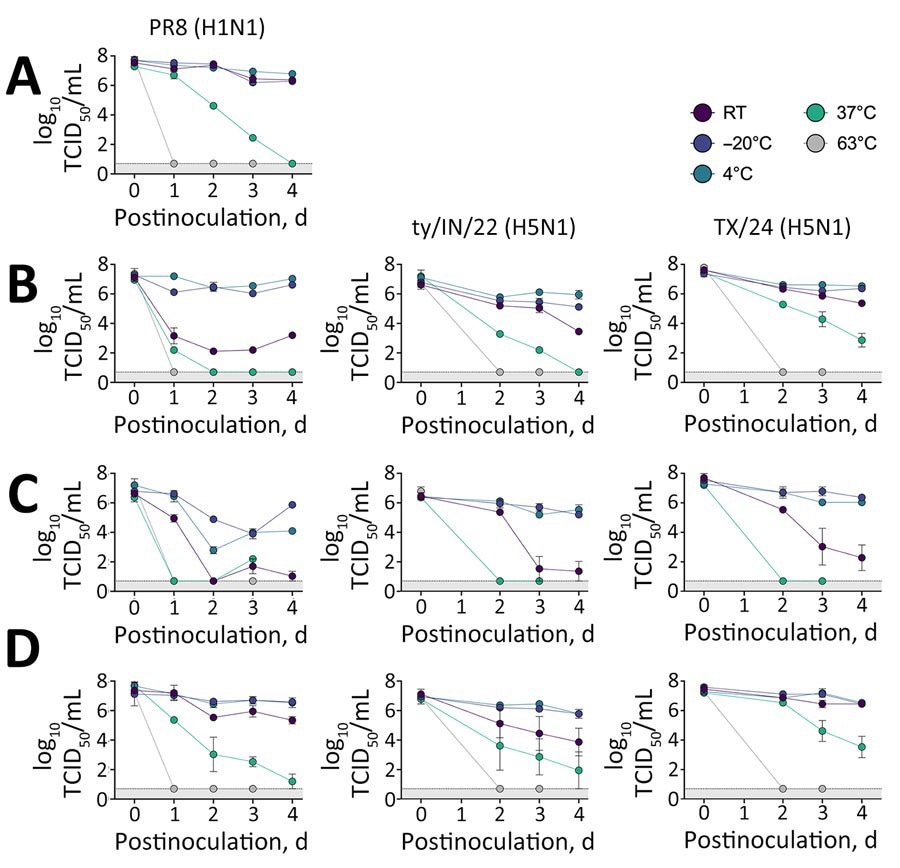
Stability of influenza A in retail and unpasteurized milk. We diluted influenza A viruses in either Opti-Mem control media (Fisher Scientific, https://www.fishersci.com) (A), retail off-the-shelf pasteurized whole milk (B), or 2 different sources of unpasteurized milk: colostrum milk (C) or mature milk (D). We then incubated 200-μL samples for several days at various temperatures, as shown. We subsequently titrated samples by TCID50 in MDCK cells. We tested 3 strains: PR8 (H1N1), ty/IN/22 (H5N1), and the reverse genetics version of TX/24 (H5N1). Unpasteurized colostrum milk produced during the first few days after birth contains high levels of immunoglobulins and antimicrobial peptides that might have had an effect in decreasing virus survival. PR8 (H1N1), wild-type strain A/Puerto Rico/8/1934 (H1N1); RT, room temperature; TCID50, 50% tissue culture infectious dose; TX/24, wild-type strain A/Texas/37/2024 (H5N1); ty/IN/22, wild-type highly pathogenic strain A/turkey/Indiana/3707-003/2022 (H5N1).Stability of influenza A in retail and unpasteurized milk. We diluted influenza A viruses in either Opti-Mem control media (Fisher Scientific, https://www.fishersci.com) (A), retail off-the-shelf pasteurized whole milk (B), or 2 different sources of unpasteurized milk: colostrum milk (C) or mature milk (D). We then incubated 200-μL samples for several days at various temperatures, as shown. We subsequently titrated samples by TCID50 in MDCK cells. We tested 3 strains: PR8 (H1N1), ty/IN/22 (H5N1), and the reverse genetics version of TX/24 (H5N1). Unpasteurized colostrum milk produced during the first few days after birth contains high levels of immunoglobulins and antimicrobial peptides that might have had an effect in decreasing virus survival. PR8 (H1N1), wild-type strain A/Puerto Rico/8/1934 (H1N1); RT, room temperature; TCID50, 50% tissue culture infectious dose; TX/24, wild-type strain A/Texas/37/2024 (H5N1); ty/IN/22, wild-type highly pathogenic strain A/turkey/Indiana/3707-003/2022 (H5N1).

Nevertheless, a critical limitation is that spiking viruses into milk does not fully replicate the dynamics of a natural infection scenario. Enveloped viruses, such as influenza, are generally less stable than non-enveloped viruses, which have been more thoroughly studied in similar settings. This limitation underscores the need for further investigation into how viral inactivation in milk behaves under real-world conditions.

Despite these findings, it is important to recognize that the presence of viral Ribonucleic Acid (RNA) in milk samples without viable viruses may be due to the sensitivity of modern detection methods rather than actual risk. Previous studies investigating HTST-like temperature conditions have produced mixed results. For instance, one study found that complete viral inactivation occurred only at 105°C, whereas another study demonstrated total inactivation using HTST conditions. These conflicting results highlight the complexity of viral resilience under varying thermal conditions. The current study adds valuable insight but must be interpreted in the context of these prior findings, emphasizing the importance of further research in this area.

The evidence indicates that HTST pasteurization can effectively inactivate the influenza virus, reducing the risk in milk supplies. However, due to the experimental limitations discussed earlier, caution is still warranted, and definitively ruling out the presence of live virus may require multiple blind passages in eggs, as is standard in surveillance studies. The study’s findings, particularly with the PR8 strain, could serve as a valuable reference for evaluating commercial pasteurization processes. Nonetheless, the study highlights that further real-world testing is essential to ensure the robustness of these processes under industry conditions. Understanding the factors influencing virus survival in milk will help guide interventions to improve milk safety and address concerns about emerging viral threats.

Conclusions

To summarize, the study demonstrates that pasteurization at standard temperatures, such as 63°C for 30 minutes and 72°C for 20 seconds, can reduce the viability of H5N1 in milk, particularly in smaller volumes. However, the study’s limitations regarding experimental conditions and previous conflicting data must be considered. Viral inactivation was more pronounced in smaller sample volumes and enhanced by preheating. Additionally, the resilience of the virus in unpasteurized milk underscores the importance of vigilant heat treatment processes in commercial dairy practices.
Journal reference:
  • Caceres CJ, Gay LC, Cargnin Faccin F, et al. Influenza A(H5N1) virus resilience in milk after thermal inactivation. Emerg Infect Dis. (2024), DOI- 10.3201/eid3011.24.0772, https://wwwnc.cdc.gov/eid/article/30/11/24-0772_article

Stay Updated

Get the latest dairy industry news directly in your feed.

Prefer Us on Google Search

Swipe to continue reading

Previous Article

Next Article